
The internet is rapidly filling with AI-generated content, new study claims
A new study by the Pew Research Center reveals that more than a third of websites published since the arrival of ChatGPT bear traces of artificial intelligence. Find out how AI is transforming digital content and why machines are beginning to dominate humans on the internet.
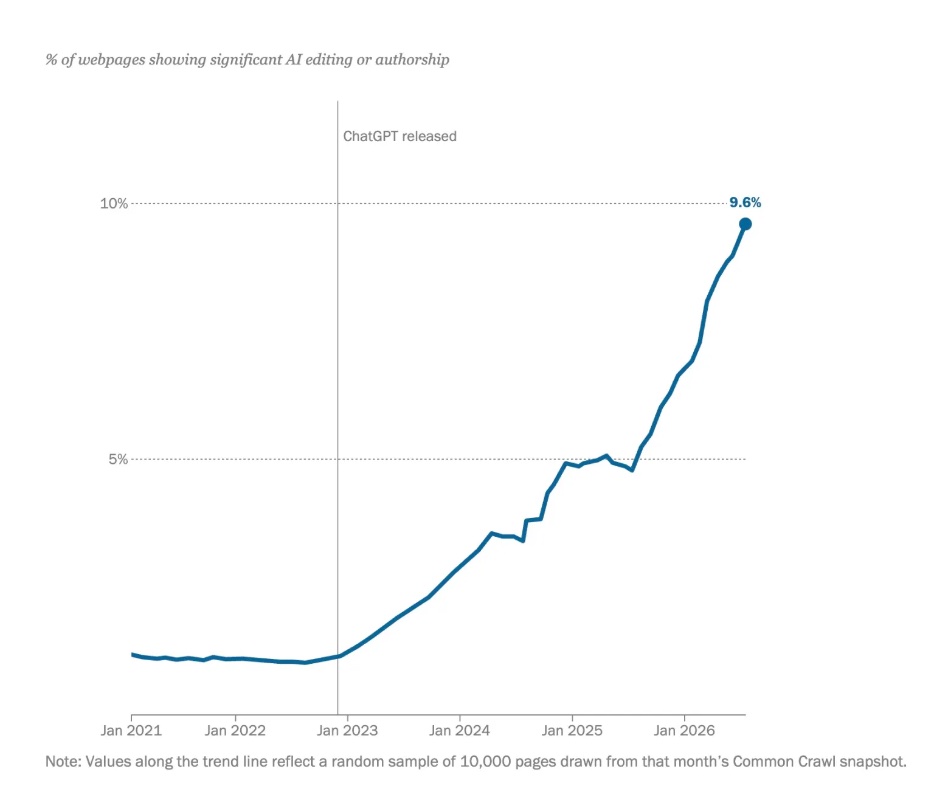
More than a third of web pages published since the launch of ChatGPT show signs that artificial intelligence was used in their creation or significant editing. This follows from a new analysis by the Pew Research Center, which tracked nearly half a million English-language pages. The share of AI-related content has been growing rapidly since the end of 2022.
AI is most visible on commercial websites
Researchers analyzed 490,000 web pages sourced from the Common Crawl archives. The data included 49 different snapshots of the internet from January 2021 to July 2026, with 10,000 English pages randomly selected from each period.
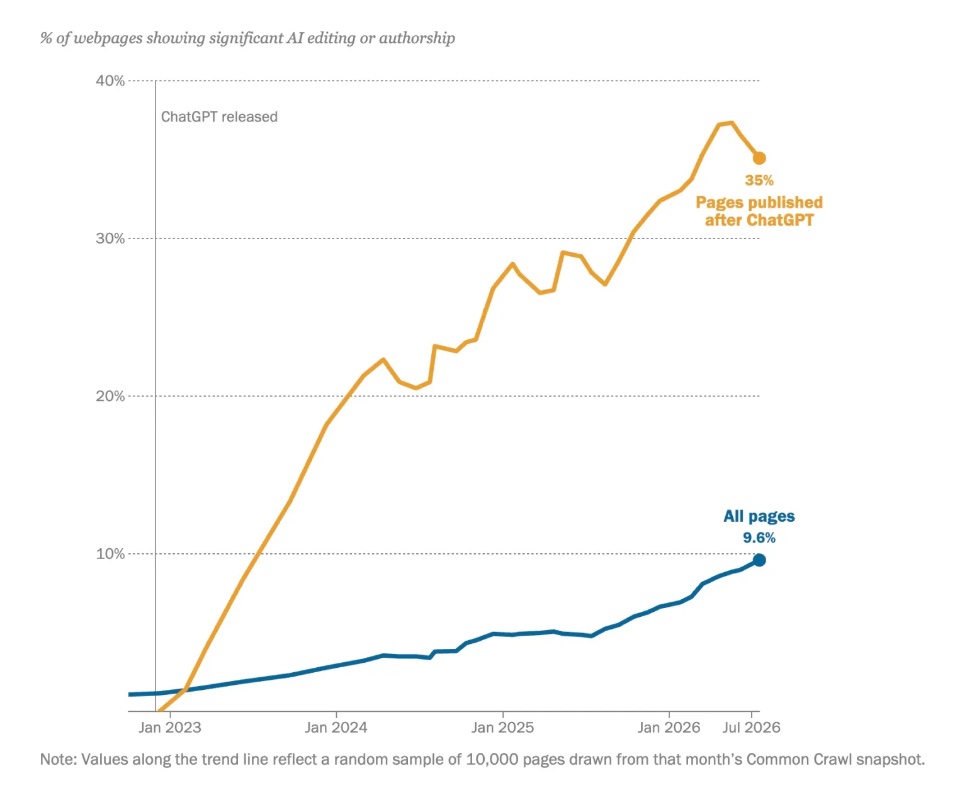
The text then passed through the Open Pangram detection model, which looks for statistical markers typical of content created or significantly modified by language models. In the entire sample from July of this year, approximately 10% of pages showed significant signs of AI use.
However, the result changed significantly when researchers tracked only pages with a traceable publication date after November 30, 2022, when ChatGPT was made available to the public. In this group, the share of pages with signs of AI authorship reached approximately 35%.
This is not an evenly distributed trend. Signs of AI use vary significantly by domain type:
- Commercial domains (.com): During 2026, signs of AI usage appeared on approximately every tenth page.
- Organizations (.org): The share hovered around 4.6%.
- Academic and government websites (.edu and .gov): These recorded a share of only about 1%.
A similar result was also brought by a separate study by researchers from Imperial College London, the Internet Archive, and Stanford University. It estimated that by mid-2025, approximately 35% of newly published websites contained AI-generated or edited text.
The way the internet writes is also changing
Pew also tracked linguistic elements that current models use more frequently than humans. The analysis revealed several interesting trends in written expression:
- Since 2023, the use of the em dash has approximately doubled.
- The occurrence of the so-called Oxford comma has increased by 63%.
- Certain words typical of language model responses have begun to appear more than twice as often.
“The mere occurrence of a certain word or punctuation does not, of course, prove the use of artificial intelligence. Even AI detectors are not infallible and can mislabel human text. Therefore, the results cannot be used as definitive proof of authorship for a specific page,” warns the Pew Research Center.
However, for tracking trends across hundreds of thousands of documents, the researchers say the data provides a fairly clear picture of the ongoing transformation of digital content.
The internet is increasingly being read by machines
Furthermore, the internet is becoming automated on the other side as well. Cloudflare stated this year that automated traffic already accounts for roughly 57% of all web requests, surpassing human-generated traffic. Thus, a growing part of the internet is not only being created by machines today but is also increasingly being read by other machines.
The results by no means imply that human content is disappearing from the internet. However, they show how extremely quickly generative artificial intelligence has become a common and inseparable part of website creation in the less than four years since the launch of ChatGPT.

I got into cryptocurrencies at the end of 2020 and quickly became a Bitcoin maximalist. I’m interested in what’s happening in the financial markets, and in my free time I travel around Southeast Asia. At KryptoMagazine, I’m in charge of news and video content.