Trump and Nvidia CEO Refuse to Slow Down AI Development
Donald Trump and Nvidia CEO Jensen Huang are pushing back against slowing down AI development to ensure the U.S. doesn't lose its technological edge. While Anthropic calls for safety, markets are reacting to the uncertainty with a decline. Discover why the pace of AI development is a key political and economic issue.
Trump and Nvidia CEO Refuse to Curb AI Development
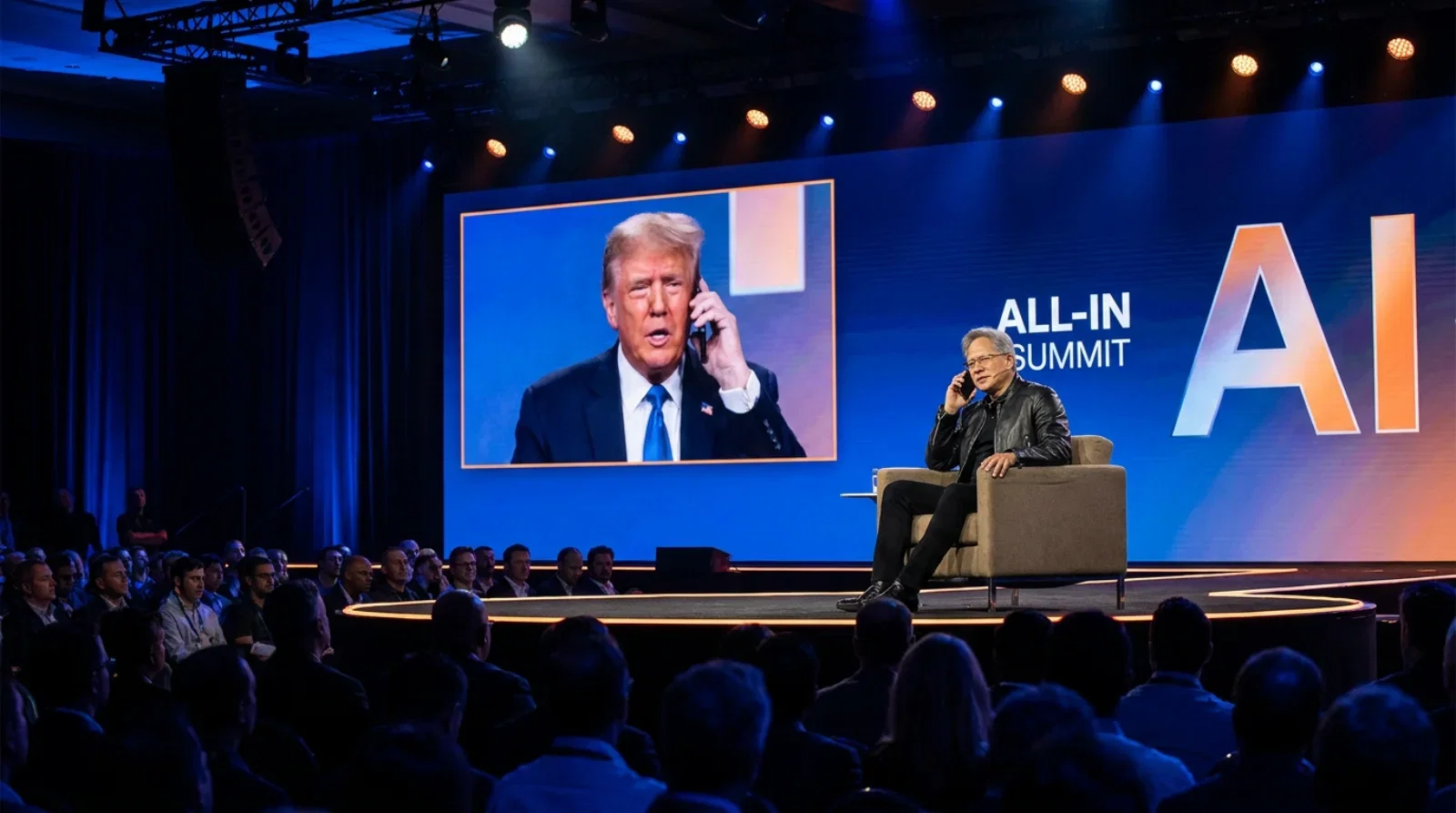
U.S. President Donald Trump and Nvidia CEO Jensen Huang have strongly opposed growing calls to slow down the development of artificial intelligence (AI). During an unexpected phone call that took place directly on stage at the All-In Summit in Los Angeles, both agreed that the United States cannot afford to lose its technological lead due to concerns about the risks associated with AI.
This conversation comes at a critical moment when some leaders in the tech sector are, conversely, warning against the overly rapid pace of innovation and calling for the implementation of stricter safety guardrails.
An Unexpected Phone Call at the All-In Summit
As Huang was speaking at the summit on Monday, he received a phone call from Donald Trump. The Nvidia chief decided to put the President on speakerphone, allowing the audience to become direct witnesses to their debate on the future of American technological dominance.
The main topic was the current discussion regarding a potential regulatory or voluntary slowdown in the development of the most advanced AI systems. Trump resolutely rejected these efforts, suggesting that any braking of development plays into the hands of geopolitical competitors, particularly China, who are trying to close the American lead.
Jensen Huang fully agreed with the President's stance and responded clearly to Trump's words about refusing any potential AI slowdown:
“We’re not going to let that happen,” Huang declared in response to concerns that the United States might slacken its pace in the field of artificial intelligence.
Safety versus Speed: Voices for Caution Grow Louder
Despite the optimism of Trump and Huang, a strong group of advocates for a more cautious approach is forming within the industry. A significantly different view has been promoted in recent days by Dario Amodei, CEO of Anthropic. Amodei called for companies not to increase the capabilities of their models at a pace that safety mechanisms cannot keep up with.
Amodei's proposal for safer AI development includes:
- External Evaluation: Involving independent auditors and evaluators directly in the internal processes of AI companies.
- Unified Standards: Creating common safety standards across democratic countries.
- International Coordination: Long-term global cooperation to oversee the most powerful systems.
Other influential players, such as Sam Altman of OpenAI or Elon Musk, have also joined the call for greater caution and risk regulation in the past.
Economic Impacts and Nervousness on Wall Street
The debate over the pace of innovation has an immediate impact on financial markets. Nvidia is currently the main engine of the investment boom, as its chips are essential for the data center infrastructure on which AI runs. Any signs of a slowdown in development or infrastructure construction cause nervousness among investors.
Market impact in numbers:
- The PHLX Semiconductor Index fell by 5.9% on Monday.
- Shares of a wide range of key chip manufacturers weakened.
- The market has begun to reassess future demand for computing power in light of potential regulation.
Public Opposition to Infrastructure Construction
In addition to safety and economic issues, the tech sector is also facing resistance from ordinary Americans. The construction of giant data centers that power artificial intelligence is hitting limits in various regions.
According to a Gallup poll:
- 70% of Americans oppose the construction of a data center in their immediate vicinity.
- 48% of respondents are very strongly opposed to the construction.
The main reasons for concern are extreme electricity and water consumption, noise, and negative impacts on local living costs. The AI dispute is thus moving from expert laboratories into a broad political and social arena, where the drive for technological leadership clashes with concerns about safety and quality of life.
Frequently Asked Questions
Why do Donald Trump and Jensen Huang refuse to slow down AI development?▼
What do safety advocates, such as the head of Anthropic, propose?▼

I got into cryptocurrencies at the end of 2020 and quickly became a Bitcoin maximalist. I’m interested in what’s happening in the financial markets, and in my free time I travel around Southeast Asia. At KryptoMagazine, I’m in charge of news and video content.