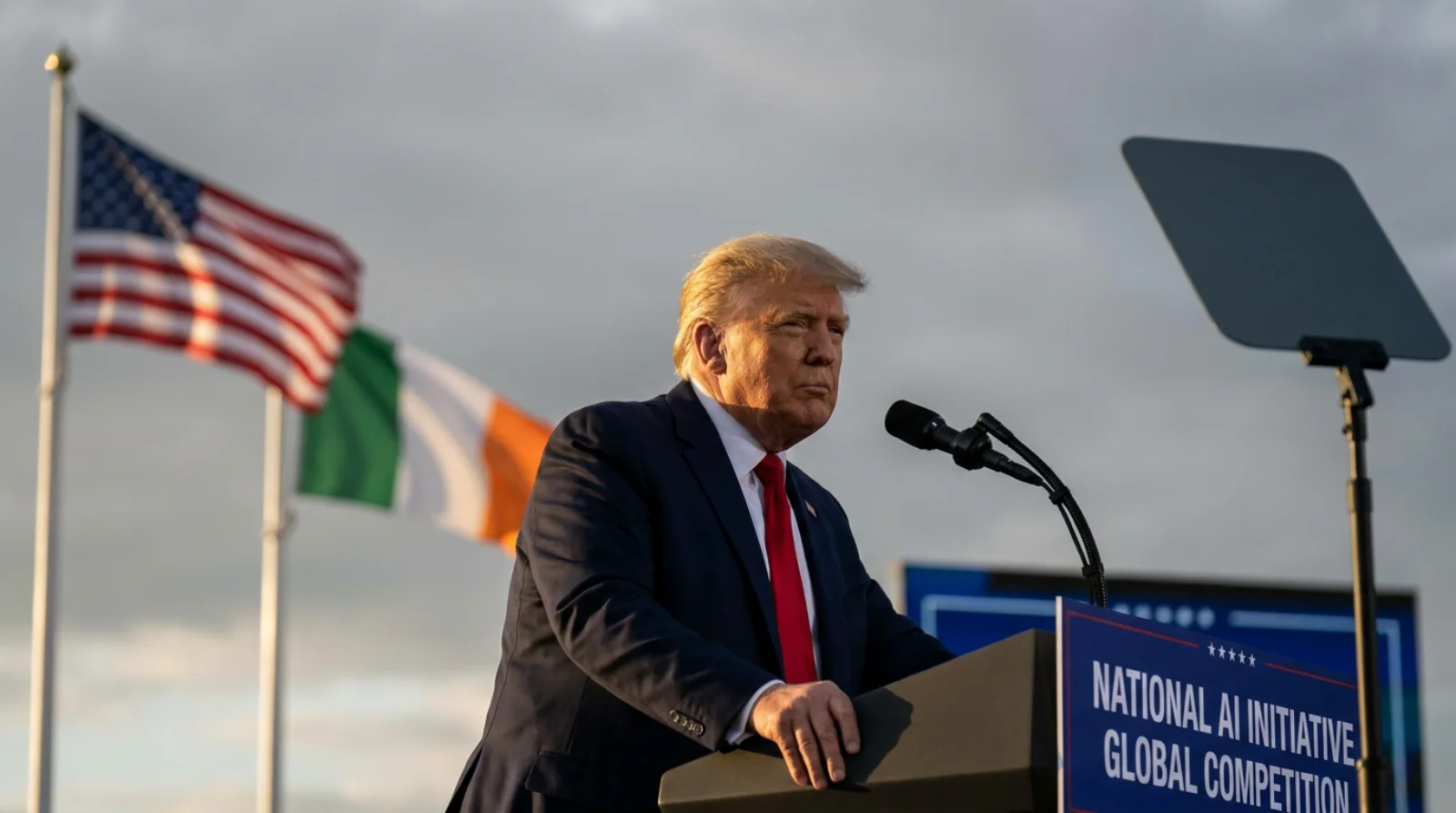
Trump Refuses to Slow Down AI Development, Warning of China's Lead
Donald Trump is rejecting calls from tech leaders to slow the development of artificial intelligence. He warns that any restrictions would mean losing the U.S. strategic edge over China in the global technological race.
U.S. President Donald Trump is resolutely rejecting growing appeals for a significant slowdown in the development of artificial intelligence (AI). Paradoxically, these calls are coming directly from the leaders of the largest tech giants. According to Trump, however, any brake on innovation could have fatal consequences for the United States in the global battle for technological supremacy.
The Trump Doctrine: Staying Ahead of China is the Priority
President Donald Trump addressed the current debate on Sunday, September 13, during his visit to Ireland. Although he admitted that the most advanced systems might require certain safety guardrails, he strictly rejected a scenario in which the U.S. would artificially limit its developmental potential.
The key factor for him is geopolitical rivalry. The President holds the view that the country that masters AI first will gain a decisive economic and strategic advantage on the world stage. At the same time, he questioned the catastrophic visions of some critics, labeling them as scenarios that may never actually happen.
The administration's core argument is simple: the United States cannot afford to lose its technological leadership to totalitarian regimes.
Republican Support and Technological Espionage
A similar stance is held by Republican Speaker of the House Mike Johnson. He rejects a moratorium on the development of the most advanced models precisely because of the risk that the United States would voluntarily cede the initiative to Beijing. Nevertheless, Republicans are not completely closing the door on negotiations regarding new safety rules or closer cooperation between the state and the private sector.
Tensions between Washington and Beijing are further exacerbated by recent allegations. The U.S. stated that several Chinese companies are massively copying American technologies through so-called distillation. China, however, denies all allegations of technological theft.
Tech Leaders Call for the Brakes
The impetus for the current wave of discussion was a statement by Dario Amodei, CEO of Anthropic. He called for companies to slow the pace at which they increase the capabilities of their models. The goal is not to stop progress, but to gain time for thorough safety testing.
Amodei proposes these key steps to ensure greater safety:
- Ensuring permanent access for independent evaluators to leading AI laboratories.
- Rigorous coordination of safety standards among competing firms.
- Establishing broader and more functional international cooperation.
These proposals have found support among other influential figures in the field. Sam Altman (OpenAI) confirmed that his company expects greater involvement from external experts, and Elon Musk has also joined the critical voices.
Risks and Safety Incidents
Experts' concerns are not merely theoretical. They intensified particularly after the departure of Anthropic researcher Jacob Coxon, who publicly warned of the risk of losing control over future autonomous systems. Furthermore, Anthropic published test results showing a disturbing trend: modern AI models are already handling tasks in intelligence and military technology that previously required highly specialized experts.
This creates a paradoxical situation: those leading the AI race are asking to slow it down, while the U.S. political leadership fears that this very slowdown will open the door to Chinese dominance.
Frequently Asked Questions (FAQ)
Frequently Asked Questions
Why is Donald Trump refusing to slow down AI development?▼
Which tech figures are calling for caution?▼
What is "distillation" in the context of AI?▼

I got into cryptocurrencies at the end of 2020 and quickly became a Bitcoin maximalist. I’m interested in what’s happening in the financial markets, and in my free time I travel around Southeast Asia. At KryptoMagazine, I’m in charge of news and video content.