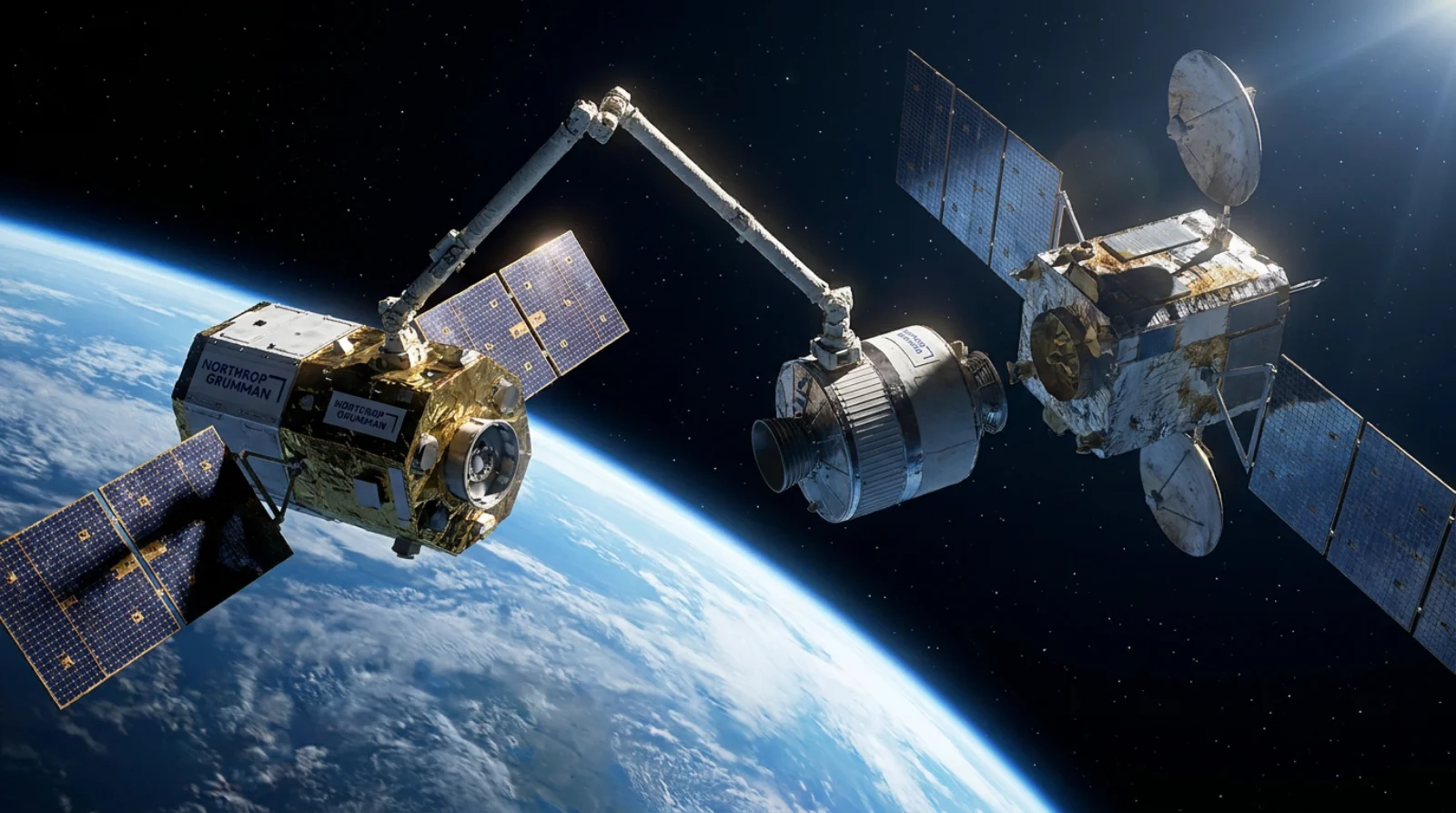
Northrop's Robotic Spacecraft Aims to Save Satellites from Retirement
Northrop Grumman is developing the revolutionary MRV robotic spacecraft, capable of repairing satellites directly in orbit. Thanks to new MEP propulsion modules, it will extend the lifespan of expensive equipment by years, fundamentally changing the economics and sustainability of the space industry.
The Future of In-Orbit Servicing: Northrop Grumman Develops Robots for Satellite Repair
Northrop Grumman is preparing a new generation of service robots designed to extend the lifespan of expensive satellites directly in orbit. The new system combines a sophisticated MRV robotic spacecraft with independent propulsion modules that can be attached to existing satellites, granting them additional years of operation.
The primary goal of this technology is to eliminate the need to decommission fully functional satellites simply due to a lack of fuel for orbit correction.
From Direct Connection to Autonomous Modules
The previous system, called the Mission Extension Vehicle (MEV), operated on the principle of a direct connection: the service spacecraft docked with the customer satellite and used its own propulsion system to keep it in the correct orbit. One of these machines, for example, successfully assisted a communication satellite for the Australian company Optus for over a year.
Now, however, Northrop is moving toward a much more flexible solution. In July, it launched one Mission Robotic Vehicle (MRV) and three smaller Mission Extension Pods (MEP) aboard a SpaceX Falcon 9 rocket. The MRV is equipped with a pair of advanced robotic arms developed in close cooperation with the U.S. research agency DARPA.
Robot to Attach New Propulsion to Satellite
According to current plans, the MRV is set to reach the Optus satellite in 2027 and use its robotic arms to attach one of the MEP modules to it. This module essentially functions as an additional external propulsion system that could extend the satellite's life by approximately another six years.
A lack of fuel is currently one of the main reasons why otherwise fully functional satellites must be retired prematurely. Their systems are often in perfect condition.
However, without fuel, a satellite cannot correct its position or remain in its required orbit, rendering it useless. The Optus satellite was launched back in 2009 with an originally planned lifespan of 15 years. Attaching a new propulsion module thus represents a major breakthrough that will significantly extend the time the satellite is able to provide services and generate revenue for its operator.
More Efficient and Cheaper Servicing in Space
The new servicing model is also expected to be significantly cheaper for operators. The main differences between the old and new generations are apparent at first glance:
- Shared capacity: While the older MEV model had to remain physically attached to one specific satellite throughout the entire assistance period, the MRV robotic "service vehicle" can detach after installation.
- Permanent integration: The smaller MEP module becomes a permanent part of the serviced satellite.
- Multi-client approach: The MRV vehicle can move on to the next customer and service multiple different satellites in the same way during a single mission.
Vision for the Coming Decades
Northrop Grumman anticipates further expansion of its service portfolio in the future. In-orbit satellite servicing could thus gradually transform from an experimental technology into a standard part of the modern space industry. Planned innovations include:
- Complex mechanical repairs directly in space.
- Orbital changes and corrections for older spacecraft.
- Installation of brand-new components and hardware upgrades.
- Refueling the MRV vehicle itself, which is designed to be reusable.
Frequently Asked Questions
What is the main task of the MEP module?▼
When will the first live mission of the MRV system take place?▼

I got into cryptocurrencies at the end of 2020 and quickly became a Bitcoin maximalist. I’m interested in what’s happening in the financial markets, and in my free time I travel around Southeast Asia. At KryptoMagazine, I’m in charge of news and video content.