Bitcoin Developer Luke Dashjr Loses BIP Editor Status and Plans New Hard Fork
Following the failure of BIP-110, developer Luke Dashjr is pushing for a new Bitcoin hard fork with a changed Proof of Work algorithm. After his minority chain stalled, Dashjr now labels the main network as compromised by 'evil actors' while losing his long-standing role as a BIP editor.
Bitcoin developer Luke Dashjr has certainly not retreated into the shadows following the failure of the controversial BIP-110 proposal. On the contrary. In recent days, he has begun describing the dominant Bitcoin blockchain as a network attacked by "evil actors," considers his own minority branch to be the true Bitcoin, and has now set out to select a new Proof of Work algorithm. The way he chose it seems bizarre, to say the least.
The BIP-110 branch stalled after a few blocks
The BIP-110 proposal aimed to temporarily limit the amount of data that can be stored in Bitcoin transactions. The proposal became part of a long-standing dispute over the non-financial use of the blockchain. However, it did not gain the support of the majority of miners.
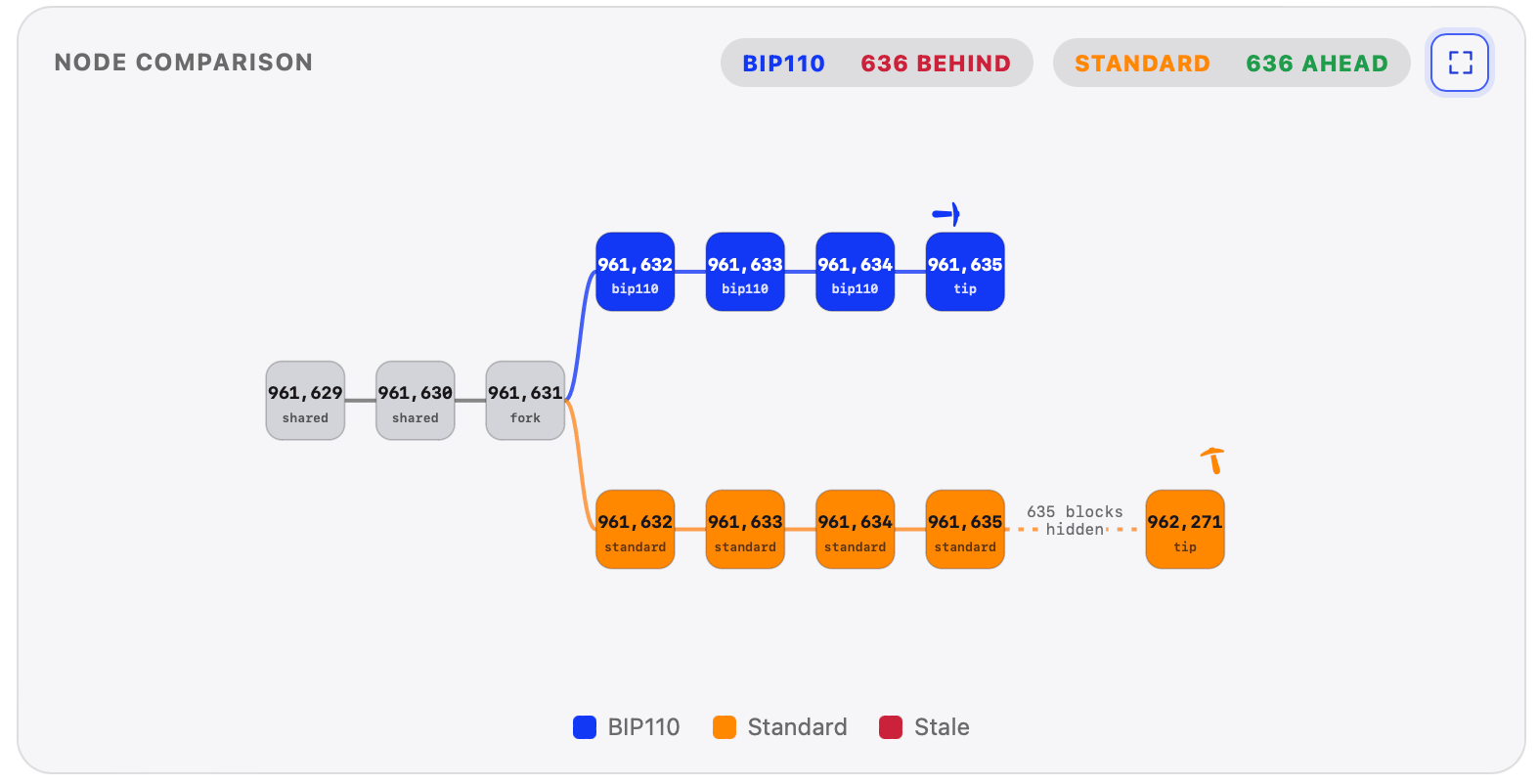
During the signaling period, the proposal was supported by only 51 out of 2,016 blocks, which corresponds to approximately 2.53%. Nodes enforcing BIP-110 subsequently began rejecting some blocks from the main network, thereby creating a minority branch. However, this branch mined only four blocks and practically came to a standstill. The BIP-110 proposal itself is now listed as closed in the official repository.
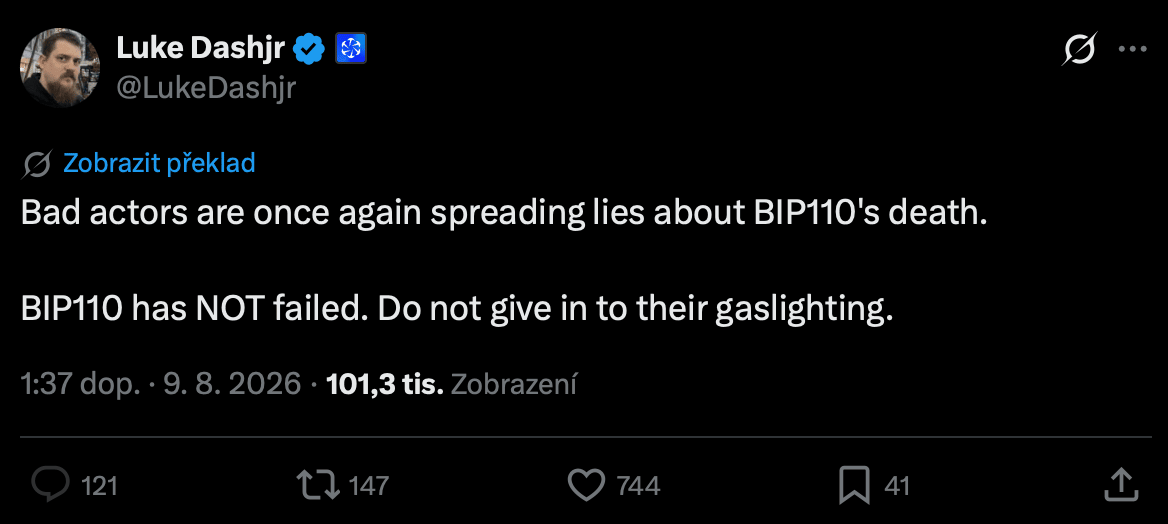
Dashjr interprets the situation quite differently. On the X network, he claimed that "evil actors" carried out a contentious hard fork with the aim of forcing users to distribute materials depicting child sexual abuse. He labeled the rival branch with the derogatory name "Bpedo" and stated that mining pools are attacking the Bitcoin network in an attempt to convince the public that this branch represents the real Bitcoin.
The controversy was also heightened by the risk of a so-called replay attack. The BIP-110 branch lacked its own protection against the reuse of transactions during the split. A signed transaction created on one branch could thus, under certain circumstances, jeopardize coins on the other chain as well.
Realize that Bpedo (or Corecoin, or whatever you want to call it) is exactly what "Segwit2X" and BCash would have looked like if miners had agreed to them. In reality, it is an attempt at a contentious hard fork. Are you just going to give up? Or will you stay with Bitcoin and fight? — Luke Dashjr (@LukeDashjr), August 10, 2026
New Proof of Work according to Testnet4 blocks
An even stranger chapter occurred on Tuesday, August 11. Dashjr announced a plan to select a new Proof of Work algorithm. He wanted to monitor the Testnet4 blockchain and determine one of the pre-prepared variants based on the last hexadecimal character of the hash of the next block.
However, the process quickly turned into chaos. When several blocks appeared in quick succession, Dashjr wrote that "trolls" had attempted to disrupt the selection. He therefore adjusted the rules, and the BLAKE2b algorithm eventually emerged from the calculation. This is intended to replace SHA-256d on the branch associated with BIP-110, not on the current dominant Bitcoin blockchain.
tl;dr: @lukedashjr decided to use a Testnet4 block hash as a random beacon to select a new PoW function for the BIP-110 chain. An absolutely insane decision. It is obvious that this can be manipulated simply by mining blocks with the correct hash. Mining a block on Testnet4 has negligible costs... — Peter Todd (@peterktodd), August 11, 2026
The dispute over BIP-110 ultimately had personal consequences as well. Luke Dashjr lost his position as a Bitcoin BIP editor. The proposal for his removal was submitted by developer Mark Erhardt, according to whom Dashjr handled his editorial powers in conflict with the established process while promoting BIP-110.
Criticism concerned, for example, the effort to assign a proposal number before discussion or the rapid approval of one of his updates. Erhardt also pointed out that since 2024, Dashjr had participated only minimally in the regular work of BIP editors. The removal of his access was subsequently confirmed directly in the Bitcoin BIP repository.
Dashjr called this decision an "abuse of power." Shortly thereafter, he also announced that he was taking a leave of absence from his position as chairman and chief technical officer (CTO) of the Ocean mining pool and wants to focus more on Bitcoin and other open-source projects.
Dashjr is preparing another hard fork
But the story doesn't end there. Dashjr and his supporters want to continue the minority branch even after the original BIP-110 gained practically no support from miners. The next step is to be a hard fork associated with a change in the Proof of Work algorithm. Instead of SHA-256d, which the main Bitcoin network uses, the branch is to switch to BLAKE2b, which Dashjr selected using the experiment with Testnet4 blocks.
The change would also completely cut off current Bitcoin ASIC miners, which are designed specifically for SHA-256. BLAKE2b, on the other hand, is optimized for standard 64-bit processors, and implementations for mining using graphics cards also exist. At least in the beginning, it would thus be possible to mine the new branch using CPUs and GPUs without the miner needing a Bitcoin ASIC miner.
Dashjr now cites September 1 as the target date. He himself admits that the chance of activating the original BIP-110 in the form of a soft fork is almost zero, which is why attention is shifting to the new hard fork. The necessary code is to be written and properly tested by the stated deadline.
This change is not intended to directly affect the main Bitcoin blockchain. That continues to operate with the SHA-256d algorithm. BLAKE2b is to be deployed only on the already separated minority branch, which Dashjr and his followers continue to present as the continuation of Bitcoin.
Keep the market under control
Follow Bitcoin, cryptocurrencies, on-chain data, and macroeconomics all in one place in our Terminal.

I got into cryptocurrencies at the end of 2020 and quickly became a Bitcoin maximalist. I’m interested in what’s happening in the financial markets, and in my free time I travel around Southeast Asia. At KryptoMagazine, I’m in charge of news and video content.