
Trading Apps Shorten the Path to Purchase: Cryptocurrency Volume Reaches $4 Billion Weekly
Trading applications are revolutionizing crypto markets by minimizing the friction between discovery and purchase. With weekly volumes surging to $4 billion, discover how these platforms leverage social proof and seamless integration to drive unprecedented transaction growth.
Trading applications for cryptocurrencies are shortening the path from someone else's idea to your own purchase. Trading volume through tracked terminals has approached four billion dollars per week since June. More interesting than the growth itself, however, is the way applications and the people who bring in more traders are profiting from this activity.
Imagine that right under a post about an interesting token, there is a buy button. The author shows their position, adds an explanation, and the reader can trade from the same environment. Between interest and payment, only a few finger movements remain. This is precisely the path that trading applications are gradually shortening.
Editorial Tip: If you are interested in current cryptocurrency prices and market data, we recommend the Kryptomagazín terminal (this is a data terminal suitable for analysis, not for "gambling" like the platforms in this article. Ours is free and without registration). Not all terminals are created equal…
It is more convenient for users. For operators, it creates a business model based on repeated activity. For the application to collect a transaction fee, it doesn't need the purchase to end in a profit. It just needs it to happen.
From Half a Billion to Four. It's Not a Record Yet
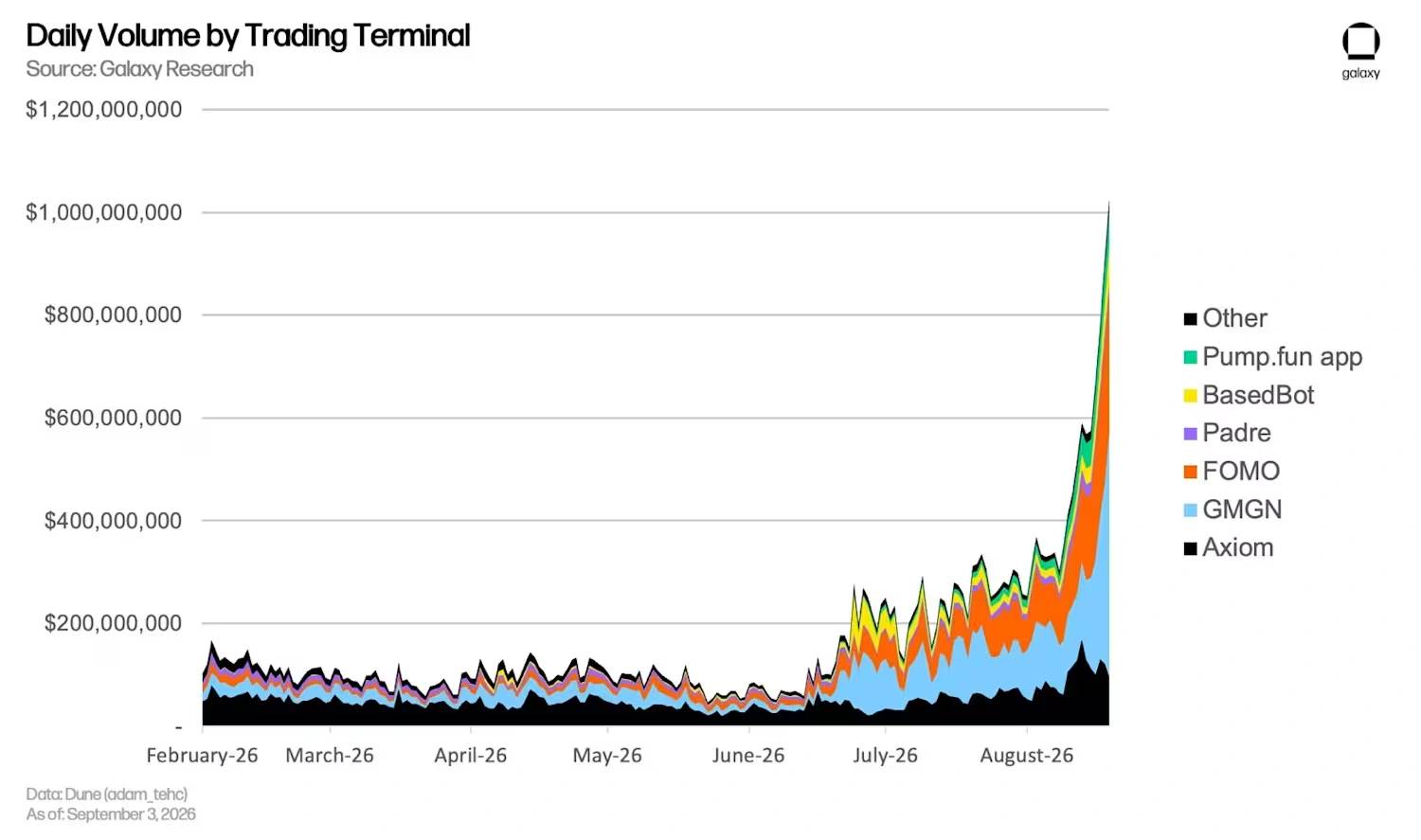
Galaxy Research, in a report from September 4, 2026, states that the aggregate weekly volume of swaps through tracked on-chain terminals has risen from approximately $500 million in June to nearly $4 billion. This is roughly an eightfold increase, or 700% growth. The set includes, among others, Fomo, GMGN, Axiom, the Pump.fun app, and several trading bots.
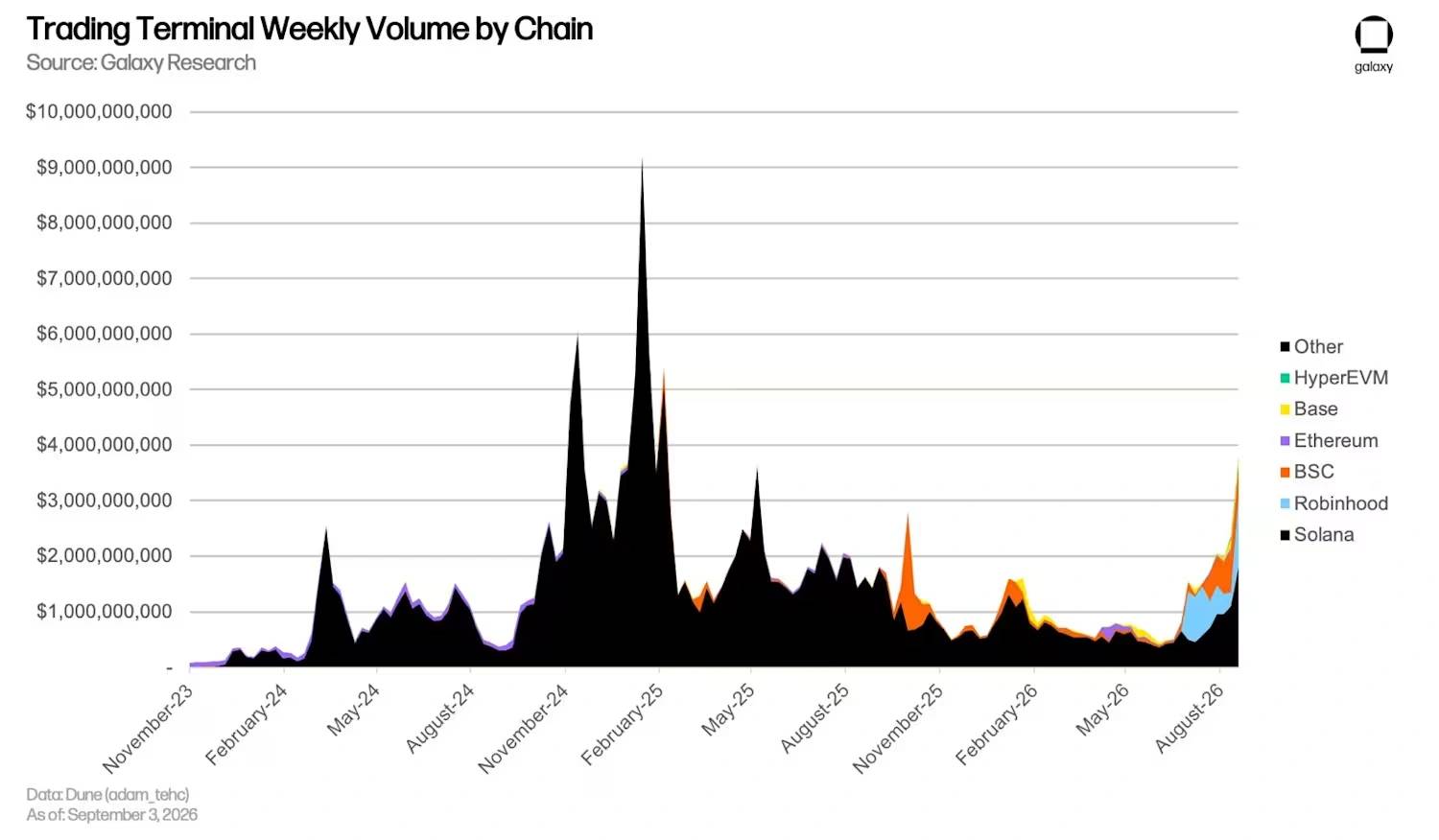
The chart also serves as a reminder that the rebound from the summer slump does not yet mean a historical high. The peak from the turn of 2024 and 2025 lies significantly higher.
The tracked applications also surpassed one billion dollars in a single day, according to Galaxy, for the first time since January 2025. These are trades, not net cash inflows. Data source and definition of the tracked set.
The Same Thousand Dollars Can Appear Repeatedly in Volume
The difference can be shown with a simple example. A trader buys a token for a thousand dollars and later sells it for the same amount. The sum of the values of both trades is two thousand dollars. Yet, they didn't have to deposit two thousand at the beginning, and no two thousand was created for them. For this example, let's set aside fees.
If they turn over the same capital several times, they will report more volume. A rising number can therefore reflect more people, higher amounts per trade, or more frequent buying and selling. The aggregate itself does not distinguish between these possibilities. Claiming that four billion new dollars poured into the terminals would mean something different from what the published data measures.
To assess the actual expansion of the applications, net deposits and withdrawals, the number of returning users, and the distribution of activity among users would be helpful alongside volume. Without these data points, busier trading can easily be mistaken for an influx of new customers.
The Trading Terminal Takes the Form of a Social Network
In its April announcement of the web version, Fomo describes trader profiles, leaderboards, alerts for their trades, and users' own investment theses. The idea, its author, and the option to buy can thus be in one place. Furthermore, a unified account connects mobile and desktop.
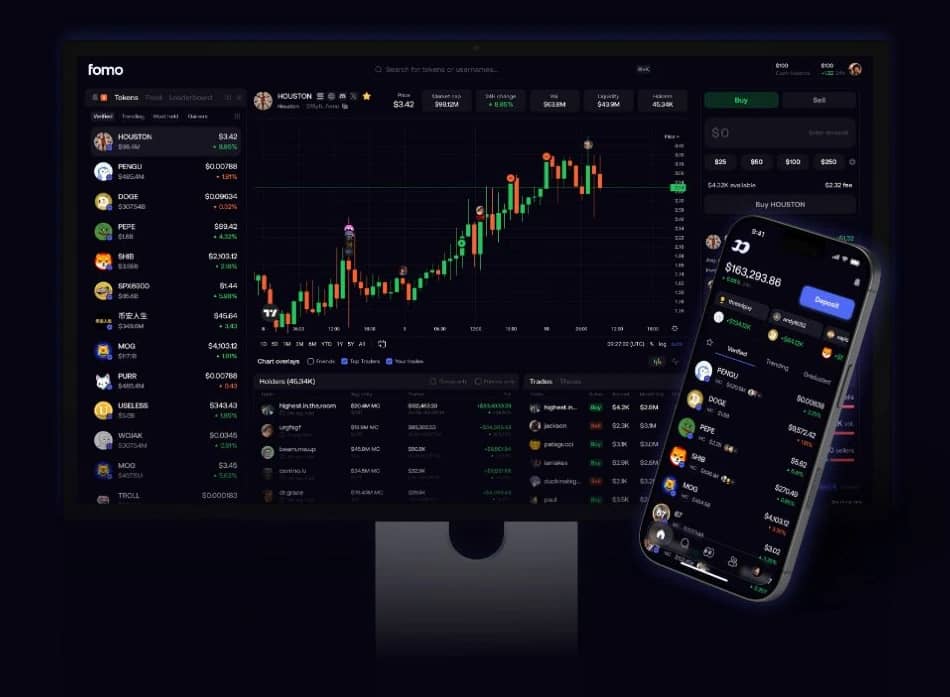
From an editorial perspective, this connection is more important than the number of buttons in the interface. A social network traditionally sells the ability to get a message in front of an audience. A trading app can additionally monetize the reaction to the message itself if the user buys immediately. Every shortening of this path can thus have value even without new technical improvements to the blockchain.
A recent post from the official Fomo account on X emphasizes user theses about future developments. It captures well how the company presents its product: placing a specific person's opinion next to a price chart. It is evidence of the company's marketing focus, not proof of the success of those opinions.
Charts show what happened.
Your fomo thesis shows what you believe will happen. — fomo (@fomo) September 7, 2026
This model is already attracting investor capital. Fomo announced a $75 million investment on June 22 led by Index Ventures with participation from Union Square Ventures and Benchmark. At the time, the company reported over 625,000 registered users and more than $4 billion traded since launch. This cumulative figure for a single app should not be confused with the weekly volume of the entire Galaxy set.
In the same announcement, Fomo also reported more than 68,000 users who made their first crypto purchase via Apple Pay, totaling $25 million. Such a figure is closer to the question of new people entering the market than gross trading volume. However, this is still a June claim by the company itself; the announcement does not include independent verification of these numbers.
Fomo Has Already Exceeded $30 Million in the Unclosed Quarter
The revenues of this model can be tracked outside of corporate announcements. The attached DefiLlama overview for Fomo shows gross protocol revenues of $30.44 million for the third quarter of 2026 so far. For the entire second quarter, it reports $7.24 million. The current value is therefore approximately 4.2 times higher, even though the third quarter has not yet ended.
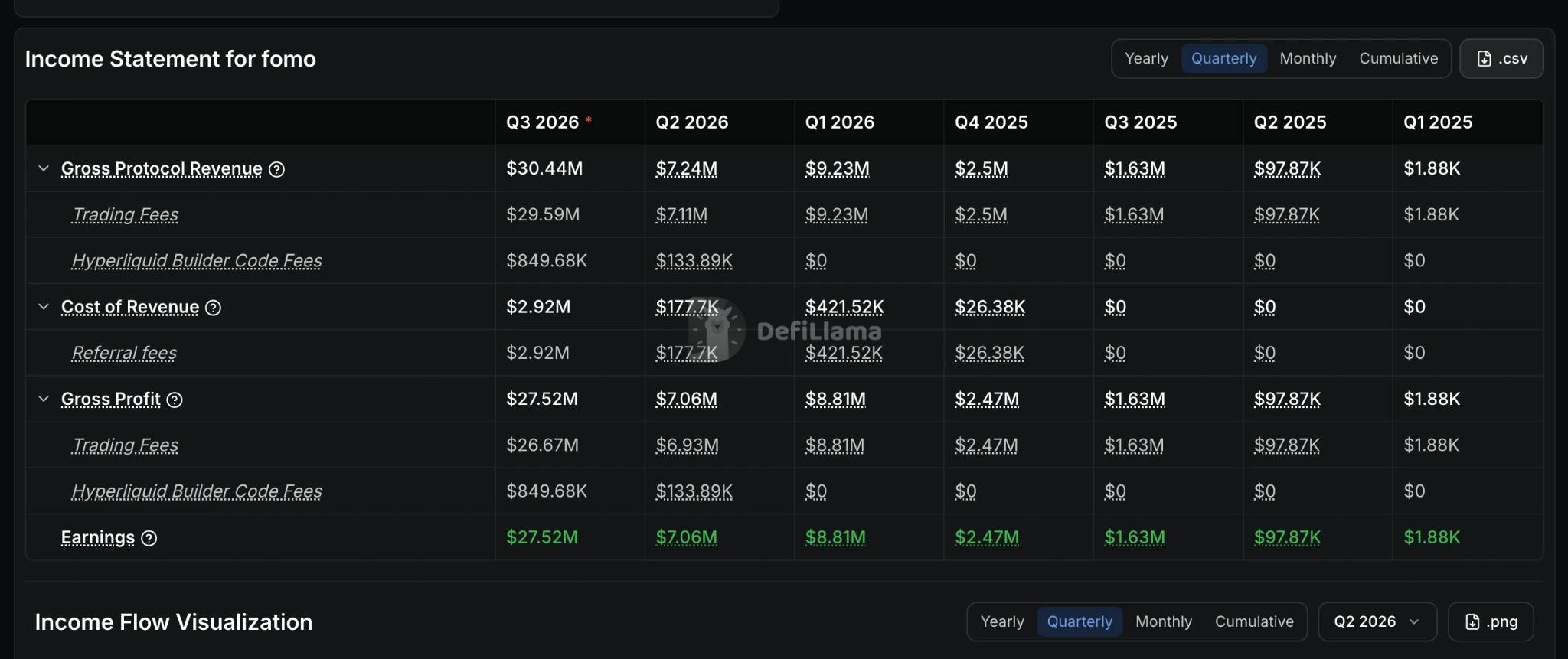
In the third quarter, the overview breaks down $29.59 million in trading fees and approximately $850,000 from fees associated with trades on Hyperliquid. Against these are $2.92 million in reported referral rewards. Here, the economics of distribution are visible directly: a portion of trading revenue is returned to the people who bring in users.
After this deduction, DefiLlama displays $27.52 million as Gross Profit and Earnings. However, these labels are not enough to conclude that Fomo achieved the same net accounting profit. The table does not show the company's full personnel, technological, or other costs.
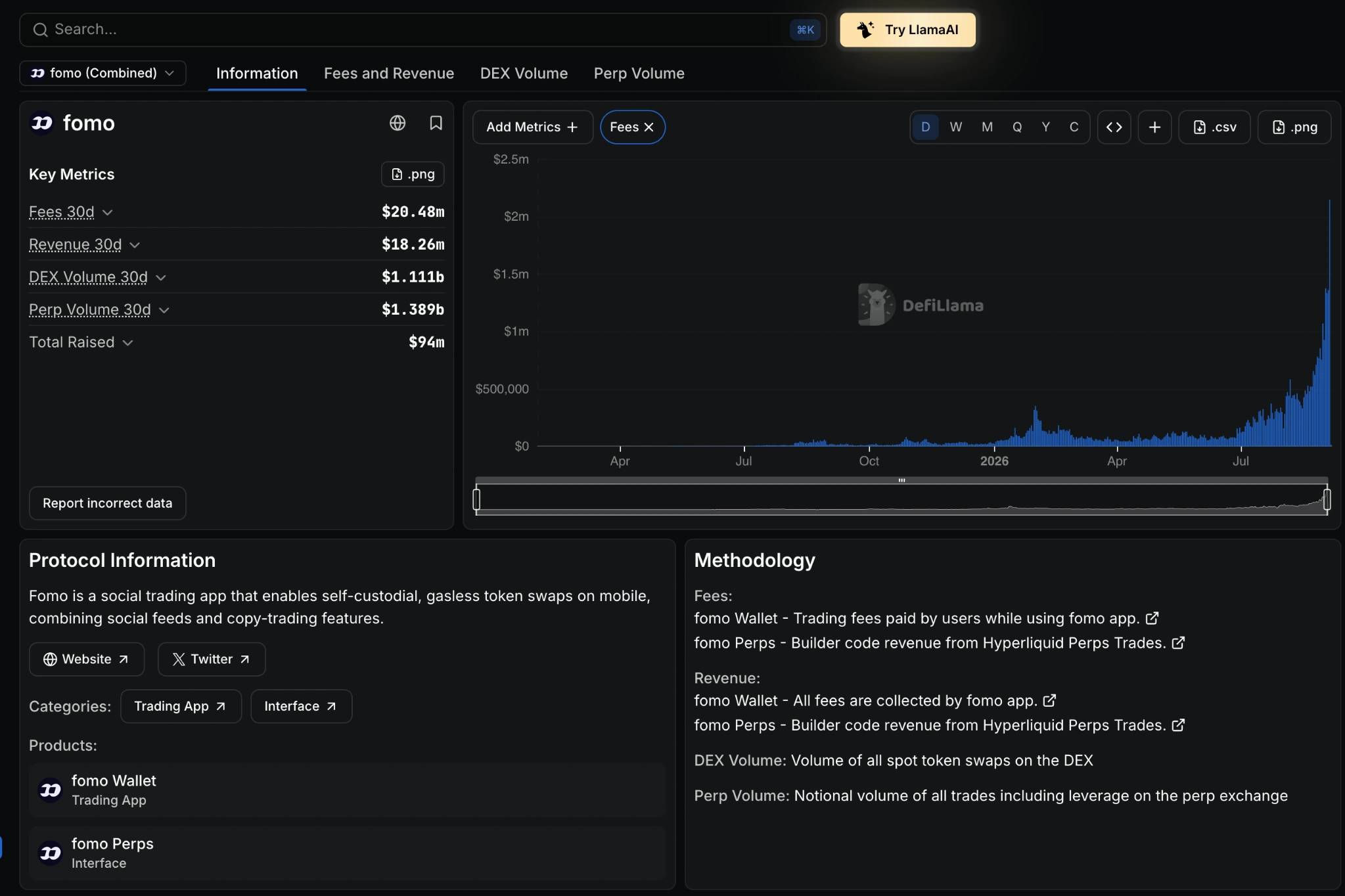
The second image also shows why it is necessary to watch definitions. Fomo Combined includes both the wallet and the service for perpetual contracts. Therefore, the overview lists spot swap volume and nominal derivative trade volume including leverage separately. Simply adding them together and comparing them with Galaxy's swap volume would mix different metrics.
One Percent Adds Up with Frequent Trading
A specific rate can be found, for example, at GMGN. Its official guide from June 18 states a standard fee of 1% per executed trade, even when copying another wallet, plus a network fee. Tracking wallets themselves is free according to the documentation. This rate is not a universal price list for all applications.
What does one percent do with repeated trading? Let's take a model account with a thousand dollars. For every purchase and sale, 1% is deducted from the amount being transferred. The token price doesn't move at all, and the entire remaining balance goes into the next trade. We will omit network fees, price slippage, and any rewards or discounts.
| Full buys and sells | Number of trades | Balance from $1,000 | Deducted fees |
|---|---|---|---|
| 1 | 2 | $980.10 | $19.90 |
| 5 | 10 | $904.38 | $95.62 |
| 10 | 20 | $817.91 | $182.09 |
After ten such rounds, approximately $818 remains. The price of the asset hasn't dropped by a single cent. In this model, the loss is created by the frequency of trading itself. The actual result would, of course, also be influenced by price movement, the billing method, and other costs. The table shows the isolated effect of a recurring percentage fee.
For the application, the collected fees are income from which it can cover operations and distribute rewards. They cannot automatically be labeled as net profit. At the same time, it would be a mistake to multiply the entire Galaxy volume by one percent and present the result as sector income: individual services have different rates and conditions.
A Recommendation May Be Backed by a Share of Your Trades
On June 2, Fomo announced on its official X account that it had paid out over $2 million in referral fees to users. At the same time, it described a reward of 25% of the fees generated by a user who registers via a referral code. This was the company's communication at the time, not a verified current fee schedule.
Over $2M in referral fees have been paid out to fomo users 🥳
Trade. Share. Earn.
When someone signs up with your referral code, you earn 25% of all fees they generate. pic.twitter.com/avq6CpivgM — fomo (@fomo) June 2, 2026
A quarter of the fees is, of course, not equal to a quarter of the money deposited. But the economic motivation is clear: the referrer can earn more the more fees the referred user generates. Their income therefore does not have to depend on whether the referred trader ends up in the black.
The mere existence of a reward does not prove unfair conduct. However, it changes the way it is reasonable to read an enthusiastic recommendation. Alongside an opinion on the quality of the application, there may also be a share in the future activity of the audience. For the reader, it is therefore essential whether the author clearly states this relationship.
Someone Else's Winning Trade Does Not Guarantee the Same Result
A similar distance is deserved by the leaderboards of successful wallets. In its guide to copy trading, GMGN points out that a follower sees a transaction only after it is recorded and may enter at a different price. It also describes wallets that attract copy traders and then sell tokens to them. The label "smart money" does not guarantee profit by itself.
In a March analysis of social trading, Galaxy also examines the inequality between an early buyer and the people who follow them. A public profile provides useful information, but it may not reveal a person's overall position in other wallets. A visible purchase is thus not yet a complete picture of their strategy.
This is where it is decided how useful social trading will be. The same interface can show a reader the basis for their own consideration, or just quickly lead them to another trade. The difference is easily lost in the total volume. The user will only recognize it in their balance after paying the fees.
The growth of terminals is therefore worth paying attention to even without looking for the next token that is supposed to skyrocket. It shows the price of the place where someone else's conviction turns into an order. The operator can collect every time this transformation occurs. The trader must additionally correctly estimate what they are buying and for how much.

I am the founder of the portal Kryptomagazin.cz. At the time, there was virtually nothing about cryptocurrencies on the Czech scene, so I decided to change that. I like the idea of decentralization, a bit of cypherpunk philosophy, and crypto-anarchy. The crypto industry is my world — I move and work in it every day, so I can no longer call it a hobby or pastime. I will always be happy to welcome you to your crypto magazine :)