
BIP-110 and the Challenges of Reaching Consensus on Bitcoin Changes
The controversial BIP-110 proposal triggered a split in the Bitcoin blockchain but met with resistance from miners. Read why the dispute between Bitcoin Core and Bitcoin Knots failed and what this situation reveals about the difficulty of implementing changes in the Bitcoin network.
The Controversial BIP-110 Proposal and the Bitcoin Blockchain Split
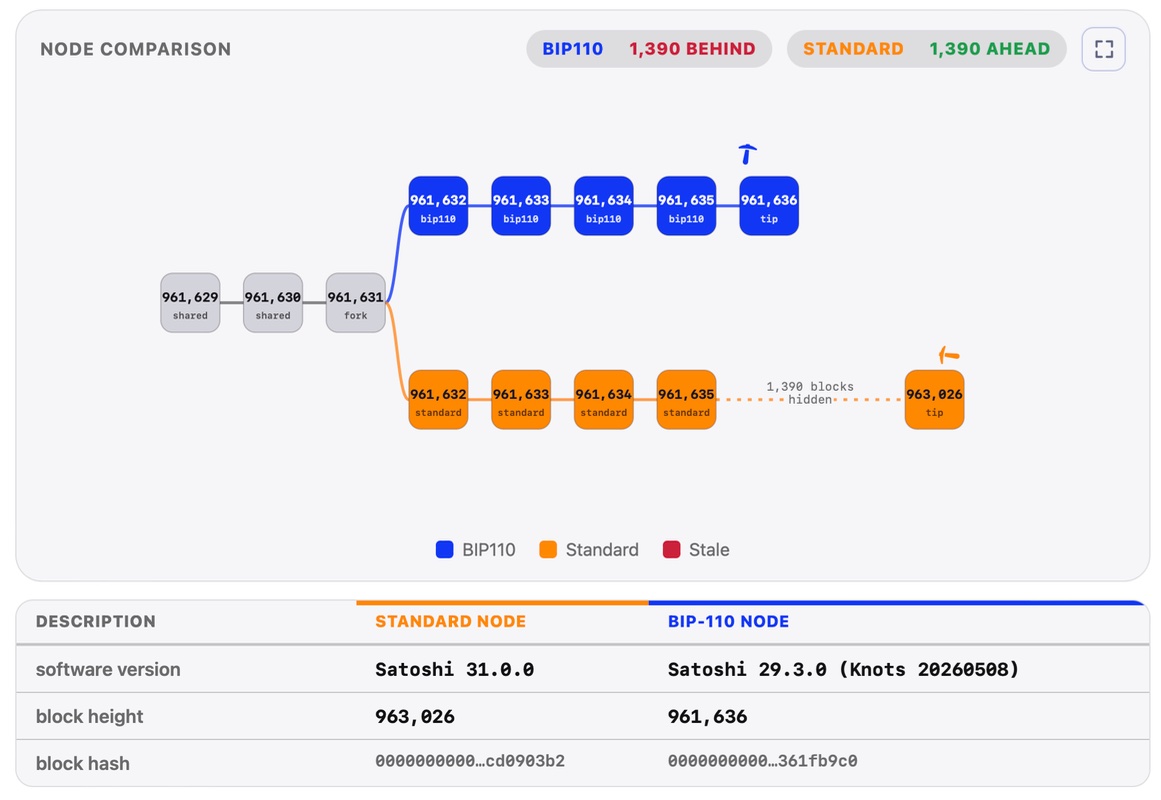
Last week marked the beginning of the so-called "mandatory signaling period" for the controversial Bitcoin change proposal BIP-110. At block 961,632, nodes enforcing this proposal began rejecting blocks that did not signal support for it. However, due to minimal miner support, only a minority branch split off from the main Bitcoin blockchain, which practically ceased to progress after mining just a few blocks.
In recent weeks, sharp disputes have taken place on social media between proponents and opponents. The conflict culminated with the start of mandatory signaling, when it became clear that BIP-110 failed to gain sufficient support, and its enforcement led only to the creation of a minority, non-functional branch of the blockchain.
The Core of the Dispute: Bitcoin Core vs. Bitcoin Knots
The dispute between Bitcoin Core (the original Bitcoin node implementation) and Bitcoin Knots (the implementation realizing BIP-110) originally concerned mainly transaction filtering. The question was straightforward: Should a node refuse to relay transactions based on the content the author stores in them?
Proponents of Knots consider certain types of transactions—specifically those they claim are non-financial—to be spam. They are thus trying to purge the network of data that, in their view, does not belong in the blockchain.
From Mempool Rules to Consensus Rules
BIP-110 takes the entire dispute to a new level. It is no longer just about mempool rules and relaying transactions between nodes, but about the consensus rules themselves—the rules by which nodes validate blocks in the blockchain.
How the attempt to enforce the change proceeded:
- Activation: BIP-110 entered the mandatory signaling period at block 961,632.
- Node reaction: Nodes enforcing these rules immediately began rejecting blocks that did not signal support.
- Result: A split occurred from the main chain, which continued with the vast majority of the mining power.
This clash is fundamental because it demonstrates how difficult it is to change Bitcoin in a situation where a significant part of the community cannot even agree on whether a problem exists at all.
Low Support and the Emergence of a Minority Branch
BIP-110 ultimately met with indifference from miners. In the last complete period before the start of mandatory signaling, support was signaled by only 51 out of 2,016 blocks, which corresponds to approximately 2.5 percent of the total hash rate.
After the start of mandatory signaling, nodes enforcing BIP-110 split off, but their branch practically froze due to minimal mining power. The result so far confirms that the proposal did not gain support from miners or the broader economic part of the Bitcoin ecosystem.
Radical Proposals: The Threat of Changing the Mining Algorithm
The failure of BIP-110 prompted some supporters to consider a much more radical step—the so-called "punishment of miners" through a change in the cryptographic algorithm used for mining.
Chris Guida has prepared an experimental implementation of this change, which would render existing mining equipment (ASICs) worthless and drastically affect the entire mining industry if this version of Bitcoin were to become the dominant one.
A Harbinger of Future Complex Debates
The dispute surrounding BIP-110 may just be a prelude to much more demanding discussions about the future of the network. While the community is currently arguing over a relatively limited change in rules, in the future, it may be forced to decide on the foundations of Bitcoin's security.
Bitcoin faces these fundamental questions:
- Will it be acceptable to change its cryptography in response to technological developments?
- Should the network force users to migrate to new standards in the event of a serious threat?
- How should coins that owners do not transfer or have lost access to be handled?
Reaching a consensus on these topics will be even more critical and likely much more turbulent than it was with the current attempt involving BIP-110.
Article provided to the editorial office by Lukáš Hozda, Lead Methodologist at Braiins.

I am the founder of the portal Kryptomagazin.cz. At the time, there was virtually nothing about cryptocurrencies on the Czech scene, so I decided to change that. I like the idea of decentralization, a bit of cypherpunk philosophy, and crypto-anarchy. The crypto industry is my world — I move and work in it every day, so I can no longer call it a hobby or pastime. I will always be happy to welcome you to your crypto magazine :)