
Is the AI Gold Rush Over? Investors No Longer Want to Burn More Cash.
The artificial intelligence gold rush is hitting reality. Investors are no longer willing to blindly finance massive spending; instead, they are demanding clear evidence of future profitability. See why record results from giants like TSMC or Alphabet are not enough for the market to grow.
The second-quarter earnings season has its highlight in the financial figures of companies linked to artificial intelligence. For the past two years, most companies in this prestigious tech sector enjoyed what investors called a grace period. Simply put, the market didn't ask too many questions about how they intended to monetize their massive investments in the long run.
The most important metric monitored at that time was CapEx (capital expenditure). It determined how much a given company intended to invest in the further development of AI. Now, however, investors in the market are significantly more cautious, and profitability growth alone associated with AI is no longer enough to satisfy them.
The question today is framed a bit differently. The market wants to see if a company fully realizes the risks associated with giant investments and how these pitfalls are realistically reflected in its financial projections.
A good example was Alphabet. Although the current figures for the cloud division were stunning, the company's management took them only as a green light for another leap in Capex.
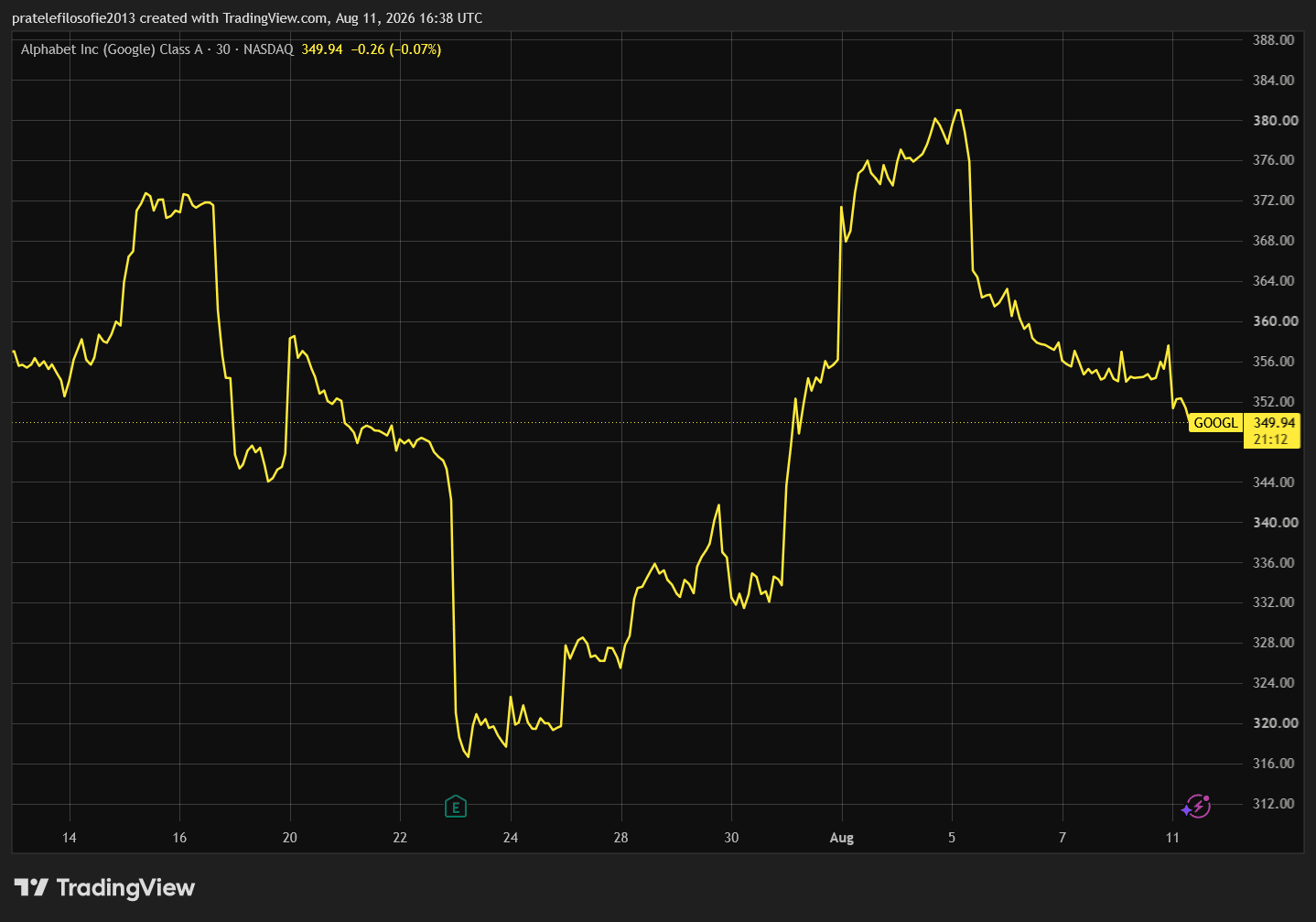
However, prudent investors evaluated this move as a sign of clear recklessness. The search giant's securities immediately ended up in the red after the report was published. Alphabet thus served as a very clear warning to the entire market.
Market participants simply aren't satisfied with just good numbers or marginally beating previous estimates. Results must be absolutely excellent, and the company must also accompany them with strong assurances of future profitability. Crucially, however, this assurance can no longer sound like this:
"We are going to burn even more money on artificial intelligence."
TSMC: When even record profit isn't enough for stock growth
The first company we will focus on in detail is the Taiwanese TSMC. It is crucial to be interested in this world's largest contract chip manufacturer, as it sits right at the second spot of the global production chain. It stands closely behind ASML, which supplies highly specialized lithography machines.
It is on these machines that TSMC produces the most advanced chips for tech leaders like Nvidia, Apple, or AMD. The utilization rate of TSMC's production capacity is therefore one of the best indicators of whether interest in AI is fading.
Similarly, we can accurately estimate from its economic results what phase the entire AI investment cycle is currently in. And the hard numbers for the second quarter certainly do not indicate any cooling of sentiment yet.
TSMC's revenue grew massively year-on-year by 36% to 1.27 trillion TWD, even slightly beating already high analyst expectations. Net profit then jumped by an incredible 77.4% and reached a historic record level of 706.56 billion TWD.
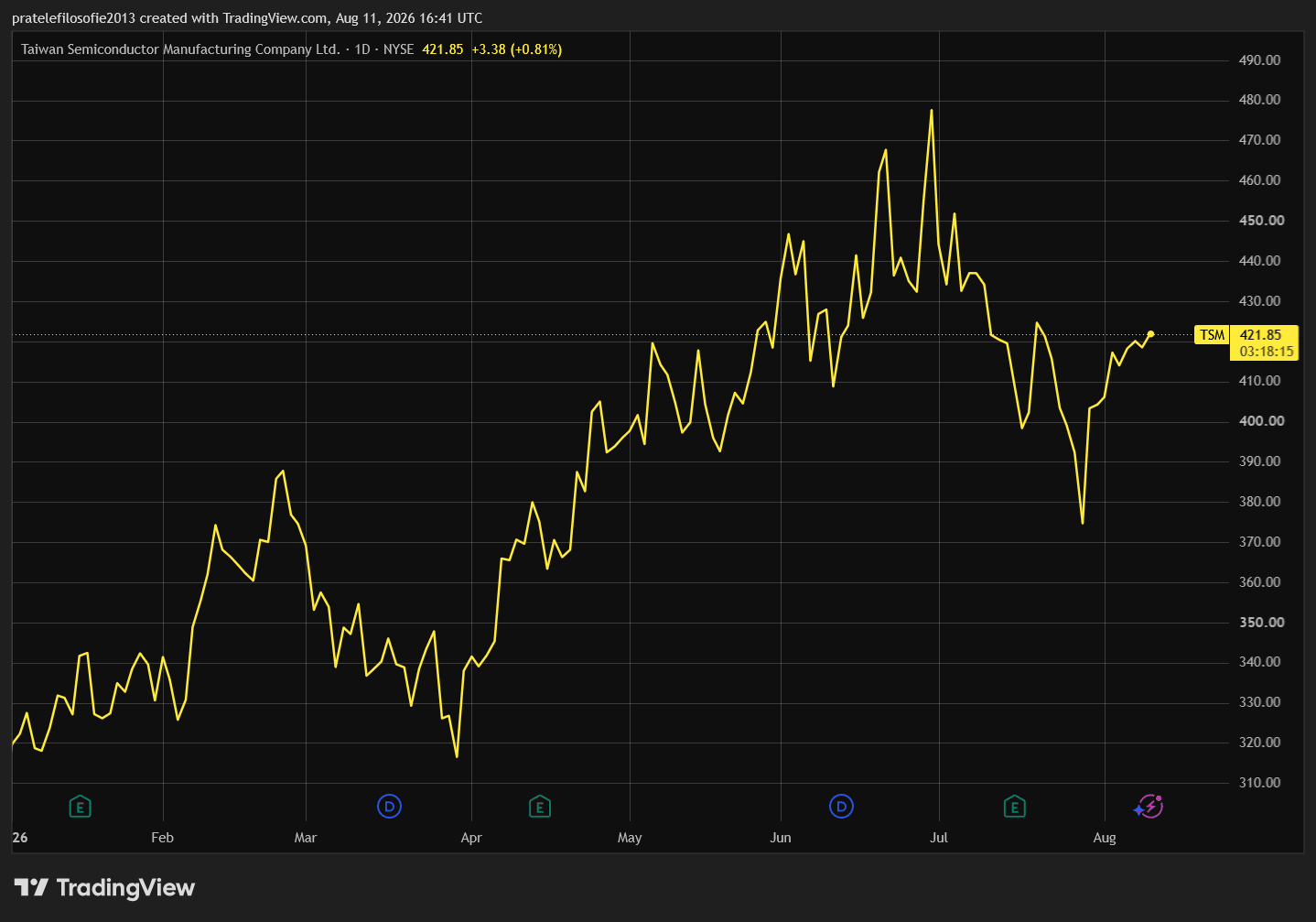
Compared to the immediately preceding quarter, profit increased by another 23.4%. TSMC was thus able to report record net profit for the fifth consecutive quarter. An even more important metric, however, is the revenue structure itself.
Advanced manufacturing processes of seven nanometers and less accounted for an impressive 77% of total wafer revenue. Five-nanometer technology alone represented 33%, and extremely complex three-nanometer technology another 30%. It is in this exclusive segment that the chips powering the current AI boom are manufactured.
Why markets punish higher capital expenditures
Management's outlook for the coming months also remains optimistic. For the third quarter, the company confidently expects revenue between $44.6 and $45.8 billion with a phenomenal operating margin in the range of 56 to 58%. Furthermore, the company improved its full-year 2026 revenue growth estimate from the original "more than 30%" to "more than 40%".
TSMC Chairman C. C. Wei summarized the current market situation very succinctly: demand associated with artificial intelligence remains exceptionally strong. At first glance, it might seem like there's nothing to worry about—capacities are stretched to the limit and profits are growing. However, the problem we defined at the very beginning reappears here.
TSMC management decided to sharply increase this year's capital expenditure plan to $60–$64 billion. In addition, it announced the release of another $100 billion for investments in US factories in Arizona. The total planned investment by the Asian firm on US soil will thus skyrocket to an astronomical $265 billion.
These huge funds are intended primarily for the production of the most modern two-nanometer chips and their advanced packaging. In other words, TSMC is very actively trying to build exactly the type of capacity that US tech giants are constantly demanding.
Nevertheless, analysts began to ask one fundamental question out loud. Will these new US factories ever be able to achieve the same fat margins as the unrivaled production in Taiwan? It was this growing uncertainty that caused TSMC's American Depositary Receipts to weaken by 2.7% in pre-market trading after the results were announced.
When capex became a risk instead of a promise
This warning price drop occurred despite record-breaking profits, beating expert estimates, and an overall increase in the annual outlook. The market's reaction thus illustrated in advance how nervously and uncompromisingly the exchange would behave in the case of Alphabet as well.
The company told major shareholders that demand is much stronger than originally calculated, and therefore it must invest even more. Two years ago, the market would have joyfully accepted this as unequivocally positive news. Today, however, it thinks differently and sees massive expenses and the possible destruction of existing margins behind words of expansion.
TSMC's results thus send us two clear signals:
- The artificial intelligence boom is not yet losing steam, and the investment cycle remains in a phase of massive expansion.
- The market perspective is changing radically. Investors are no longer just interested in how many new hi-tech factories a company puts into operation.
Above all, they want to know if the company can profit from them as efficiently in the long term as it did from the old ones. And that is a significantly more difficult task given the diametrically different labor costs for top engineers in the US.
Microsoft spends on AI differently than the competition
While the uncompromising numbers from Alphabet and TSMC were a clear warning for big players, competitor Microsoft demonstrated the exact opposite. It managed to serve the market the exclusive news everyone craved. During the presentation, it tangibly showed that its massive investments in artificial intelligence are finally starting to generate fat profits.
The most fundamental step was the reassuring statement that, despite the ongoing AI boom, the company will not increase its existing investment plan for the 2026 calendar year. And to that, it added the accounting figures themselves, which were simply excellent.
Quarterly revenue broke the $90 billion mark, representing a respectable 18% year-on-year growth. The company thus comfortably beat analyst estimates, which predicted a value around $87.6 billion. Earnings per share climbed to $4.81 compared to the expected $4.24.
It is fair to admit that the result was partially improved by extraordinary accounting items worth 27 cents per share, including an unrealized gain from a strategic investment in Anthropic. Even after adjusting for these, it is quite clear that operating results were fundamentally strong.
However, the strongest message was sent by the key cloud division, Azure. Its revenue soared by a fantastic 43%, even though market consensus cautiously bet on growth around 40%. The entire umbrella Intelligent Cloud division then swelled by a solid 32%.
Copilot adoption as proof of ROI
For the upcoming quarter, Microsoft looks forward to further accelerating Azure growth to nearly 45%. Here, investors are no longer being sold mere dreams that artificial intelligence will one day fundamentally change the world. Microsoft demonstrates with exact data that AI integration is realistically and rapidly accelerating its core business.
An even more attractive view is offered by the dynamic development around the enterprise assistant Microsoft 365 Copilot. The number of paying users for this breakthrough service is constantly growing—while it was over 20 million in April, by the end of June, the number of paid licenses crossed the 30 million mark.
If we go back six months, approximately 3% of the giant base of more than 450 million Microsoft 365 ecosystem users were paying for Copilot. Now, this share is approaching nearly 7%. Although this is still a fractional percentage in terms of market penetration, the established growth trend is absolutely clear.
It is true that Microsoft is starting to successfully monetize artificial intelligence through two streams. It no longer does so only through the wholesale rental of server computing capacity, but also directly through its premium software. Therein lies its greatest and hard-to-match advantage over the rest of Silicon Valley.
The company doesn't have to painfully search the complex market for someone to sell its latest AI products to. It already has hundreds of millions of creditworthy corporate users in its portfolio. It naturally offers them Copilot as a functional add-on to the software services they realistically work with every day.
Its only challenge remains the need to convince customers that the product is worth an increase in regular monthly expenses. The rapid adoption of paid licenses so far suggests that it is succeeding brilliantly. But the most important fact is that Microsoft certainly hasn't stopped spending aggressively to achieve these results.
Capacity optimization instead of blanket increases
Capital expenditures (Capex) for the past quarter reached $41 billion, and for the entire ending fiscal year, they climbed to roughly $145 billion. Unlike its rivals, however, management did not increase the economic scale of the budgeted investment plan for the 2026 calendar year.
Only a minor accounting adjustment was noted, linked to the internal reclassification of some data center leases, which accounting-wise lowered the Capex estimate from roughly 190 to 175 billion USD. Although it wasn't a real cash saving, the market appreciated that there was no further unexpected increase in existing costs.
More important, however, was the information that developers at Microsoft managed to squeeze significantly more computing power out of the existing hardware infrastructure. Since the beginning of the year, the company has enormously increased network throughput for Copilot, fourfold.
At the same time, it managed to nearly halve the time it previously needed to deploy brand-new GPUs into full operation. This is exactly the type of engineering progress that shareholders are willing to pay handsomely for. The corporation is not just mindlessly building more giant data centers but is intensively trying to maximize the use of the capacities it already owns.
Microsoft stock at highs after results
The market rewarded this operational efficiency with applause. Microsoft securities jumped by 15% after the report was published, experiencing its most profitable trading day since the 2008 financial crisis. The giant's total market capitalization grew by an incredible $450 billion in just a few hours.
This aggressive bullish move also significantly transformed the technical picture of the stock on the charts. The sharp rise left two relatively large price gaps behind on the price curve. While the price may eventually descend to these over time, filling them is never a 100% rule in the market.
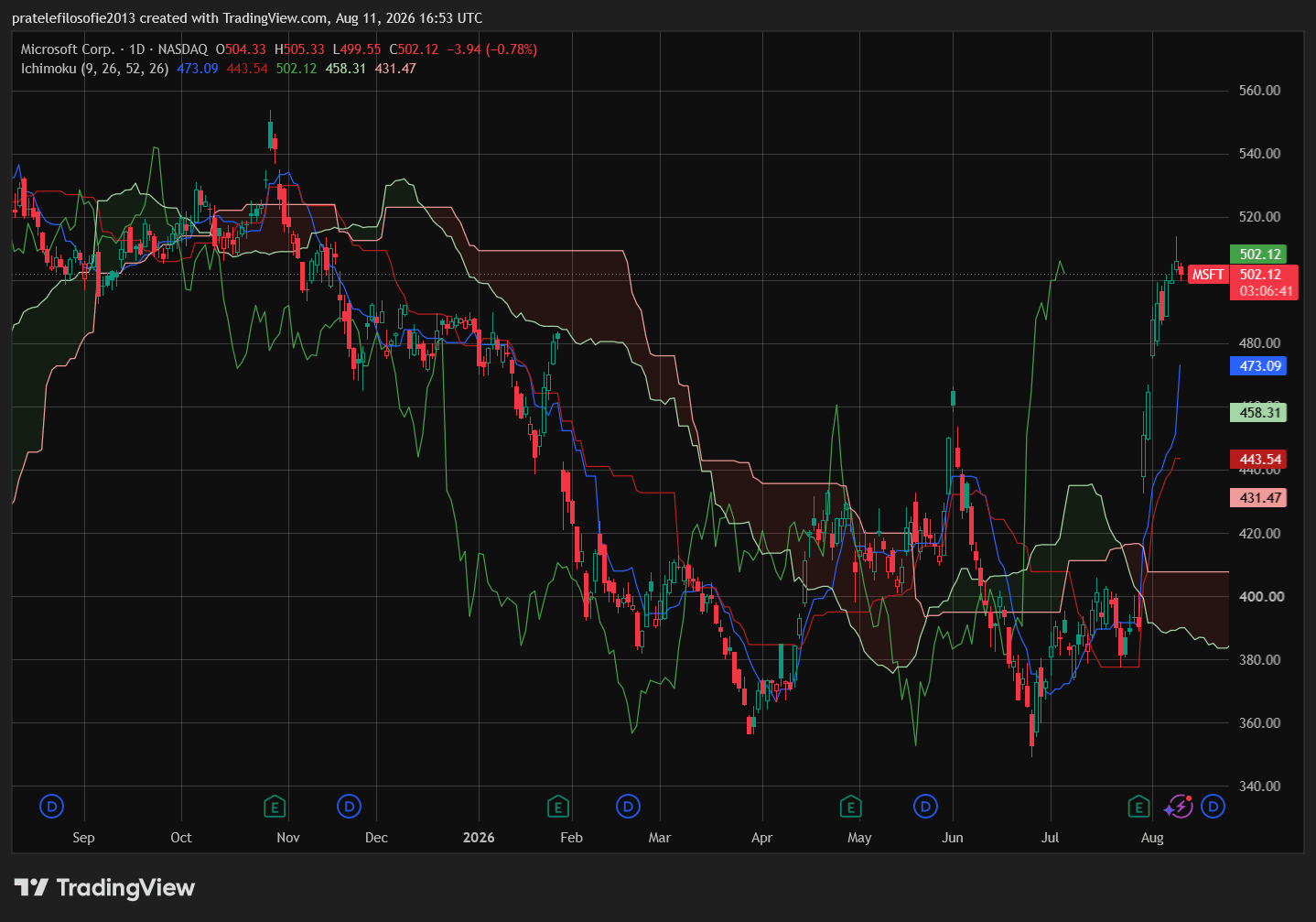
The nearest important technical test for the bulls is now the resistance area moving around $523, which is directly derived from the Ichimoku indicator system. If the market convincingly breaks through this barrier and stays above it, space will open up for a massive attack on new all-time highs.
If, on the other hand, the resistance remains unbroken, the objective risk of a deeper correction will increase significantly. This would open a real path to filling the aforementioned gap, which is located in the wider range of $460 to $472.
All in all, Microsoft management managed to create a clear mental shift in how all of Wall Street views the integration of AI technologies. It showed that investors don't actually mind high Capex—they only mind Capex without visible profitability and sufficient control. Microsoft presented investors with rapid Azure growth, strong Copilot adoption, and tangible savings from optimization, convincingly answering where the real returns from AI lie.
Amazon increased capex by another $20 billion. The market appreciated it this time
Microsoft managed to pass on the created optimism, and it didn't remain alone with its extraordinary success for long. Just a day later, Amazon confidently supported the positive view of artificial intelligence. Its published results also proved that high strategic investments in AI technologies make deep business sense.
The only fixed condition for success with shareholders remains that they must undoubtedly see real customer demand and reliably growing revenue behind the billions spent. Amazon announced total revenue of $200.6 billion for this year's second quarter, representing a great 20% increase.
Regular Wall Street analysts were noticeably more pessimistic, expecting a turnover of "only" $196.5 billion. A reliably positive surprise was also brought by the reported adjusted earnings per share, which reached an excellent level of $1.97 compared to the expected $1.82.
While media attention was grabbed by a fairy-tale net profit of $5.75 per share, this was catapulted to extreme heights exclusively by an unrealized gain from a corporate stake held in the progressive company Anthropic. It was thanks to the accounting revaluation of this startup investment that Amazon could report a paper profit exceeding $53 billion before tax.
This figure, breathtaking at first glance, does not provide an accurate picture of the company's real operating machine. That is hidden exclusively in the internal structure—and especially in the AWS division report.
How fast AWS is growing
Revenue for the Amazon Web Services (AWS) cloud services section reached $42.2 billion and grew by an excellent 37% in a strong year-on-year comparison. This performance comfortably crushed the market's more cautious estimates, which calculated a 31% acceleration.
For the strategically important AWS, this also meant the fastest growth rate since 2021. To add to the good news for bulls, the operating margin of this tech branch shot up to 39%, clearly confirming top-tier scaling capability.
Although AWS currently accounts for only 21% of Amazon's gross revenue in the total pie, it generates a disproportionate 61% of all operating profit for the company. For seasoned investors, it is therefore much more essential to monitor the health of the cloud architecture than to count packages sold and delivered during discount events like Prime Day.
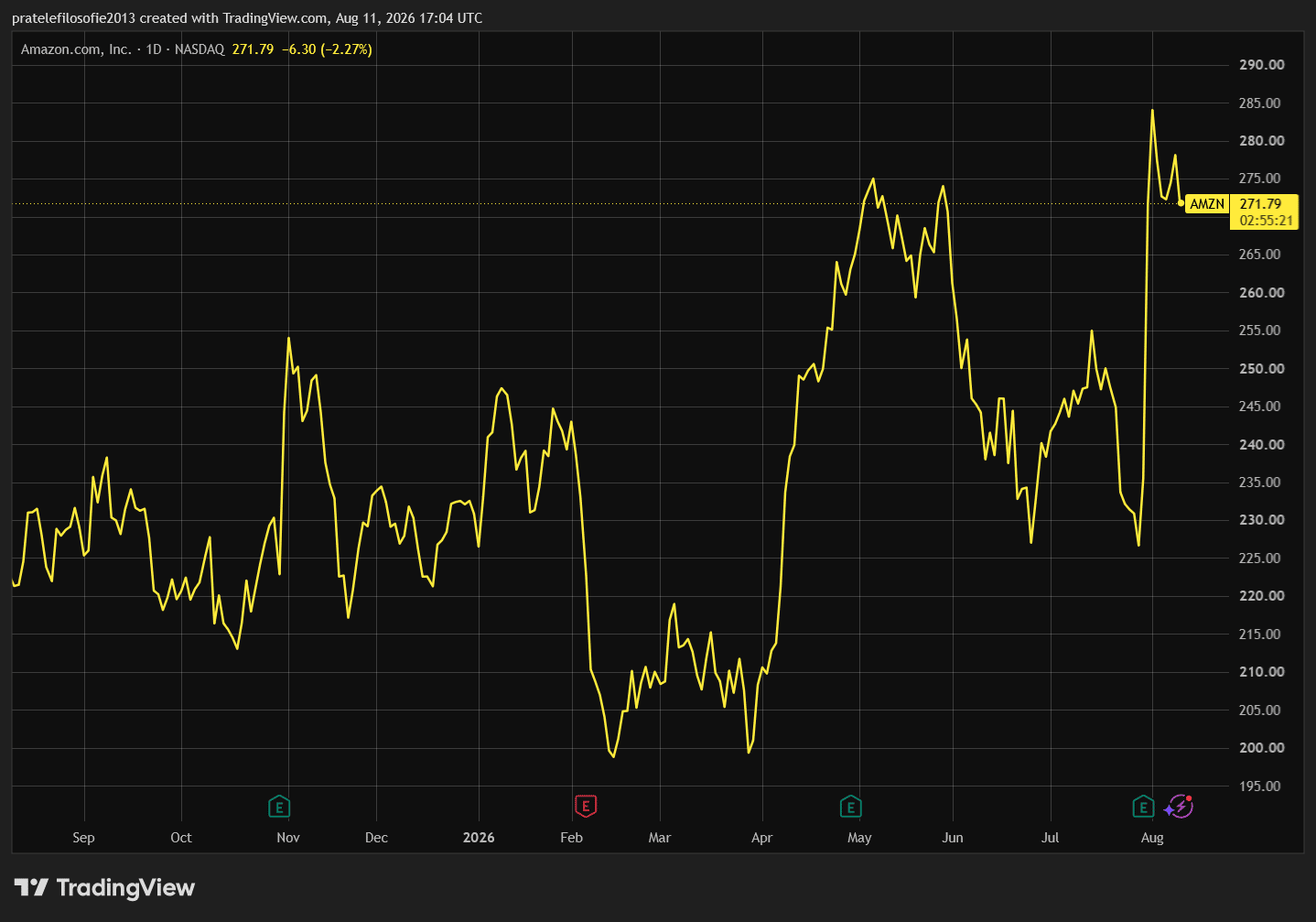
It was this dynamically growing division that unerringly showed that investments in artificial intelligence are starting to pay off handsomely. The company's management is fully aware of this and is therefore confidently intensifying its investment commitment even further.
Regular capital expenditures in the quarter reached $54.2 billion, compared to $32.1 billion at the same time last year. Based on this, the empire's CEO, Andy Jassy, decided on a radical increase in the annual Capex plan from the current 200 billion to a record $220 billion for the coming year (partly driven up by skyrocketing memory chip prices).
Amazon customers are willing to pay more
Under normal economic conditions, news of such frantic spending would undoubtedly scare analysts. After all, tech sibling Alphabet saw a cruel sell-off after announcing a similar move. Amazon, however, crushed fears in pre-market trading and instead strengthened by a luxurious 12%. What is the huge difference in the market's perception?
The secret lies in the statement of the Amazon boss himself. Jassy told investors that even after a massive injection of $220 billion, his company would not have enough physical capacity to fully satisfy the rising demand in 2026. This extreme tension is projected to continue at least into 2027, and the company feels an enormous hunger for capacity from the market looking ahead to 2028.
The huge excess demand is evidenced especially by contracted orders. The volume of closed contracts for AWS, which haven't even figured in official annual revenue yet, climbed to a staggering $496 billion. Solid market demand is clearly growing significantly faster than Amazon can currently secure its own hardware space for its clients.
Furthermore, the e-commerce and cloud giant significantly increased prices for renting its dedicated AI servers twice this year due to its strong bargaining position. Here lies the golden nugget of the news. Amazon simply isn't sinking billions out of panic or fear of competition, but because it has crowds of customers waiting who are ready to purchase new technologies immediately, even with a higher price tag.
The AI Bill: Negative cash flow and rising debt
However, this doesn't mean these plans for gigantic expansion don't have downsides and risks. Quarterly capital expenditures exceeded the generated operating cash flow by a painful $8.8 billion. This affected corporate finances such that Amazon had to report negative free cash flow for the second consecutive quarter.
From a trailing twelve-month perspective, negative cash flow amounted to $7.6 billion, even though just last year the company was comfortably in the black with a value of $18.2 billion. The giant must therefore replace the missing free cash to a large extent with massive debt. During the first half of the year, for example, it sharply increased its long-term debt burden by a full $63 billion.
And to top it off, this sum doesn't even include the July bond issue valued at an additional 25 billion. Overall, current interest costs represent a rather negligible 0.7% relative to revenue, but their nominal value is growing dynamically. In the final tally, the bill for a ticket in the global race for AI dominance was certainly not cheap.
Moreover, even the carefully guarded corporate outlook for the next quarter showed a small crack. Amazon expects autumn revenue between $197 and $202 billion, while professional estimates relied on a value closer to $204.1 billion. It should be noted, however, that management plausibly explained the weaker numbers by the internal shift of the massive Prime Day sale from July back to June. A good number of sales were thus already counted in the completed spring quarter.
AI enters a period where it must prove ROI
So, what fundamental things has the current earnings season for the second half of the year fully confirmed? By far the most visible fact is the finding that the tense investment boom circling around artificial intelligence is not stopping in the slightest and is certainly not approaching a precipice.
Chipmaker TSMC's production capacities remain permanently stretched to the extreme. The Azure cloud corporate environment showed 43% year-on-year acceleration, and the directly competing AWS system boasted impressive 37% growth. Looking for any real cooling of tech demand in the published charts today is pointless.
But the calculus of key large investors has changed—and very drastically. Neither banks nor private funds are applauding just for the promise that a corporation will release money for AI business. In today's harsh reality, they demand a tangible presentation in which they hear exactly when and in what volumes the tens of billions spent will turn into free profit.
Microsoft passed this test with flying colors, showing fantastic dynamics in the adoption of corporate Copilot with the bonus of smarter and significantly more efficient use of older data centers. Close behind emerged a nearly identical business success from Amazon, which is, however, burdened by a riskier model with negative free cash flow and rapidly rising debt.
From a quick read of the stock terminal monitor, the immediate panic reactions of many investors might have seemed irrational to some. Alphabet, along with TSMC, paid dearly for massive investments in the eyes of the market with a drop in stock prices, while Amazon, enriched by the same move, shot up by incredible percentages.
However, the hidden logic of the exchange is cruelly pragmatic and clear. Investment companies don't mind high developer costs at all—they require confirmed profitable margins, a critical shortage of free space in the server room, and a long line of wealthy companies willing to pay a higher subscription from one minute to the next.
When capacity meets demand
Market Armageddon thus threatens the entire software universe only when the curve of massively produced computing capacity finally meets the highly strained level of corporate demand. That will be the moment when providers like Amazon or Microsoft will no longer be able to raise prices for customers indefinitely and aggressively.
The utilization ratio of newly built data bases will then painfully decrease, but the billion-dollar write-offs from technology, debt interest, and personnel costs will remain unchanged at a high level. Investment Capex, which today keeps technological progress on its feet and evokes global wonder among brokers, will suddenly turn into toxic, consuming ballast.
This year's Q2 closing season certainly didn't drag the euphoria surrounding neural networks to its doom; on the contrary, it rather poured blood into its veins. But the most essential point is indisputable—reckless spending had its limits. The grace period has definitely ended, and the entire AI industry has uncompromisingly stepped into the raw era of hard economic proof.
I first became interested in investing in 2013, when I bought my first stocks. Through my studies of philosophy, I gradually became interested in political questions. This interest in political developments eventually led me to a deeper understanding of what is happening in financial markets. I have published my reflections in various Czech media outlets (Euro, Česká pozice, Ekonom, Hospodářské noviny, Novinky) as well as in international publications. Understanding the world of finance and being able to interpret it is today essential not only for understanding the financial system itself, but also the world around us. Connecting events and analyzing developments from multiple perspectives is my passion. In my free time, I focus on popularizing philosophy on the YouTube