


Google Gemini is one of the most important artificial intelligence systems in the world today. But the name refers to much more than a chatbot competing with ChatGPT. Gemini is the name of Google’s family of advanced AI models, its consumer-facing AI assistant, and an increasingly broad AI layer integrated across Search, Android, Workspace, Google Cloud and other services.
Today’s Gemini is the result of years of research at Google and DeepMind. Its history runs through technologies such as the Transformer architecture, LaMDA, PaLM and the original Bard chatbot.
What began as an experimental service in 2023 has evolved into one of Google’s most strategically important products.
So what exactly is Gemini, how does it work, how has it developed and why is it so important to Google’s future?
What Is Google Gemini?
Gemini is the name given to a family of multimodal artificial intelligence models developed by Google DeepMind.
The models can work with text, images, audio, video and computer code. Depending on the specific version, they can also use external tools or complete complex, multi-step tasks.
For most users, Gemini is primarily an AI assistant available through web and mobile applications.
It can be used to explain complex topics, write and edit text, analyze documents, program, work with images and conduct online research.
It is important, however, to distinguish between the Gemini application and the underlying models.
The Gemini app is the product users interact with, while the individual Gemini models are the technology running behind it.
Google also integrates these models into many of its other products, including Google Search, Gmail, Docs, Android and Google Cloud.
Google’s AI History Began Long Before Gemini
Google had been working on artificial intelligence for years before either ChatGPT or Gemini existed.
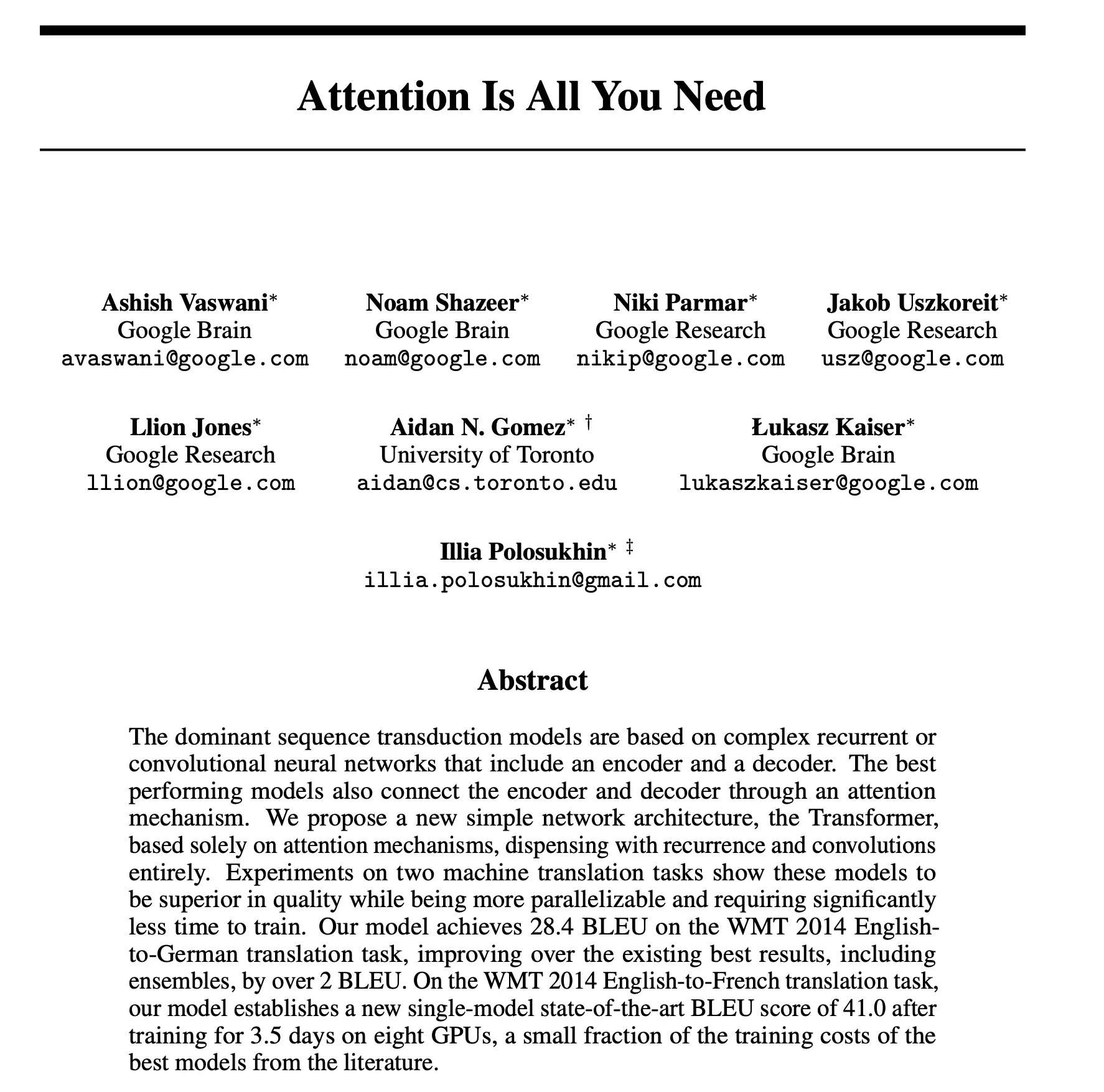
One of the most important milestones came in 2017, when Google researchers published the paper Attention Is All You Need.
The paper introduced the Transformer architecture, which fundamentally changed natural language processing and later became the foundation of a large share of modern language models.
Google subsequently developed systems such as LaMDA and PaLM.
At the same time, DeepMind was working on advanced AI of its own. Google had acquired the company in 2014, and it later became widely known for projects such as AlphaGo and AlphaFold.
In April 2023, Google merged the Brain team from Google Research with DeepMind to create a new organization called Google DeepMind.
This became the home of the new generation of Gemini models.
Bard Was the Predecessor to Today’s Gemini
The direct predecessor to the Gemini app was Google Bard.
Google announced Bard in February 2023, just a few months after the explosive rise of ChatGPT.
Its first version was powered by LaMDA, and Google presented it as an experimental conversational AI service connected to information from the web.
Public testing began in March 2023.
Only a few months later, Bard moved to the more powerful PaLM 2 model and gained new capabilities in areas such as programming, mathematics and image processing.
But Bard was only the beginning.
Behind the scenes, Google was preparing a much broader AI platform.
The Birth of Gemini
Google first publicly introduced the Gemini project at Google I/O in May 2023.
From the beginning, it was designed as a natively multimodal system.
Rather than building an AI focused primarily on text, Google wanted a model that could work naturally across different types of information.
The first generation, Gemini 1.0, launched in December 2023.
Google divided it into three versions: Ultra, Pro and Nano.
The most powerful variant was designed for complex tasks, while Gemini Nano could run directly on certain mobile devices.
Gemini Pro was also integrated into Bard.
Bard Becomes Gemini
The definitive transition came in February 2024, when Google renamed Bard to Gemini.
At the same time, it launched the paid Gemini Advanced service and began developing a mobile app designed to gradually take over some of the functions of the traditional Google Assistant.
This was more than a rebranding exercise.
Google began bringing its most advanced AI models, its consumer app and a growing number of AI services under the Gemini name.
Shortly afterward, it introduced Gemini 1.5 Pro, which featured a dramatically larger context window.
This allowed the model to process extensive documents, source code and video within a single request.
The faster Gemini 1.5 Flash followed soon after.
Gemini Is Evolving Into an AI Agent
With the Gemini 2.0 generation, Google increasingly shifted its attention from traditional chatbots toward AI agents.
The difference is significant.
A chatbot mainly responds to questions.
An AI agent can receive a goal, break it into several steps, search for the necessary information, use external tools and then complete the task.
The ability of AI not only to generate answers but also to take action has become one of the central directions of Gemini’s development.
Later generations also placed greater emphasis on advanced reasoning.
Instead of immediately generating a response, a model can devote additional computing resources to working through the problem itself.
This is particularly useful for mathematics, programming and more complex analytical tasks.
Gemini Is Not a Single Model
Gemini is no longer one specific language model.
It is an entire family of AI systems.
Google offers more powerful models for difficult tasks as well as faster variants optimized for lower cost and latency.
There are also specialized models and technologies for voice, multimedia generation and AI agents.
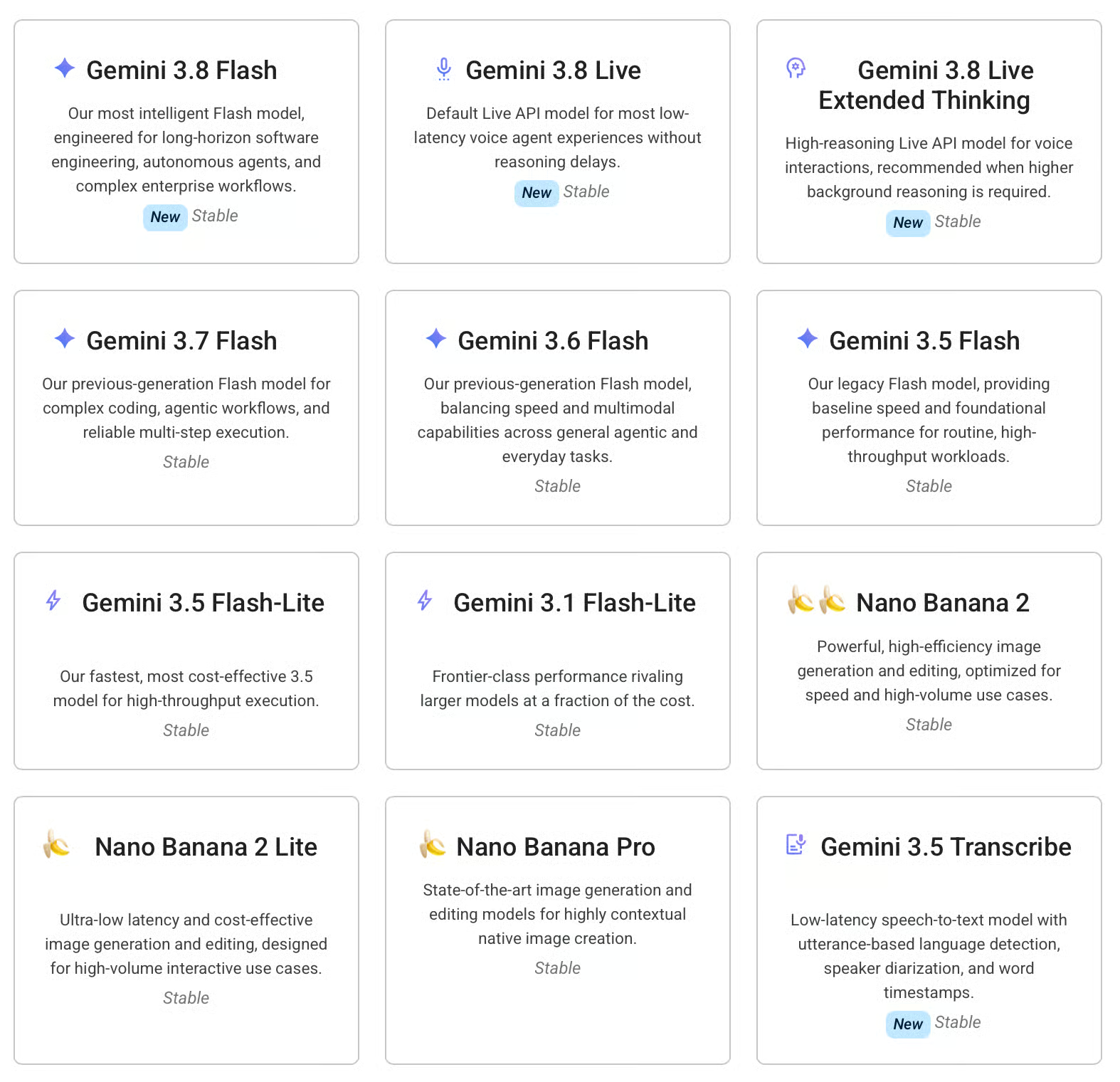
Development moves extremely quickly, meaning model names and availability change regularly.
For ordinary users, it often does not matter which specific model is running in the background.
Developers, however, can choose between models based on performance, speed, cost and context-window size.
How Does Gemini Work?
At a basic level, Gemini works in a similar way to other modern large language models.
During training, the model learns patterns and relationships from enormous amounts of data.
When a user enters a prompt, Gemini generates a response based on those learned relationships.
Multimodality is a major part of the system.
Gemini does not have to work only with text.
It can analyze images, audio, video and source code while combining information across different formats.
More advanced versions also include reasoning capabilities and tool use.
The model can search the web, work with files, access Google services and interact with other applications.
Modern Gemini is therefore best understood as a combination of an AI model, external tools and agent-based capabilities.
Gemini and Google Search
One of the most important uses of Gemini is inside Google Search itself.
Google built a large part of its business around search and digital advertising.
Generative AI therefore represents both a major opportunity and a potential challenge for the company.
Gemini is increasingly integrated into AI features within Google Search.
Instead of simply returning a list of links, the search engine can answer some questions directly, summarize information and display interactive elements.
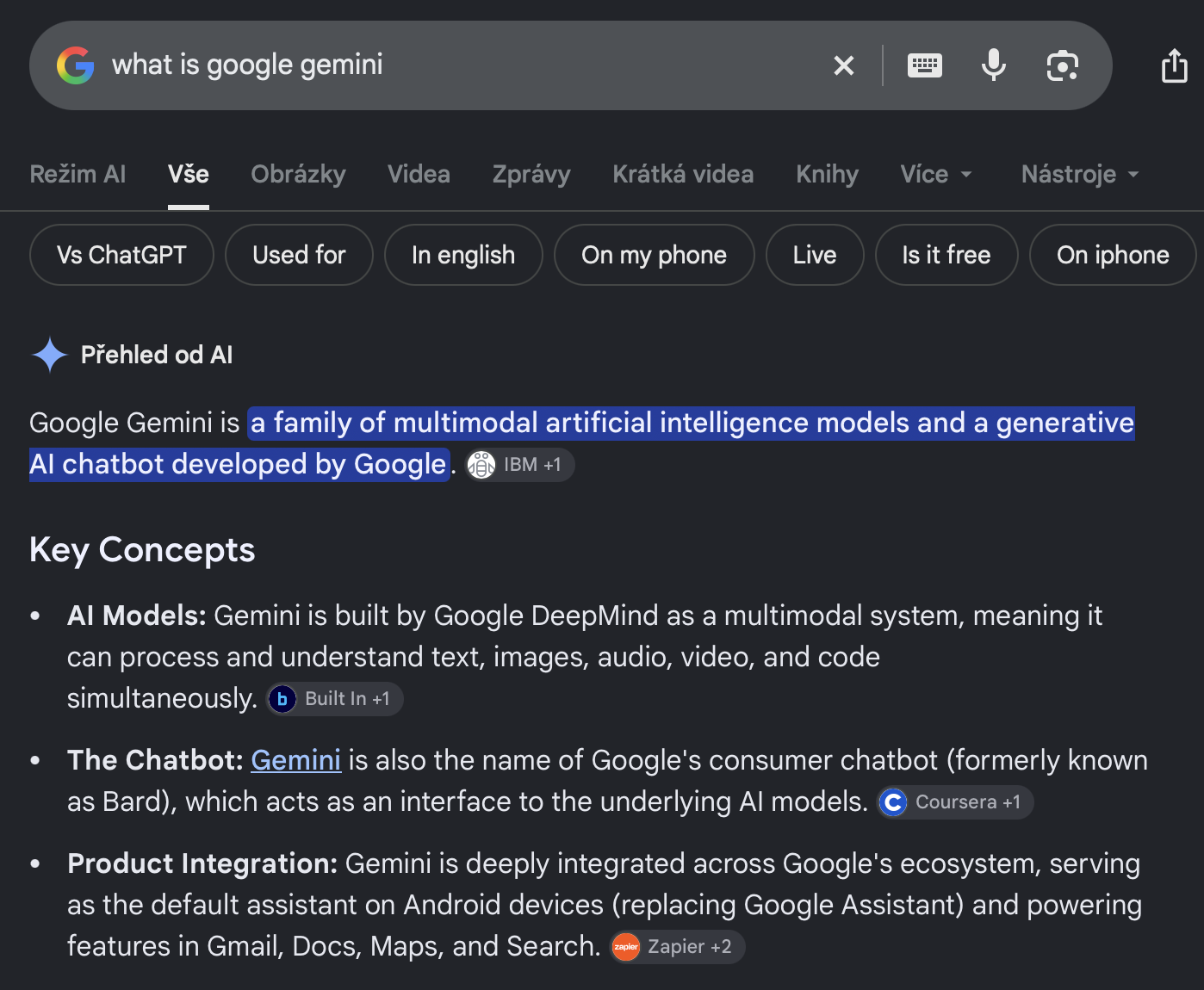
This is strategically important for Google.
The company does not have to distribute its AI only through a standalone application.
It can integrate Gemini directly into services already used by billions of people.
Why Is Gemini So Important to Google?
Gemini is much more than another chatbot.
Generative AI is changing the way people search for information, create content, work with documents and use software.
That touches almost every major part of Google’s business.
The company also has several significant advantages.
It operates its own cloud infrastructure, develops its own TPU accelerators, and controls products such as Google Search, Android, YouTube, Gmail, Workspace and Google Cloud.
If Google can integrate Gemini effectively across this ecosystem, it does not need to compete only for users of a standalone AI application.
It can bring artificial intelligence directly into the products people already use every day.
Distribution may therefore become one of Google’s biggest competitive advantages.
Gemini vs. ChatGPT
Gemini is most commonly compared with OpenAI’s ChatGPT.
Both systems can be used for conversations, document analysis, programming, content creation, image-related tasks and online research.
Their broader strategies, however, are different.
OpenAI built ChatGPT as a standalone AI product and has gradually developed a wider ecosystem around it.
Google, by contrast, is integrating Gemini across a vast portfolio of existing services.
For Gemini, its connection to Google Search, Android, Workspace and YouTube may therefore be especially important.
Other major competitors include Anthropic’s Claude and xAI’s Grok.
Model performance changes so quickly, however, that declaring one system the long-term “best” can become outdated very quickly.
In practice, the more useful approach is to choose a tool based on the specific task.
Gemini Is Not Infallible
Like other generative AI systems, Gemini can produce incorrect or misleading information.
This problem is commonly referred to as an AI hallucination.
A model may generate an answer that sounds highly convincing while still being factually wrong.
Important information should therefore be checked against original sources, particularly in fields such as finance, healthcare, law or other areas where mistakes can have serious consequences.
One well-known example came in 2024, when Google temporarily paused Gemini’s ability to generate images of people after the system produced controversial and historically inaccurate results.
The development of more capable AI models is therefore not only about improving performance.
Reliability and safety are equally important.
What Is the Future of Gemini?
The development from Bard to modern Gemini illustrates just how quickly generative AI is changing.
In 2023, Bard was primarily a chatbot: users entered a question and received a text response.
Modern Gemini can work with text, images, video and audio, write code, conduct research, use external tools and increasingly operate as an agent.
AI agents, multimodality and integration into everyday software are likely to remain central to the next stage of development.
Google also controls one of the largest distribution networks in the technology industry.
If it continues expanding Gemini across its services, using AI could increasingly become a normal part of interacting with the internet without users ever needing to open a dedicated chatbot.
Gemini is therefore no longer simply Google’s answer to ChatGPT.
It is gradually becoming one of the core technology platforms on which Google plans to build the next generation of its products.
