US Authorities Investigate Tesla Over Autonomous Cybercab
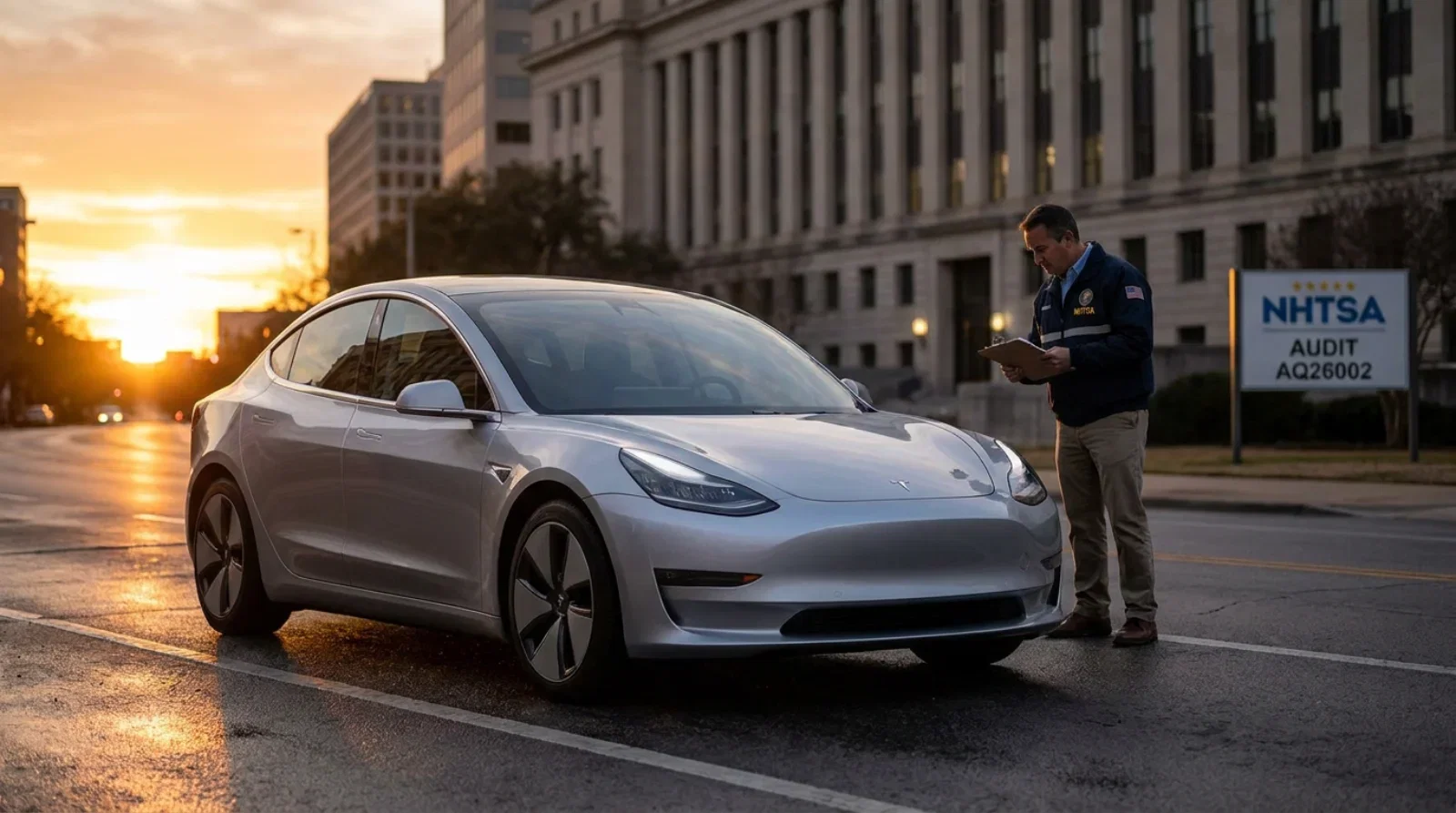
Tesla is facing an investigation by the US NHTSA regarding its autonomous Cybercab. The regulator is examining how the vehicle, which lacks a steering wheel and pedals, meets safety standards and whether its operation in Austin is legal.
Tesla Cybercab Under Regulatory Scrutiny: Revolution Hits Official Rules
Tesla has officially launched commercial operations of its groundbreaking autonomous vehicle, the Cybercab, in Austin, Texas. However, the joy over this technological milestone was short-lived. Just a day later, the US federal regulator began an intensive inquiry into the new vehicle, which could have a significant impact on the future expansion of this service.
The National Highway Traffic Safety Administration (NHTSA) has opened an audit investigation designated as AQ26002. This process specifically focuses on how Tesla verified and documented compliance with federal safety standards for a vehicle that completely defies established conventions.
A Car Without a Steering Wheel and Pedals
The Cybercab represents a significant departure from the design of conventional passenger cars for both the automotive industry and legislation. The vehicle's construction reflects a vision of a fully autonomous future:
- Absence of controls: The two-seater vehicle is not equipped with a traditional steering wheel, brake pedal, or accelerator.
- Missing mirrors: The vehicle lacks conventional rearview mirrors, which are replaced by a camera system.
- Passenger-oriented interior: The entire interior space is designed exclusively for the crew, who have no way to physically intervene in the driving.
This radical design is precisely the main point of contention. Current US safety rules still rely in many respects on the presence of a human driver and their physical access to vehicle controls.
Dispute Over Self-Certification and Safety Standards
The USA operates under a system of so-called self-certification, where manufacturers themselves guarantee that their products comply with Federal Motor Vehicle Safety Standards (FMVSS). Tesla officially notified the NHTSA that the Cybercab meets all these requirements. However, the regulator has doubts.
As part of the audit, the NHTSA is now requesting that Tesla provide specific technical data and procedures upon which its claims are based. Investigators will determine whether the automaker interpreted certain safety requirements in its own way or labeled them as inapplicable precisely because of the machine's unique autonomous nature.
The NHTSA is examining whether a vehicle without a steering wheel can be considered safe according to standards that were created at a time when the presence of a driver was the only option.
Parallel with Zoox
Tesla is not the first to encounter this problem. A very similar situation was faced by Zoox, which developed its own robotaxi without traditional control elements.
- 2022: Zoox performed a self-certification of its technology.
- Follow-up audit: The NHTSA immediately launched an investigation and requested additional technical documentation.
- July 2026: Only after years of processes did the company obtain the necessary federal exemption for full operation.
Will This Slow Down Musk's Plan to Dominate Transportation?
Elon Musk has ambitious plans for Cybercabs, but regulation could significantly slow down his vision. Although the NHTSA is currently working on modernizing rules for autonomous vehicles so as not to unnecessarily hinder innovation, the process is slow. Until new legislation comes into effect, Tesla must strictly adhere to existing standards or go through the complex process of applying for exemptions.
According to reports from Reuters, the current investigation concerns approximately 1,000 Cybercab vehicles. However, this is just the beginning, as Tesla plans a massive scaling of production and a gradual expansion of its robotaxi service to other cities.
The current investigation does not automatically mean that the Cybercab is breaking the law. However, it clearly illustrates a situation where technology is evolving disproportionately faster than the legislative framework intended to regulate it.
Frequently Asked Questions
Why is the NHTSA investigating the Tesla Cybercab?▼
Can the Cybercab drive without a steering wheel?▼

I got into cryptocurrencies at the end of 2020 and quickly became a Bitcoin maximalist. I’m interested in what’s happening in the financial markets, and in my free time I travel around Southeast Asia. At KryptoMagazine, I’m in charge of news and video content.