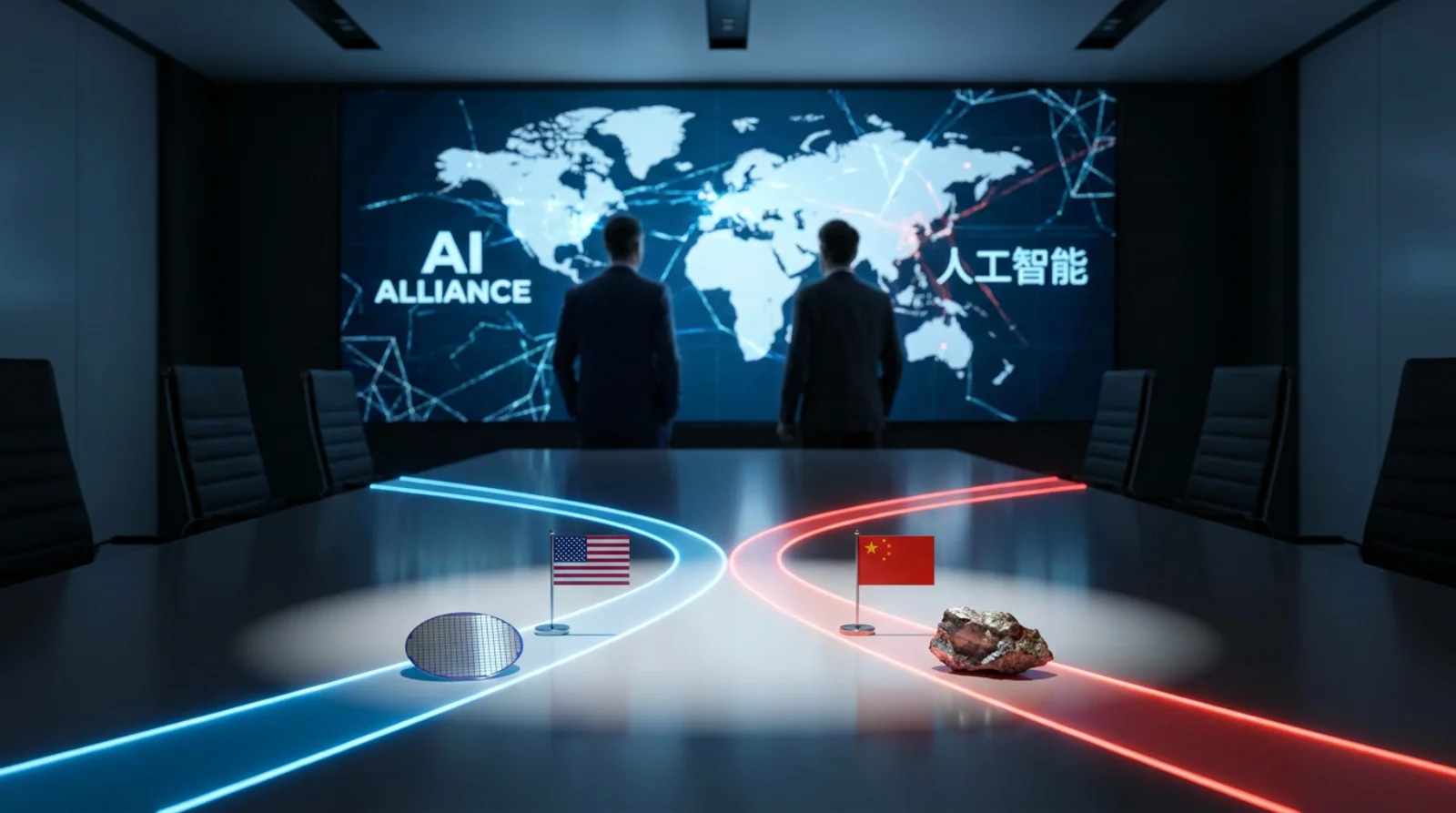
US Pressures Allies to Choose Between America and China in AI Race
The US is intensifying the tech war. The new Pax Silica initiative aims to force allies to choose between American and Chinese ecosystems for AI, chips, and critical raw materials. Read about the growing tension between the superpowers.
US Intensifies Tech Rivalry: AI Cooperation May Mean a Stop for Chinese Projects
The United States plans to significantly tighten rules for international cooperation in the field of artificial intelligence (AI). According to a leaked draft letter from the US State Department obtained by Reuters, Washington is sending a clear signal to its partners: if you want to be part of the American technological ecosystem, you cannot simultaneously figure in competing structures led by China.
This move confirms that the global rivalry for AI supremacy has long since ceased to be just about the software models themselves. Increasingly, the battle is being fought over hardware, energy resources, and control over critical raw materials.
Pax Silica: An American Shield for Tech Supply Chains
The letter is intended for the 35 signatories of the AI Opportunity Statement from June of this year. This document is closely linked to the broader American initiative Pax Silica. The goal of this initiative is to create a robust and secure supply chain, which is absolutely crucial for the development and operation of artificial intelligence.
According to the United States' vision, a secure ecosystem must cover these strategic areas:
- Mining and processing of strategic raw materials: Securing materials essential for the production of modern electronics.
- Energy and Semiconductors: Stable energy sources for data centers and self-sufficiency in chip manufacturing.
- Infrastructure: Building high-capacity data centers.
- Software development: The actual training and operation of advanced AI models.
The US State Department openly identifies Pax Silica as its priority tool for ensuring security in the technology sector.
The Pax Silica initiative was established in 2025. Its members include key allies such as Japan, South Korea, and Australia, as well as strategic partners like Kazakhstan. In June 2024, the European Commission also joined the initiative.
End of Two-Sided Diplomacy?
The main point of the forthcoming letter is the demand for exclusivity. Washington is bothered by situations where countries try to benefit from both camps. An example is Kazakhstan—a country with vast reserves of critical minerals, which is the only known country to have joined both the American initiative and the emerging Chinese block.
The United States emphasizes that this is not a formality, but a deep economic and security interconnection. Pax Silica aims to:
- Implement joint massive investments in technology.
- Connecting research and development capacities.
- Build the energy infrastructure necessary for AI.
- Reduce the critical dependency on China, which currently dominates the market for many strategic minerals.
Involvement in the American ecosystem is meant to represent a real commitment, not an option to simultaneously cooperate with all rival blocks.
China's Response: World Artificial Intelligence Cooperation Organization
Beijing is not lagging behind and is actively building its own alternative. In July 2024, Chinese President Xi Jinping announced the creation of the World Artificial Intelligence Cooperation Organization. China presents it as an open platform for global AI governance, thereby seeking to gain influence particularly among developing countries.
The battle is also intensifying at the technical level. Chinese developers are beginning to rapidly close the technological gap with the US. A major topic is Chinese open-weight models, which are becoming affordable competition for the closed systems of American giants like OpenAI or Anthropic.
Furthermore, China is betting on "tech diplomacy":
- It offers 5,000 training positions for experts from developing countries over the next five years.
- It criticizes the American approach as the "politicization of trade," which, according to Beijing, hinders global progress.
The Future: Two Separate Worlds?
If Washington truly pushes through its new conditions, it could mean a definitive split of the technological world into two incompatible blocks. States will have to decide which standard they will align with.
In this geopolitical match, it is no longer just code and algorithms that decide, but primarily the ability to control the physical world—from lithium mines in Africa and Asia to the giant transformers powering servers in Nevada or Shanghai. The AI race is thus definitively turning into an uncompromising battle for global dominance.
Frequently Asked Questions
What is the Pax Silica initiative?▼
Why does the US demand partner exclusivity?▼
How is China reacting to these steps?▼

I got into cryptocurrencies at the end of 2020 and quickly became a Bitcoin maximalist. I’m interested in what’s happening in the financial markets, and in my free time I travel around Southeast Asia. At KryptoMagazine, I’m in charge of news and video content.