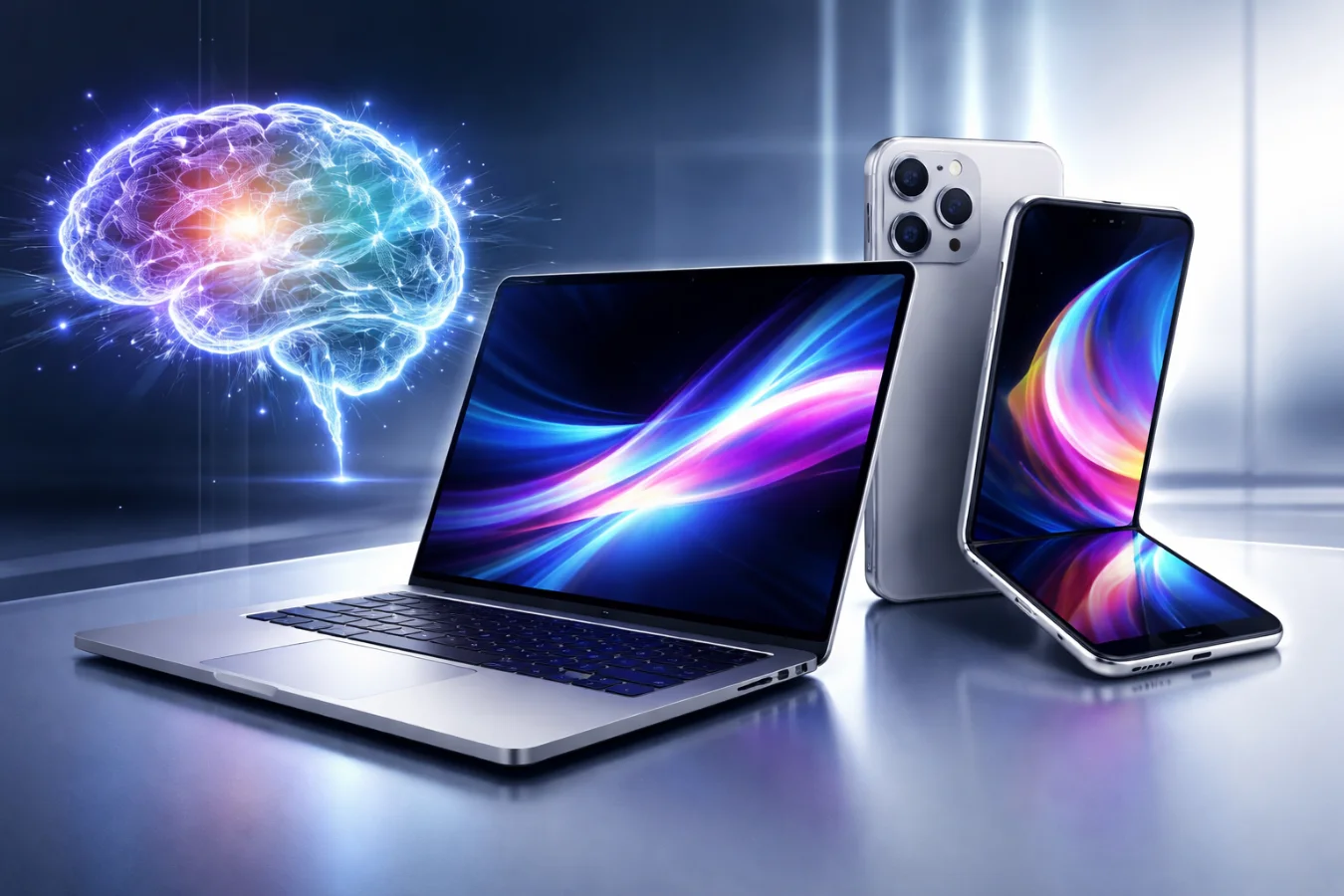
Apple 2026: Budget MacBook, iPhone 17e, Siri with a Brain, and a Foldable iPhone
It is February 2026, and Apple stands on the threshold of its most significant transformation in a decade. While the base M5 chips have been powering the first devices for several months, the main event is yet to come. According to supply chain analysis, the company is preparing to aggressively attack Chromebooks, revive Siri with generative AI, and finally enter the foldable phone era this fall.
Key Takeaways
- Silicon reality: The base M5 has been here since fall, but March brings the revolutionary M5 Pro/Max with 3D stacking (SoIC).
- Price war: iPhone 17e and the new "budget" MacBook aim to dominate schools and corporations.
- Siri 2.0: The spring iOS 26.4 update brings an assistant that understands screen context.
- Ultra-Premium: The second half of the year promises a foldable iPhone priced over $2,000.
If you think Apple has "merely" been fine-tuning details in recent years, 2026 will prove you wrong. Mark Gurman and other analysts speak of a "new era" defined by three pillars: the maturity of generative AI, advances in chip lithography, and the unification of software under the "Liquid Glass" visual language.
Silicon Renaissance: Why Were M5 Pro and Max Delayed?
Let's set the record straight. The base M5 chips quietly appeared in October 2025. They power the base 14-inch MacBook Pro and the latest iPads, delivering a solid performance boost for AI.
The real "drama," however, concerns the higher-tier M5 Pro and M5 Max, expected this spring. Apple hit the physical limits of cooling with these chips, forcing a radical architectural change. While the base M5 is a classic monolith, the upcoming high-performance versions will use SoIC (System on Integrated Chip) technology.
This 3D component stacking process (often called "chiplets on steroids") enables vertical stacking of memory and logic, dramatically reducing energy leakage. The result should be a MacBook Pro that sustains peak performance for tens of minutes longer than the M4 generation without melting down.
Attacking the Mid-Range: iPhone 17e
Apple realizes it's missing out on the price-sensitive market. The answer is the iPhone 17e. Forget about recycling old chips. The 17e gets the latest A19 processor (manufactured on TSMC's 3nm N3P process), 8 GB RAM (necessary for running AI models), and MagSafe for the first time.
At $599 with flagship-level performance, Apple creates a lethal combination against mid-range Androids. The following table shows how aggressive this shift is:
| Specification | iPhone 16e (Previous) | iPhone 17e (New Generation) | iPhone 17 (Standard) |
|---|---|---|---|
| Processor | A18 Chip | A19 Chip | A19 Chip |
| RAM (for AI) | 8 GB | 8 GB | 8 GB |
| Display | 6.1" OLED (Notch) | 6.1" OLED (Dynamic Island) | 6.3" ProMotion |
| Connectivity | C1 Modem (5G) | C1X Modem, N1 Chip (Wi-Fi 7) | C2 Modem, N1 Chip |
| Price (from) | $599 | $599 | $799 |
The Secret Weapon: "MacBook for Students"
An even bigger disruption could come from the rumored "Low-cost MacBook." The goal? Break the dominance of Chromebooks.
- Heart: A-series chip (from iPhones), not M-series.
- Price: $699–$799.
With this move, Apple leverages the massive manufacturing capacity for iPhone chips to create a notebook with all-day battery life and full macOS for schools and businesses.
Siri Finally Gets a Brain
Spring 2026 brings iOS 26.4 and the end of "dumb" Siri. Thanks to the transition to a large language model (LLM) architecture, the assistant gains an "Onscreen Awareness" feature.
Imagine looking at a photo and saying: "Send this to that group from yesterday." Siri understands what's on the screen, finds the context in your messages, and sends the photo. For more complex queries about "world knowledge," Apple leverages its partnership with Google Gemini, while private data is processed securely through its own Private Cloud Compute.
The Foldable Future and "Ultra-Premium"
While the beginning of the year belongs to efficiency, the end of 2026 brings luxury. The long-awaited iPhone Fold (book-style) aims to redefine price ceilings. Using the ultra-modern 2nm A20 chip (which TSMC is just ramping up), it will be a technological demonstration of power.
| Product | Device Format | Display Size | Chipset (Lithography) | Estimated Price |
|---|---|---|---|---|
| iPhone Fold | Foldable (book-style) | 7.6"–7.8" OLED | A20 (2nm) | $2,000 – $2,500 |
| iPhone 18 Pro | Flagship | 6.3" / 6.9" | A20 (2nm) | $1,099+ |
| MacBook Pro (M6) | OLED / Touch | 14" / 16" | M6 (2nm) | $2,499+ |
| Foldable iPad/Mac | Hybrid large foldable | 18.8" OLED | M6 / A20 | $3,000+ |
Conclusion: The End of Fragmentation
2026 shows an Apple that has stopped playing it safe. The strategy is clear: base chips (M5/A19) are already out or coming to cover the mass market, while the technological cutting edge (SoIC for M5 Pro/Max and 2nm for A20) will push the boundaries of what's possible in the premium segment. If Apple manages to overcome the manufacturing challenges at TSMC, we're in for a year when the Apple ecosystem becomes more closed but also more capable than ever.
Frequently Asked Questions
Should I buy a MacBook with the M5 chip now, or wait for the Pro/Max versions?▼
What's the "catch" with the iPhone 17e? Why does it have the latest chip if it's budget?▼
Will the "budget" MacBook with an iPhone chip (A-series) be enough for work?▼
Should I worry about privacy now that Siri works with Google?▼
When will I be able to buy a foldable iPhone, and is it worth waiting for?▼

Cryptocurrency and new technology enthusiast. Loves the Apple ecosystem and things that actually work. Studied at the Technical University of Ostrava and currently works as an editor in Prague.