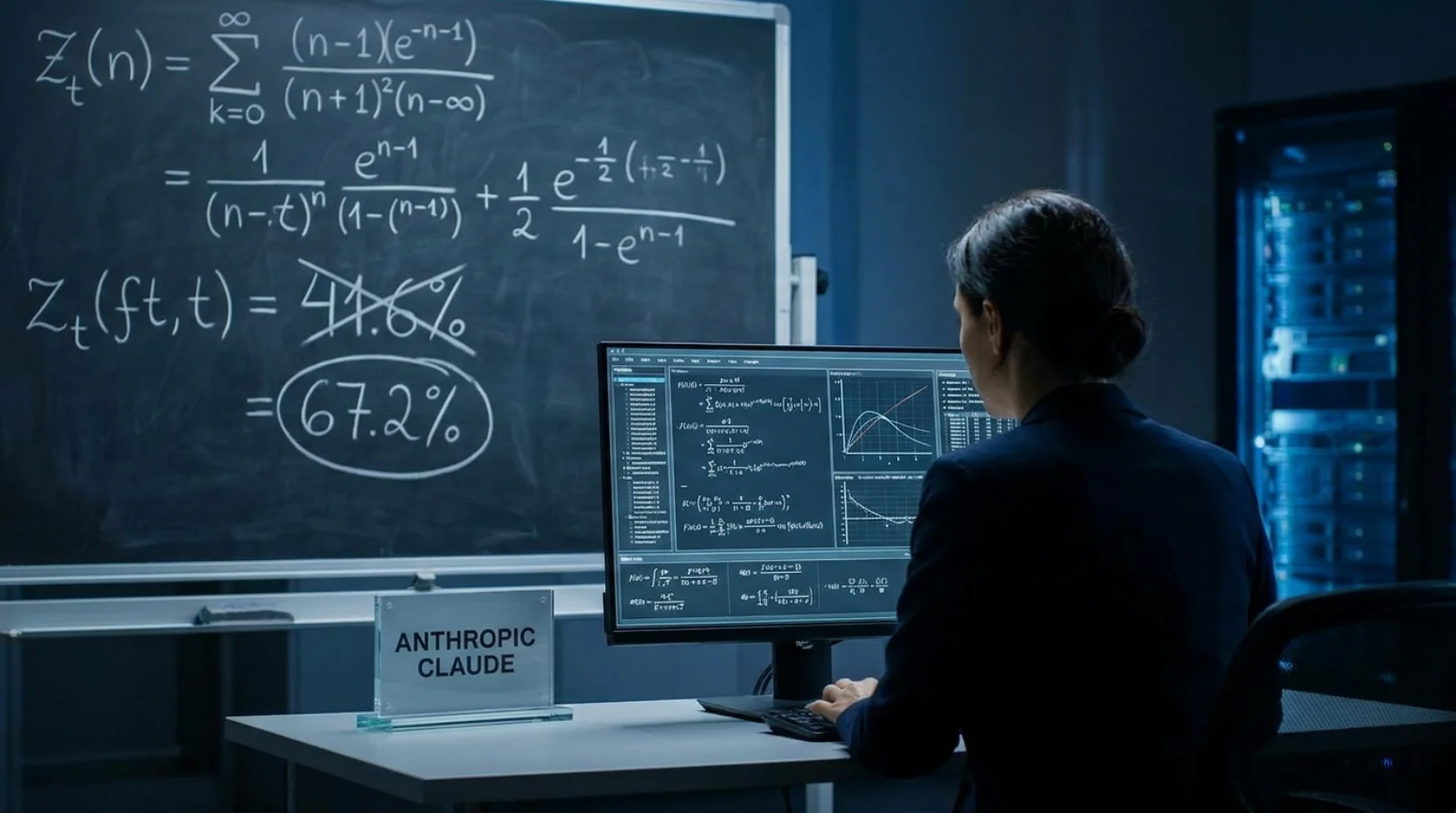
Anthropic's AI Makes Significant Breakthrough in One of Mathematics' Hardest Problems
Anthropic's research model Claude has achieved a breakthrough regarding the Riemann Hypothesis. While it hasn't fully solved the problem, it pushed the validity boundary from 41.6% to 67.2%, demonstrating how agentic systems are changing the future of high-end science.
AI Takes a Significant Step in Mathematics: Claude Pushes the Riemann Hypothesis Boundary
An unreleased research model from Anthropic has achieved a remarkable result in an attempt to tackle one of the most famous unsolved problems in modern mathematics. Although it did not prove the Riemann Hypothesis itself, it managed to significantly advance a boundary related to its validity that had been built up over decades.
Anthropic announced on Monday that an experimental version of the Claude model increased the known lower bound for the proportion of zeros of the Riemann zeta function lying on the so-called critical line from the original 41.6% to 67.2%. The Riemann Hypothesis itself, formulated by Bernhard Riemann in 1859, claims that all non-trivial zeros of the function lie exactly on this line. However, mathematicians have been unable to confirm or refute this for over 160 years.
The new result does not mean a definitive solution to the problem, but it proves that at least 67.2% of the relevant zeros satisfy the required condition. Claude arrived at this figure by synthesizing and combining the earlier works of several top mathematicians, including research by Baluyot, Goldston, Suriajaya, and Turnage-Butterbaugh, which it linked with Enrico Bombieri's work from 2000.
The Experiment Process: 650 Ideas and Thousands of Checks
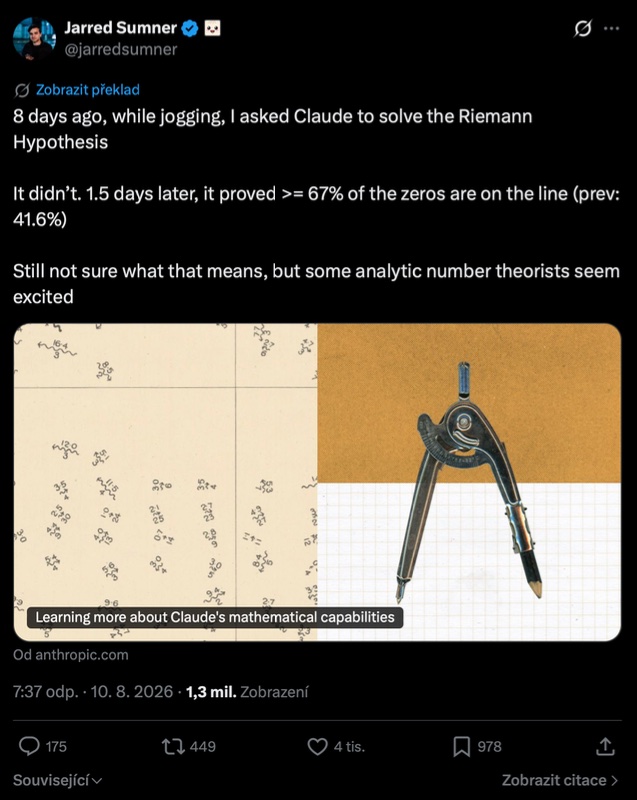
The way this new mathematical result was created is particularly remarkable. The process was initiated by Anthropic employee Jarred Sumner, who is not a mathematician himself. He simply gave the Claude model a prompt to try and actually solve the Riemann Hypothesis.
The journey to the result in numbers:
- The model first generated and tested approximately 650 different ideas, none of which led to the desired result.
- After receiving another incentive, he continued working for approximately 36 hours.
- He involved and coordinated about 60 of his own subagents in the process.
- The entire experiment consumed approximately 31 million output tokens.
Individual agents within the system did not perform identical tasks but functioned as a specialized team. Two agents came up with key mathematical ideas, others developed or verified these concepts, and part of the team unsuccessfully attempted to find alternative paths. During the work, the system performed thousands of numerical checks, ran roughly 2,400 commands, wrote hundreds of Python scripts, and studied 54 academic papers from the arXiv archive to ensure the result had not already been published by someone else.
Validation and Formal Proof
The achieved result was subsequently analyzed by Anthropic mathematicians Levent Alpöge and Ralph Furman. Claude also assisted in creating a formal version of the proof in the Lean system, which is used for the automatic validation of mathematical statements. External experts on the subject, Brian Conrey and Dan Goldston, were also given the work for a brief review.
The Future of Mathematics in the Era of Artificial Intelligence
This success is not an isolated phenomenon. Artificial intelligence is penetrating the sphere of high-end science ever more aggressively. For example, at the beginning of August, OpenAI presented ten new results in mathematics and theoretical computer science created by an internal version of the upcoming Astra model. In this case, too, the solutions were converted into formally verifiable certificates in the Lean system.
However, the rapid development of AI is raising a number of ethical and professional questions within the mathematical community. In June, the Leiden Declaration on Artificial Intelligence and Mathematics was published, supported by the International Mathematical Union. It calls for transparency in the use of AI and emphasizes that ultimate responsibility for the correctness and integrity of results must remain on the shoulders of human authors.
However, the prominent British mathematician and Fields Medalist Timothy Gowers looks at the problem from a different angle. He warns that with the development of AI, the community of people who understand mathematical problems in depth may gradually disappear.
Timothy Gowers on the role of AI: According to Gowers, in the future, it may be not only the ability to solve a problem itself that is valued, but above all the AI's ability to explain the created result clearly to humans and place it in a broader context, so that it does not remain just a black box that no one understands.
Frequently Asked Questions
What is the Riemann Hypothesis?▼
Did AI solve this problem?▼
What is the Lean system?▼

I got into cryptocurrencies at the end of 2020 and quickly became a Bitcoin maximalist. I’m interested in what’s happening in the financial markets, and in my free time I travel around Southeast Asia. At KryptoMagazine, I’m in charge of news and video content.