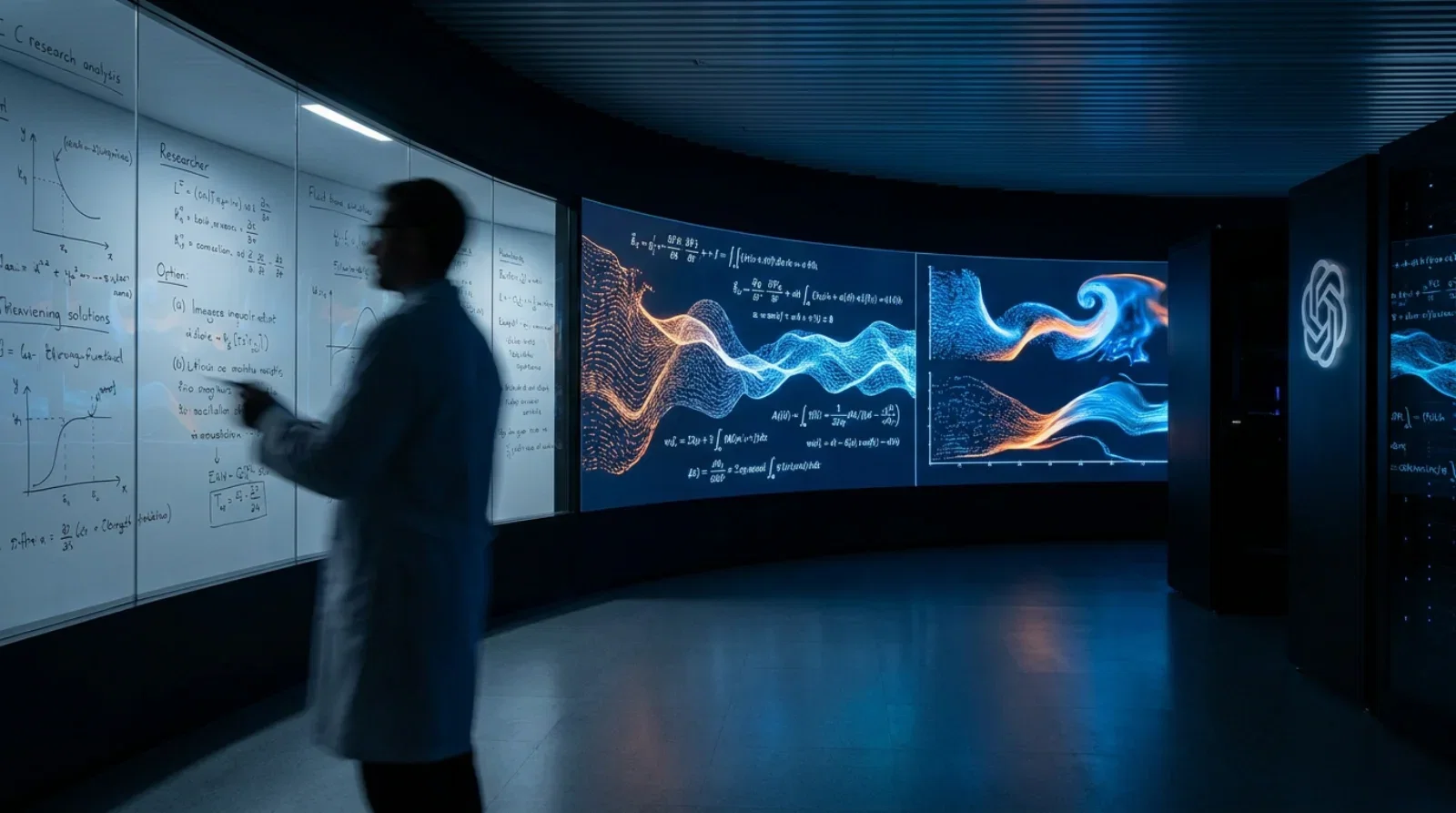
OpenAI Claims to Have Solved One of Mathematics' Toughest Problems
OpenAI has announced a breakthrough in mathematics: its AI agents have allegedly solved the Navier–Stokes equations. The achievement is accompanied by an authorship dispute with Anthropic scientists and a wait for confirmation from the mathematical community.
Breakthrough in Mathematics: OpenAI's Artificial Intelligence Allegedly Solves Navier–Stokes Equations
OpenAI has published a proof that aims to close one of the greatest chapters in modern mathematics. According to the company's official statement, their internal system has found a solution to the problem of existence and smoothness of the Navier–Stokes equations. This puzzle is among the seven so-called Millennium Prize Problems, for which the Clay Mathematics Institute has offered a one-million-dollar reward.
Navier–Stokes equations are crucial to our understanding of the physical world. They describe the flow of liquids and gases and form the basis for:
- weather forecasting and modeling,
- aerodynamic calculations for aircraft and automobiles,
- studying blood flow in the human body,
- analysis of ocean currents.
Technological Background: 10,000 Agents in Action
OpenAI claims that its system has demonstrated the possibility of a singularity forming in finite time. This is a situation where the mathematical model ceases to be smooth and the velocity in a certain area grows without any limit. The scale of the operation that led to this finding is unprecedented in the history of computing.
Approximately 10,000 coordinated AI agents were used to solve the problem. The entire process took roughly 88 hours of net time, with an additional 17 hours spent on subsequent formalization and verification of the proof using the GPT-6 Astra model and the Lean system. Total consumption amounted to approximately 130 billion output tokens.
Controversy and Dispute with Anthropic Researchers
Instead of unequivocal celebrations, however, a wave of controversy and disputes over priority has erupted around the discovery. New York University professor Tristan Buckmaster, who worked on related research together with Levente Alpöge, a mathematician working at rival company Anthropic, has entered the fray.
The duo had long been dealing with Euler equations, and Buckmaster believes their approach may have laid the groundwork for solving the Navier–Stokes equations. Buckmaster openly suggested that OpenAI might have accelerated its project after obtaining clues about their progress, pointing to the fact that they used OpenAI's Codex tool in their work.
Reaction from OpenAI and Sam Altman
OpenAI management denies the allegations of unfair practice. The company confirmed it launched the experiment on September 1 after reports emerged of a possible breakthrough in two Millennium Prize Problems, but denies that researchers had access to the non-public work of Buckmaster and Alpöge.
"Allegations of plagiarism are baseless. From the beginning, OpenAI has strived for a coordinated and transparent disclosure of results," Sam Altman stated in response to the tense situation.
The dispute has also escalated on a personal level. Buckmaster claims that Sébastien Bubeck from OpenAI suggested excluding Alpöge from official credit, which Bubeck denies. At the same time, OpenAI admitted that anonymized data from the use of its products could have unknowingly contributed to improving models in the past, opening a broader discussion about the ethics of training AI on the data of scientific researchers.
What Comes Next?
Although OpenAI has announced a historic success, the path to its definitive recognition will be long. The mathematical community is cautious about proofs generated by artificial intelligence.
The Clay Mathematics Institute has strict rules for recognizing a solution: the proof must be published in a qualified professional journal, and at least two years must pass during which the solution is subjected to criticism and general acceptance by the community.
OpenAI concluded by adding that it will not seek the $1 million financial reward, apparently wishing to emphasize its interest in scientific progress rather than commercial gain from this specific discovery.
Frequently Asked Questions
What are the Navier–Stokes equations?▼
How did OpenAI arrive at the proof?▼
Is the problem already officially solved?▼

I got into cryptocurrencies at the end of 2020 and quickly became a Bitcoin maximalist. I’m interested in what’s happening in the financial markets, and in my free time I travel around Southeast Asia. At KryptoMagazine, I’m in charge of news and video content.