


Anthropic has encountered a surprising problem with its most powerful model, Fable 5. According to data from Ramp, American companies prefer cheaper models, even though Fable 5 is at the absolute technological forefront. This development clearly suggests that for corporate AI use, maximum raw power is no longer the sole deciding factor; instead, the ratio of price to real-world benefit is increasingly taking center stage.
Economic Reality: Companies don’t want to pay for unused performance
Ramp, which tracks the spending of more than 70,000 U.S. companies, brought an interesting finding in its August data. It turned out that the Fable 5 model accounted for only 6% of tokens purchased by Anthropic customers, representing 11.4% of the total money spent on the brand’s models.
Comparison with competition and pricing policy
Compared to OpenAI, this disparity is significant. The rival model GPT-5.6 Sol accounted for 25% of tokens consumed and 23% of spending during the same period. The main reason is aggressive pricing and corporate pragmatism:
- Fable 5 (Anthropic): $10 per million input tokens / $50 per million output tokens.
- Opus 5 (Anthropic): Costs exactly half ($5 input / $25 output).
- GPT-5.6 Sol (OpenAI): Following the August 21 discount, the price dropped to $4 for input and $20 for output.
For a wide range of common enterprise tasks, it makes no economic sense to use the most expensive model. If a cheaper variant can handle document analysis, programming, or automation without issues, a few extra percentage points of performance do not justify significantly higher operating costs.
Although the data from Ramp does not represent the entire market and focuses primarily on U.S. technology companies, it clearly illustrates a trend: businesses can switch between providers very quickly and flexibly based on current cost-effectiveness.
Anthropic’s growth in the context of market risks
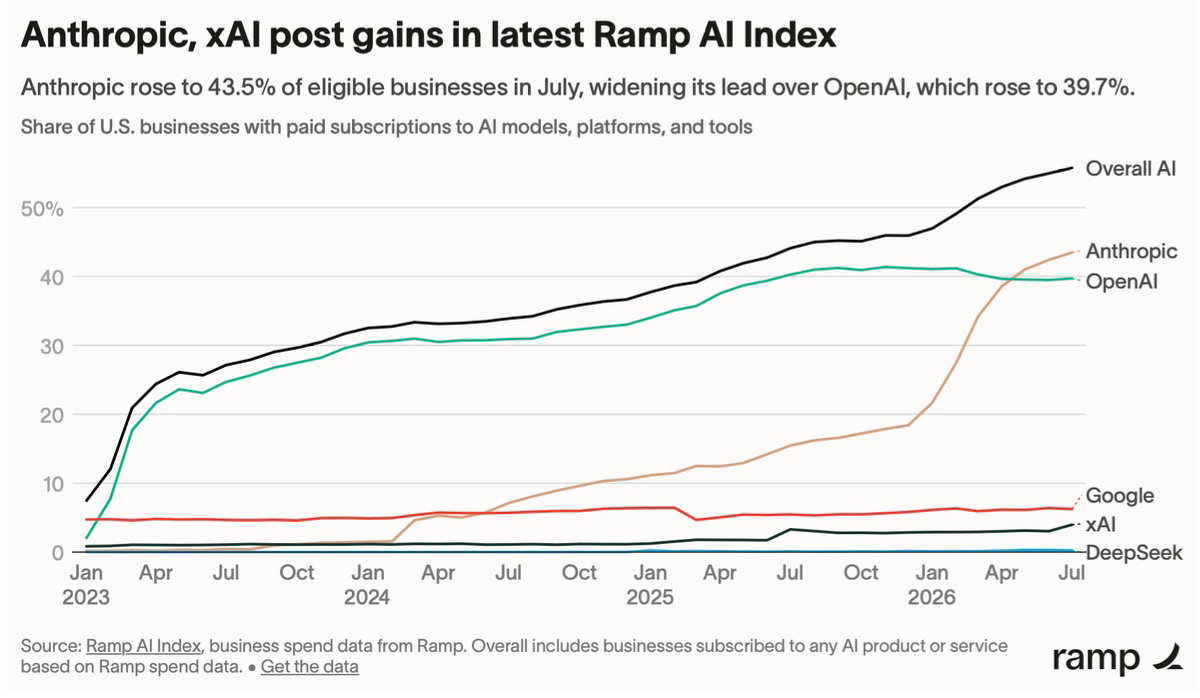
Weaker interest in the premium Fable 5 model does not mean a decline for Anthropic as a whole. On the contrary, the company is experiencing a period of rapid expansion. In July, 43.5% of tracked companies were using Anthropic’s paid products, surpassing OpenAI, which reached a share of 39.7%.
Financial results and the future
Anthropic is showing an extraordinary pace of revenue growth:
- July 2024: Annual revenue run rate exceeded $65 billion.
- May 2024: $47 billion.
- End of 2023: Original estimates were only $9 billion.
This growth comes at a sensitive time ahead of an expected IPO. However, the real challenge remains the sustainability of the business model. Leading labs are investing astronomical sums into infrastructure, while customers are beginning to strictly calculate return on investment (ROI) and are increasingly looking toward more affordable open-weight alternatives.
The situation surrounding the Fable 5 model is a clear indicator that the next phase of the AI race won’t just be about brute force. The key to success will be the ability to offer high performance at a price that truly pays off in real-world business.
The main reason is the price-to-performance ratio. For most corporate tasks, such as document analysis or programming, cheaper models are sufficient, while Fable 5 is up to twice as expensive as the alternatives.
According to data from Ramp, 43.5% of tracked companies used Anthropic’s paid services in July, while OpenAI had a share of 39.7%. Anthropic is therefore currently leading in corporate adoption.
