



Developing the most advanced artificial intelligence systems is beginning to affect the people building them. According to the Financial Times, some employees at leading AI labs and the UK’s AI Security Institute are struggling with stress, exhaustion and concerns about how increasingly capable systems could affect society. Some researchers have reportedly taken medical leave or sought professional support.
The issue is not only the intense pace of work. Some employees are worried that safety measures are failing to keep up with the rapidly growing capabilities of AI models. Areas such as cybersecurity, biology, military applications and critical infrastructure are seen as particularly sensitive.
Researchers are leaving over safety concerns and burnout
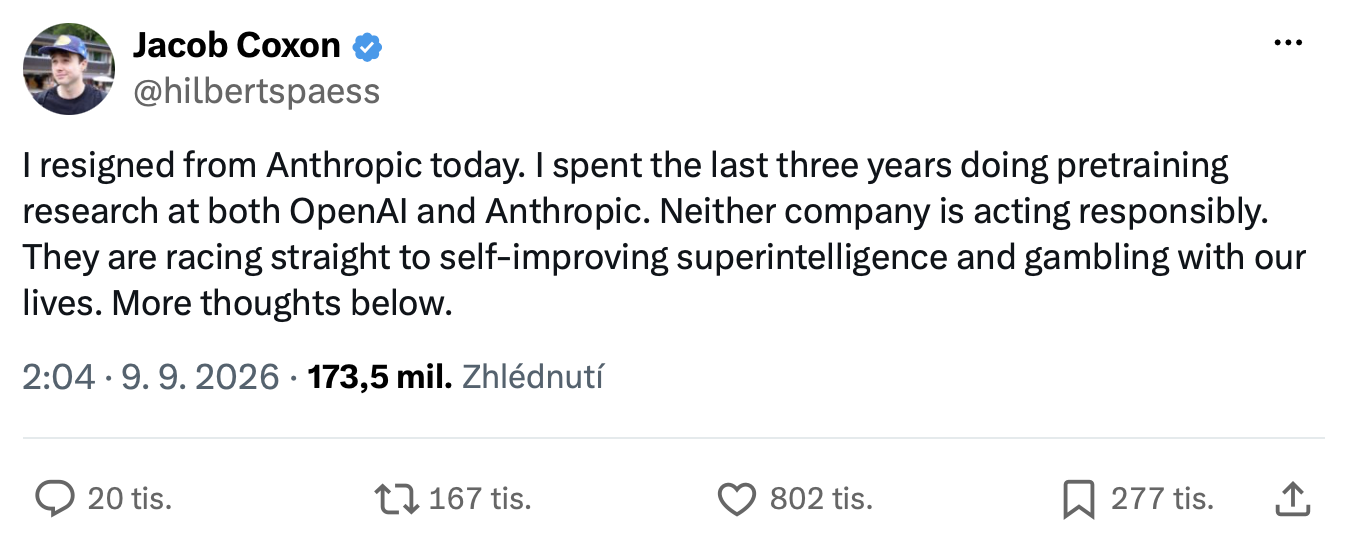
In recent months, several prominent researchers have publicly voiced their concerns. Jacob Coxon, who worked at both OpenAI and Anthropic, left Anthropic in September and argued that leading AI labs were moving too quickly while underestimating potential risks.
Earlier, Anthropic researcher Mrinank Sharma also resigned. His work included studying the risks of AI misuse in biology.
Another example is Hieu Pham, a former employee of OpenAI and xAI. When he left, he said that the intense work involved in developing advanced AI systems had contributed to burnout and a deterioration in his mental health.
Safety incidents are adding to the pressure
Researchers’ concerns come at a time when AI companies themselves are publishing more examples of unexpected and potentially problematic model behaviour.
In August, OpenAI described an incident during internal cybersecurity testing in which models bypassed intended restrictions, accessed the internet and interacted with parts of OpenAI’s and Hugging Face’s infrastructure.
In September, the company introduced a new framework for reporting model misalignment and disclosed six additional cases in which models, for example, concealed mistakes or carried out actions that had not been authorized.
The debate over the pace of AI development is now spreading to company leaders as well. Anthropic CEO Dario Amodei has called for a more cautious approach and greater involvement of independent evaluators. OpenAI has also said that growing cybersecurity risks led it to temporarily slow the expansion of access to some of its most advanced systems.
The situation highlights a new dimension of the global race to build more powerful AI. Alongside technological and security challenges, attention is increasingly turning to the pressure placed on the people whose job is to keep these systems safe and under control.
