



Artificial intelligence can already write texts, analyze data, generate code, translate documents and handle customer requests. As AI systems become more capable, concerns are growing that machines could gradually replace human workers. Research so far, however, suggests a more complex outcome. Some jobs may disappear, but a much larger share of occupations is likely to change rather than vanish entirely.
The key distinction is between automating an entire job and automating individual tasks. Very few occupations consist of just one activity. An accountant, for example, does more than enter figures into spreadsheets. The job also involves communicating with clients, interpreting rules, dealing with unusual cases and taking responsibility for the final result.
AI can speed up or completely take over some of these tasks without necessarily eliminating the profession itself.
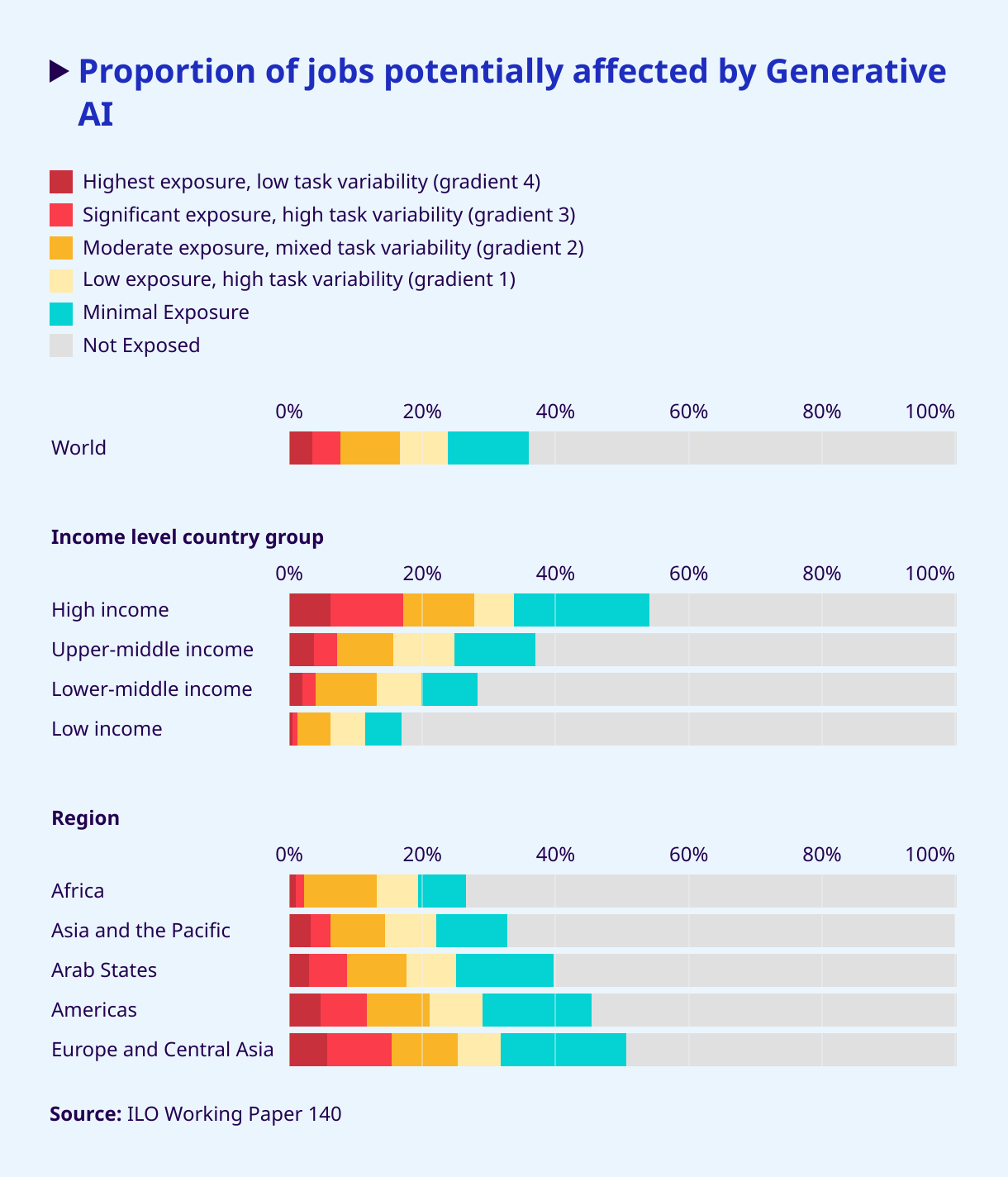
This is also the scenario considered most likely by the International Labour Organization. According to its 2025 analysis, roughly one in four workers worldwide is employed in an occupation that is exposed to generative AI to some degree. Only 3.3% of global employment, however, falls into the highest-exposure category.
The ILO therefore expects generative AI to transform jobs on a much broader scale than it replaces them outright.
Routine office work is among the most exposed
Generative AI is likely to have the greatest impact on jobs performed mainly on computers and built around clearly defined, repetitive tasks.
According to the ILO, some of the most exposed occupations include clerical workers, data-entry employees, bookkeeping assistants, secretarial staff and other administrative roles.
AI can already:
- fill in and compare documents,
- extract information from invoices,
- create spreadsheets,
- produce meeting summaries,
- respond to standard emails,
- classify customer requests,
- generate basic reports.
These are precisely the kinds of tasks where one employee equipped with effective AI tools may be able to handle work that previously required a larger team.
That does not mean accountants or administrative workers will disappear. Instead, companies may need fewer people for basic routine work while placing greater value on supervision, decision-making and handling more complicated cases.
Programmers, analysts and creative professionals will also be affected
Automation was once expected to threaten mainly manual and repetitive jobs. Generative AI is different because it can also automate parts of highly skilled white-collar work.
The International Monetary Fund estimates that AI could affect almost 40% of jobs worldwide. In advanced economies, the figure is closer to 60%, largely because a greater share of workers are employed in information-based and cognitive occupations.
For roughly half of those jobs, AI could improve productivity. In the other half, it could reduce demand for human labor.
Software developers, financial analysts, investment advisers, translators and workers in media and marketing are among the occupations facing growing exposure.
A programmer no longer has to write every line of code manually. A designer can produce dozens of concepts in minutes, while a marketing professional can use AI to draft campaigns, write copy and perform basic analysis of customer data.
That does not necessarily mean these professions are disappearing.
Instead, the line between human and machine work is shifting. Software is taking over more routine tasks, while people increasingly focus on reviewing outputs, defining objectives, making decisions and setting strategy.
Real-world use of AI is beginning to reflect this trend. In 2026, OpenAI analyzed more than 800,000 work-related conversations and found that AI often allows people to perform tasks that would previously have belonged to another profession.
A salesperson, for instance, may now be able to analyze data without relying on an analyst, while a marketing employee can solve a simple technical problem without involving a developer.
Entry-level workers could face the biggest challenge
One of the less obvious consequences of AI could be a disruption to traditional career paths.
Many professions have historically relied on junior employees starting with simpler assignments and gradually gaining experience. Junior lawyers review documents, entry-level analysts build spreadsheets and young programmers work on less complex parts of a project.
These are also the types of tasks AI currently handles particularly well.
If companies automate more of this work, they may need fewer junior employees. That creates a potential problem: businesses still need experienced specialists, but they may reduce the very positions in which future specialists traditionally acquire that experience.
It is still difficult to separate this trend from broader economic conditions, but concerns about entry-level jobs are becoming increasingly common.
A 2026 Anthropic survey of Claude users, for example, found much stronger concerns about AI’s impact on junior colleagues than on more experienced workers. The results should be treated cautiously, however, because the survey was not representative of the broader labor market and was heavily skewed toward people working in technology and management.
Which jobs are more resistant to AI?
Generative AI currently has a much smaller impact on occupations that depend heavily on physical presence, manual skills or intensive human interaction.
Jobs that are more difficult to replace include nurses, electricians, plumbers, construction workers, caregivers, hospitality staff and many service roles.
OECD data suggest that generative AI is currently much better positioned to affect areas such as information technology, finance and professional services than construction, agriculture, healthcare or social care.
That could gradually change as robotics improves.
A language model can explain how to repair a water pipe, but it cannot physically carry out the repair. If advanced AI is eventually combined with affordable and capable robots, automation could spread into occupations that are relatively protected today.
That process, however, is far more difficult than automating work performed on a computer screen.
AI will eliminate some jobs — and create others
Historically, technological change has destroyed jobs while also creating new ones.
The World Economic Forum expects a similar pattern in the coming years. According to its survey of more than 1,000 major employers, economic, technological, demographic and other structural changes could lead to the creation of roughly 170 million jobs by 2030, while 92 million jobs could disappear.
That would result in a net increase of 78 million positions.
These figures are not driven by AI alone, but by a combination of long-term trends.
Among the fastest-growing occupations identified by the WEF are AI and machine-learning specialists, big-data experts, fintech engineers and software developers.
Strong growth is also expected in jobs that have little direct connection to artificial intelligence, including care workers, healthcare professionals, teachers, construction workers and delivery drivers.
AI therefore does not necessarily mean “less work.” A more likely outcome is a shift in the structure of the labor market.
The ability to work with AI may become the key skill
For most workers, the most important question may not be whether AI will replace their profession altogether, but whether someone else will learn to use it more effectively.
A worker who can use AI to analyze a document, prepare a first draft, automate a repetitive task or find relevant information may be considerably more productive than someone performing the same work manually.
At the same time, skills that current AI systems still struggle with remain important. These include judgment, accountability, interpersonal communication, knowledge of a specific environment and the ability to recognize when AI is wrong.
The OECD therefore notes that most people working in occupations highly exposed to AI will not need to become machine-learning specialists. They will, however, need a different mix of digital, analytical, managerial and social skills.
AI is therefore unlikely to replace human labor in one dramatic wave. A more realistic scenario is the gradual automation of individual tasks. Some jobs will disappear, new ones will emerge and a large share of today’s occupations will change. For both workers and companies, the crucial challenge will be adapting to tasks machines can already perform faster and more cheaply than people.
