


Alongside OpenAI and Google DeepMind, Anthropic has become one of the companies shaping the direction of modern artificial intelligence. Its best-known product is Claude, a family of large language models and an AI assistant capable of working with text, writing code, analyzing documents and images, searching for information and using external tools.
Although Anthropic was founded only in 2021, it has grown into one of the world’s most valuable technology startups in just a few years. Amazon and Google have played a major role in that expansion, providing not only capital but also access to enormous amounts of computing power.
From the beginning, Anthropic has also tried to build its identity around AI safety. That philosophy led to one of the company’s best-known approaches: Constitutional AI.
What Is Anthropic?
Anthropic is a U.S.-based company developing advanced artificial intelligence systems. It describes itself as an AI safety and research company focused on building systems that are reliable, interpretable and steerable.
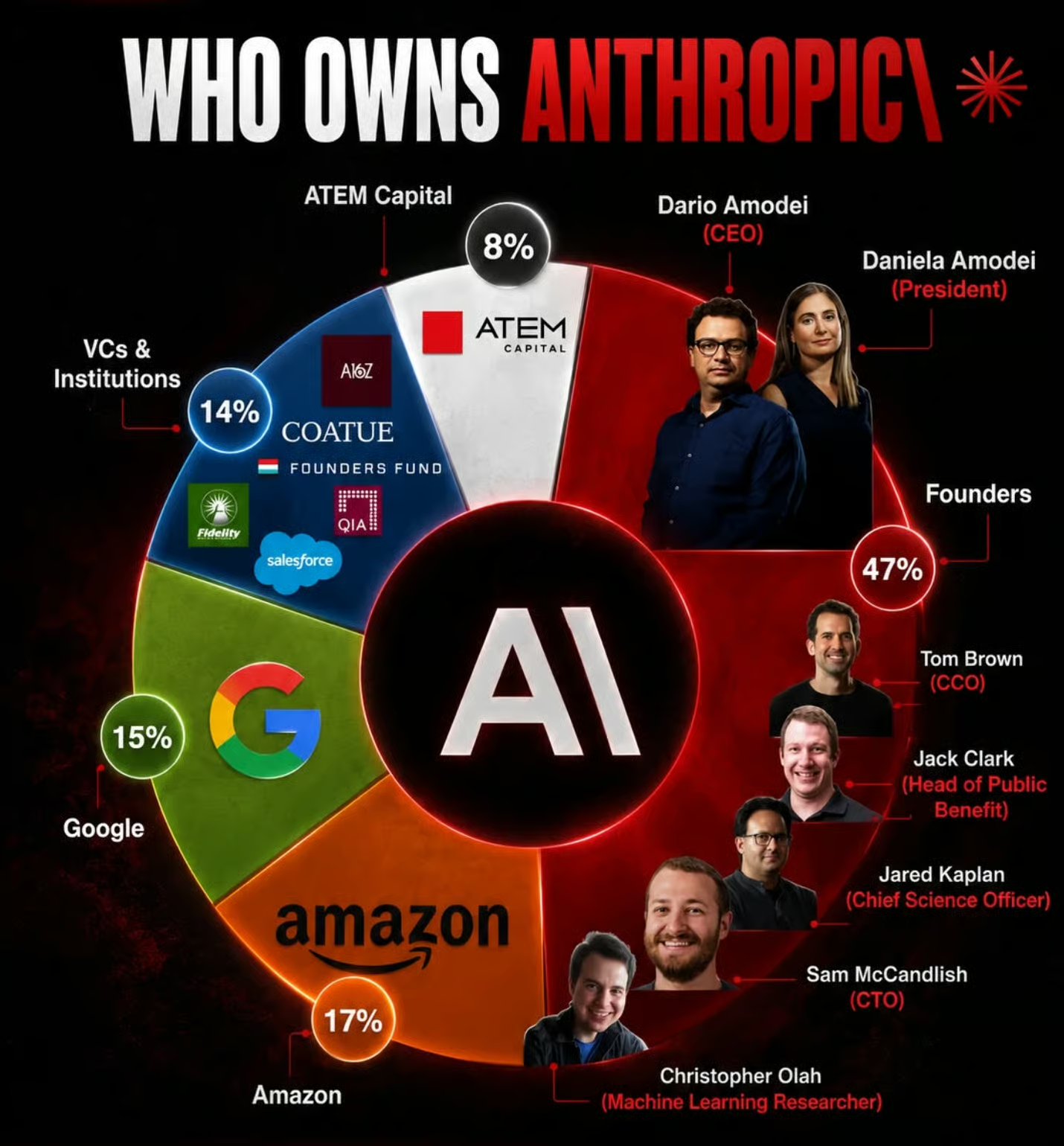
The company was founded in 2021 and is led by siblings Dario Amodei, its CEO, and Daniela Amodei, its president.
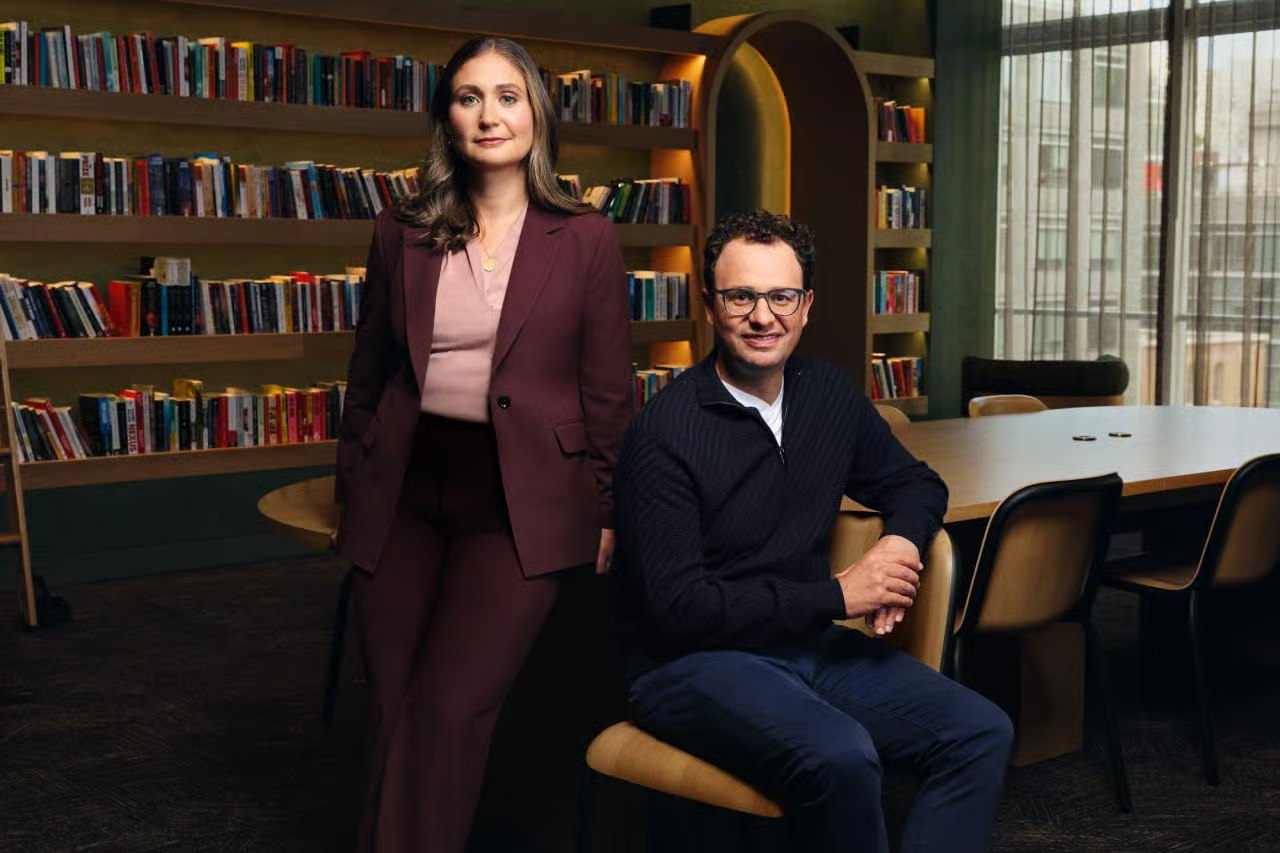
A large part of Anthropic’s founding team previously worked at OpenAI. Other co-founders include Tom Brown, Jack Clark, Jared Kaplan, Sam McCandlish and Chris Olah. Many of them had worked on some of the most important research projects from the early era of large language models before launching Anthropic.
Its first funding round already made clear that this would not be an ordinary technology startup. In May 2021, Anthropic announced USD 124 million in funding, primarily aimed at researching large and more reliable AI systems.
The company then expanded rapidly and began pouring billions of dollars into development.
Claude Arrives as a Rival to ChatGPT
Anthropic’s most important product became Claude, which the company publicly introduced in March 2023.
The first version was designed for tasks such as summarizing documents, retrieving information, writing text, answering questions and programming. Claude was also available through an API, allowing other companies to integrate it into their own products.
Claude entered the market only a few months after the launch of OpenAI’s ChatGPT triggered a surge of public interest in generative AI.
By July 2023, Anthropic had released Claude 2, bringing stronger capabilities in mathematics, coding and reasoning, as well as the ability to work with significantly larger amounts of text. At the same time, the company opened Claude.ai to a broader audience.
The biggest advances, however, would come with later generations.
Claude 3 Split the Models Into Three Tiers
In March 2024, Anthropic introduced the Claude 3 family, dividing it into three main model categories.
Haiku was positioned as the fastest and least expensive option. Sonnet was designed to strike a balance between cost, speed and capabilities. Opus represented the most powerful model, aimed at the most demanding tasks.
Anthropic continued using this structure in subsequent generations.
Claude 3 also significantly improved image understanding and the model’s ability to analyze larger amounts of information.
In June that year, Anthropic followed up with Claude 3.5 Sonnet.
This generation in particular helped strengthen Anthropic’s reputation among software developers. The model performed very well on programming tasks while remaining faster and cheaper than the company’s then-largest Opus model.
Anthropic also introduced Artifacts, a feature that allowed users to display generated code, documents, charts or webpages alongside the main conversation and continue working with the output interactively.
Claude Evolves From a Chatbot Into an AI Agent
The next stage of Claude’s development was no longer simply about producing better answers.
The goal was to enable AI to carry out entire tasks.
In October 2024, Anthropic introduced an experimental feature known as computer use. It allowed Claude to interact with graphical computer interfaces in a way similar to a human user — viewing the screen, moving the cursor, clicking and typing text.
In February 2025, the company launched Claude 3.7 Sonnet, which Anthropic described as its first hybrid reasoning model.
Depending on the task, the model could either respond almost immediately or spend more computing time carrying out a deeper analysis.
Anthropic launched Claude Code alongside it.
The tool allowed developers to give AI more complex programming assignments directly from the terminal.
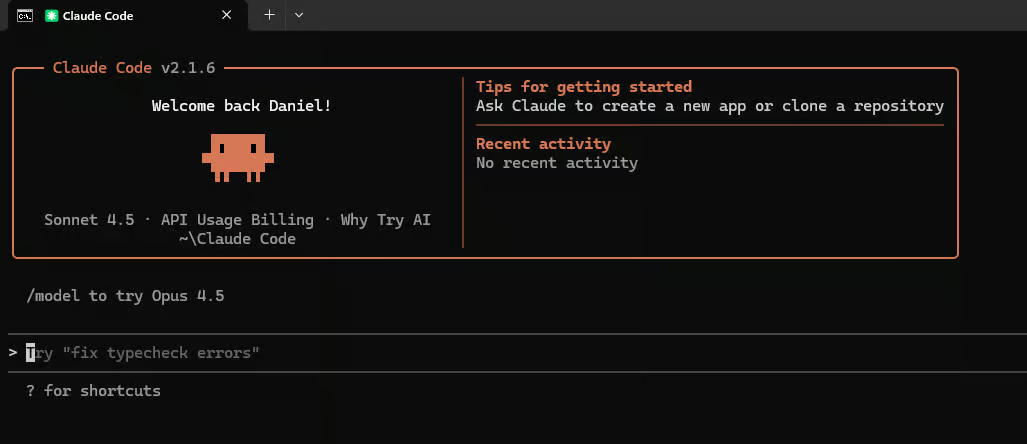
Claude Code subsequently became one of the company’s most important products.
During 2025, it gained integrations with development environments and became capable of working more autonomously on larger software projects. According to Anthropic, Claude Code reached more than USD 1 billion in annualized revenue within just six months of its public launch.
Claude’s evolution illustrates a broader shift taking place across the AI industry.
Simple chatbots are gradually becoming AI agents capable of using tools, working with files, browsing the internet and independently completing several connected steps.
What Is Constitutional AI?
One of the biggest differences between Anthropic and many of its competitors is the company’s emphasis on how AI models should behave.
Anthropic developed an approach known as Constitutional AI.
Instead of relying exclusively on large numbers of human reviewers to determine which model behavior is acceptable or unacceptable, the AI is given a set of fundamental rules and principles — effectively a constitution.
The model can then evaluate and revise its own answers based on those principles.
The aim is to create AI that remains useful while also refusing dangerous requests, respecting human autonomy and openly acknowledging uncertainty.
In 2023, Anthropic even experimented with using the views of roughly 1,000 people to help shape some of those principles.
In January 2026, the company released a new and significantly expanded version of the Claude Constitution, providing a more detailed description of the values and expected behavior of Claude models.
Anthropic published the document under a CC0 license, allowing other companies and researchers to use it freely.
Constitutional AI does not, however, mean that Claude will always respond correctly or safely.
Like other large language models, it can still generate inaccurate information, misunderstand instructions or behave unpredictably when interacting with external tools.
Claude 4 and the Rise of Truly Agentic AI
Another major generation arrived in May 2025, when Anthropic introduced Claude Opus 4 and Claude Sonnet 4.
The focus shifted even further toward programming, reasoning and long-running agentic tasks.
The models could combine deeper reasoning with the use of external tools and APIs. Further versions followed throughout 2025 and 2026.
In February 2026, for example, Anthropic released Sonnet 4.6, which added beta support for a context window of up to one million tokens.
This allowed the model to work with very large documents or substantial parts of software projects in a single session.
Other generations followed, including Opus 4.8 and, during the summer of 2026, Anthropic’s fifth-generation models.
Claude 5
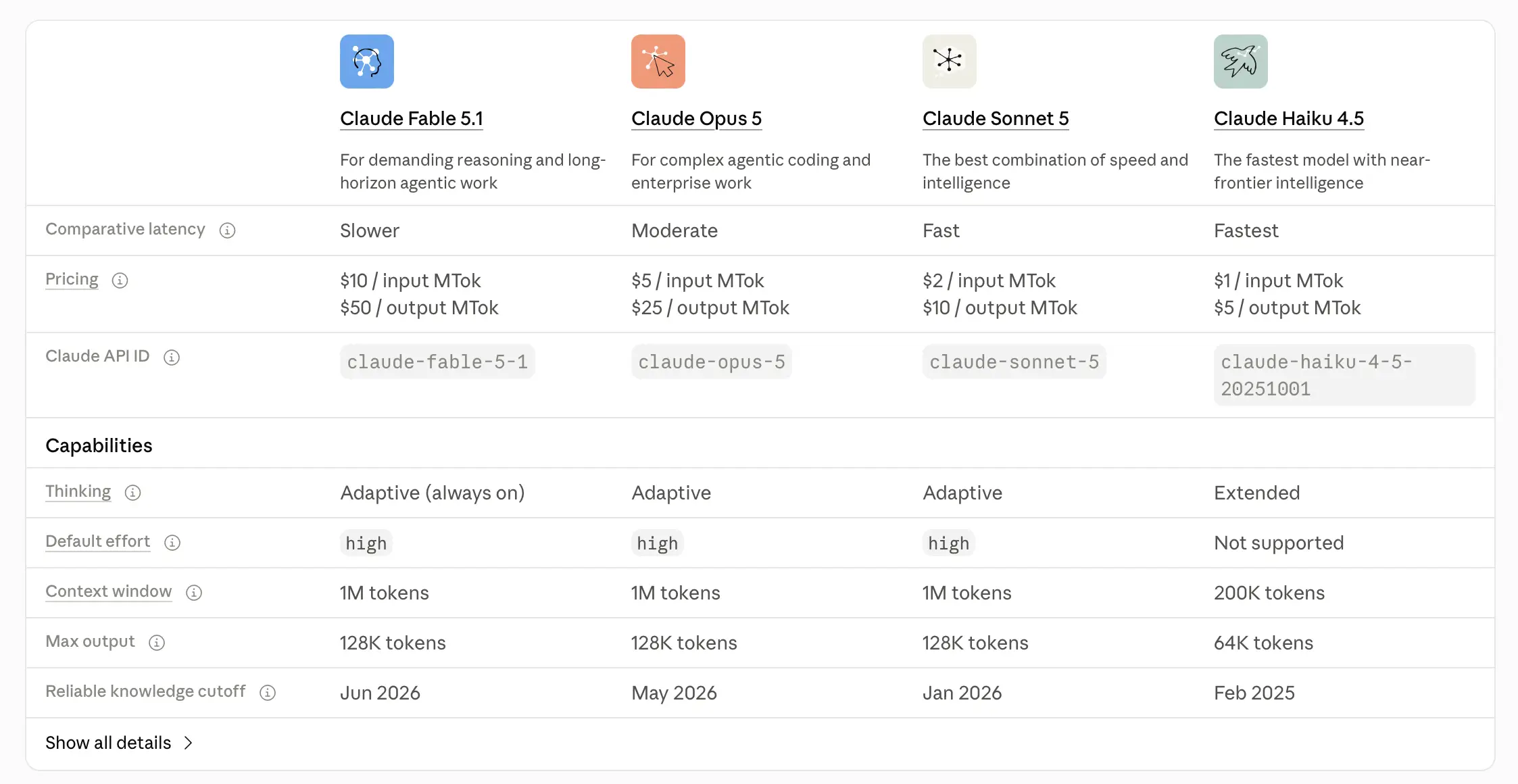
In June 2026, Anthropic introduced Claude Sonnet 5, focused primarily on agentic work, programming, reasoning and tool use.
According to the company, the model is capable of planning its own approach and independently working with tools such as web browsers and terminals.
Claude Opus 5 followed in July, designed for more demanding professional use and complex everyday tasks.
Anthropic has also been experimenting with even more powerful frontier models, including Claude Fable 5 and Mythos 5.
Their capabilities also highlight a problem that is likely to become increasingly important as AI develops: the more capable the models become, the greater the potential consequences of misuse or unexpected behavior.
What Is MCP and Why Does It Matter to Anthropic?
One of Anthropic’s most significant contributions to the broader AI ecosystem is the Model Context Protocol, or MCP.
Anthropic introduced MCP in November 2024 as an open standard for connecting AI applications to external data sources and tools.
Instead of requiring developers to build separate integrations for services such as Google Drive, databases, GitHub or internal company systems, applications can communicate through a standardized protocol.
Anthropic’s competitors later began adopting MCP as well.
By the end of 2025, Anthropic said the protocol was supported by products including ChatGPT, Gemini, Microsoft Copilot, Cursor and Visual Studio Code.
Anthropic later transferred MCP to the newly established Agentic AI Foundation under the Linux Foundation, ensuring that future development of the standard would not remain under the direct control of a single company.
If MCP establishes itself as one of the long-term standards for communication between AI agents and external tools, it could ultimately become a more important technological legacy for Anthropic than some individual generations of Claude.
Amazon, Google and Billions of Dollars Behind Claude
Developing frontier AI models requires enormous amounts of capital and computing power.
Anthropic has therefore built deep partnerships with both Amazon and Google.
Amazon gradually invested billions of dollars in Anthropic through AWS and became its primary cloud and training partner. By the end of 2024, Amazon’s announced investments had reached a total of USD 8 billion.
The relationship later expanded significantly.
In April 2026, Anthropic announced an agreement with Amazon covering up to 5 GW of computing capacity, along with a commitment to spend more than USD 100 billion on AWS technology over a ten-year period.
Amazon simultaneously announced another USD 5 billion investment, with the possibility of increasing it further in the future.
Anthropic does not want to depend on a single type of computing infrastructure, however.
Claude runs on a combination of AWS Trainium chips, Google TPUs and Nvidia GPUs.
In 2026, Anthropic also expanded its cooperation with Google and Broadcom on several gigawatts of future computing capacity.
Securing enough chips, electricity and data-center capacity has therefore become almost as important in the race to build the best AI models as the research itself.
Anthropic Became One of the World’s Most Valuable Startups
Claude’s rapid growth has also transformed the value of the company behind it.
In February 2026, Anthropic raised USD 30 billion at a post-money valuation of USD 380 billion.
Only three months later, another funding round brought in USD 65 billion, valuing the company at USD 965 billion.
That extraordinary valuation was supported in part by rapid revenue growth.
During the May funding round, Anthropic said its annualized revenue had surpassed USD 47 billion.
Reuters later reported that the company’s revenue run rate had exceeded USD 65 billion by the middle of 2026.
Anthropic is still privately held, meaning ordinary investors cannot simply buy its shares on a stock exchange.
That could eventually change.
According to Reuters reporting from September 2026, Anthropic has been discussing an unusually large IPO in which it could raise as much as USD 100 billion.
A potential valuation of around USD 2 trillion has reportedly been discussed, although this remains part of ongoing negotiations and should not be treated as a guaranteed IPO price.
Claude Is Already Helping Build the Next Claude
The rise of agentic AI is bringing another fundamental change.
Artificial intelligence is beginning to help build future generations of artificial intelligence.
According to data published in September 2026, Claude was responsible for roughly 26% of research and development work involved in building Anthropic’s next AI models.
In March of the same year, that share had been only around 1%.
Anthropic emphasizes that Claude still operates under human supervision.
Even so, by August the company was reportedly using around 30,000 AI agents within its internal research systems, while more than 90% of its research involved some form of human-AI collaboration.
This trend could prove more important over the coming years than direct comparisons between individual chatbots.
If AI systems can automate an ever-larger share of research, programming and experimentation, they may also accelerate the pace at which their own successors are developed.
What Is the Future of Anthropic and Claude?
Anthropic has undergone an extraordinary transformation in just a few years.
What began as a relatively small group of former OpenAI researchers focused primarily on AI safety has become one of the major players in the global technology industry.
Claude, meanwhile, is no longer simply a competitor to ChatGPT.
Claude Code automates parts of software development. Cowork brings a similar approach to office work. MCP connects AI systems to external tools and data, while increasingly capable models are able to plan and carry out complex tasks.
The key question for the coming years may therefore no longer be whether Claude is a better chatbot than ChatGPT or Gemini.
What matters more is how much real human work systems like Claude will eventually be able to take over — and how safely they will be able to perform it.
Anthropic is particularly interesting in this respect.
On one hand, the company is investing enormous sums in making AI systems more capable. On the other, it was founded on the belief that technological progress must be accompanied by research into how increasingly powerful systems can be controlled.
Whether Anthropic can continue pursuing both goals at the same time will be one of the most important stories in the next stage of artificial intelligence development.
