


Artificial intelligence has moved from research labs into smartphones, search engines, office software, cars and financial services in remarkably little time. Generative AI can now produce text, images, video, music and computer code, while a new generation of AI agents is beginning to tackle increasingly complex tasks with less human input. But what exactly is artificial intelligence, how does it work, and how do AI, machine learning and large language models differ?
What Is Artificial Intelligence?
Artificial intelligence, or AI, is a broad term covering computer systems designed to perform tasks traditionally associated with human intelligence. These include recognizing images and speech, understanding language, identifying patterns in data, making decisions, planning and creating new content.
The U.S. National Institute of Standards and Technology (NIST) describes AI as a machine-based system capable of generating predictions, recommendations or decisions that influence real or virtual environments based on human-defined objectives.
AI is not a single technology. It is better understood as an umbrella field encompassing a wide range of methods and technologies.
A simplified relationship between some of its key concepts looks like this:
artificial intelligence → machine learning → deep learning → generative AI
The boundaries between these categories are not always clear-cut. Modern generative AI, for example, typically relies on deep neural networks, which themselves are a form of machine learning.
AI does not need to look or behave like a human, either. Recommendation algorithms, fraud-detection systems, translation tools, navigation apps and software that analyzes medical scans can all use artificial intelligence without involving a chatbot at all.
How Does Artificial Intelligence Work?
There is no single mechanism behind all AI systems. Most modern AI, however, relies on some combination of data, mathematical algorithms and computing power.
Traditional software generally follows rules written directly by programmers. If condition A occurs, the program performs action B.
Machine learning takes a different approach. Instead of defining every rule manually, developers provide a system with large amounts of data and allow it to identify useful patterns during a process known as training.
Imagine an AI model designed to distinguish between photographs of cats and dogs. During training, it may be shown thousands or even millions of images. It gradually adjusts its internal parameters until it becomes better at identifying animals in images it has never seen before.
Once training is complete, the model can move into the inference stage. This is when a trained model receives a new input and produces an output.
For a language model, that might mean receiving a question and generating an answer. For an image-generation model, it could mean turning a written prompt into an image.
What Is an AI Model?
An AI model can be thought of as a mathematical system that has learned patterns and relationships from data during training.
What it has learned is encoded in its parameters. Large modern AI models can contain enormous numbers of them.
An AI model is generally not a conventional database containing exact copies of everything it encountered during training. Instead, it develops mathematical representations of patterns and relationships within the data.
That is one reason AI models can often deal with situations they have never encountered in exactly the same form before.
What Is Machine Learning?
Machine learning, or ML, is a branch of artificial intelligence focused on systems that learn from data rather than relying entirely on manually programmed instructions.
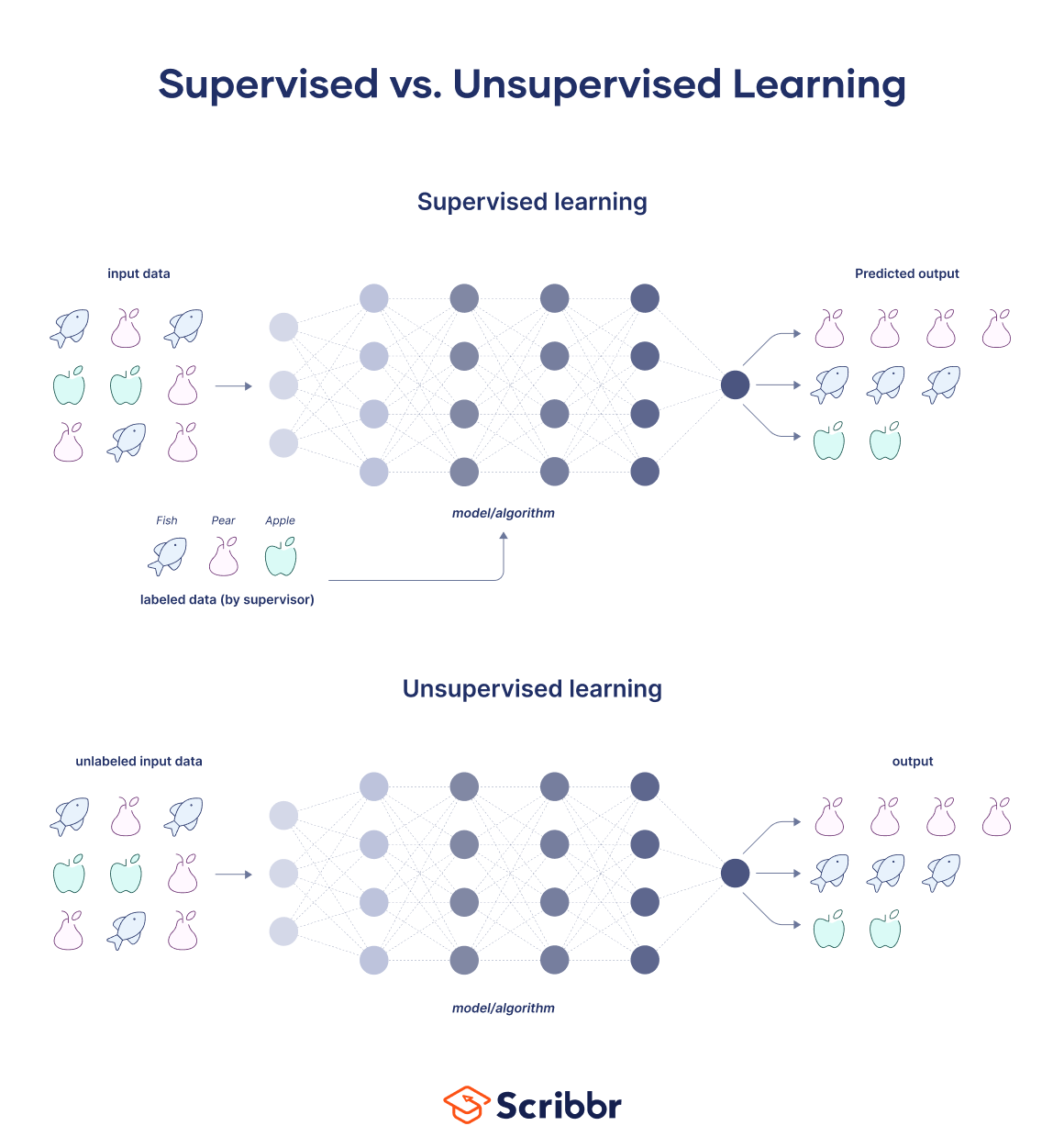
The main approaches include supervised learning, unsupervised learning and reinforcement learning.
With supervised learning, the model receives examples together with the correct answers. A spam-detection system, for instance, might be trained on thousands of emails labeled as either “spam” or “not spam.” The model then learns which characteristics tend to distinguish the two categories.
With unsupervised learning, there are no predefined correct answers. The algorithm instead searches for patterns or structure on its own. A company might use this approach to group customers according to similarities in their behavior.
Reinforcement learning works through feedback. A system performs actions, receives rewards or penalties depending on the outcome, and gradually learns a strategy that maximizes its expected reward.
Machine learning existed long before the current generative AI boom. It has been used for years in spam filters, recommendation engines, demand forecasting, algorithmic trading and fraud detection.
Neural Networks and Deep Learning
One of the foundations of modern AI is the artificial neural network.
Neural networks are loosely inspired by the way biological neurons communicate, although they should not be viewed as digital replicas of the human brain.
A neural network consists of interconnected computational units arranged in layers. Connections between them have numerical weights that change during training.
When a neural network contains many layers, the approach is known as deep learning.
Deep neural networks have been central to major advances in computer vision, speech recognition, natural language processing and, more recently, generative AI.
IBM describes deep learning as a subset of machine learning that uses multilayer neural networks to model highly complex relationships within data.
One of the major strengths of deep learning is its ability to discover useful features automatically within huge amounts of unstructured information such as text, photographs and audio.
What Is Generative AI?
Generative AI refers to artificial intelligence designed to create new digital content.
It can generate:
text, images, computer code, music, speech, video and even 3D content.
NIST defines generative AI as a class of models that learn the structure and characteristics of input data and use that knowledge to create new synthetic content.
That makes it fundamentally different from many older AI systems focused primarily on classification or prediction.
An image-classification model might answer:
“Is there a dog in this image?”
A generative model can respond to a different kind of request:
“Create an image of a dog sitting on a bench in Prague.”
The rapid rise of generative AI has also transformed the way ordinary people interact with artificial intelligence. Instead of specialized systems operated mainly by experts, users can now work with AI simply by describing what they want in everyday language.
What Is an LLM and How Do Large Language Models Work?
LLM stands for Large Language Model.
Large language models are AI systems designed to work with language. They can answer questions, summarize documents, translate text, write articles, explain complex topics and generate computer code.
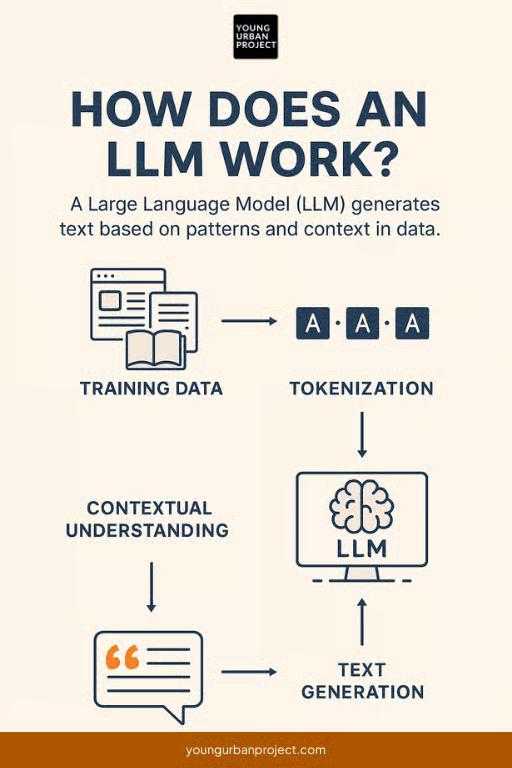
At a very basic level, the principle behind an LLM sounds surprisingly simple: it attempts to predict what comes next in a sequence of text.
Before processing text, a language model divides it into smaller units known as tokens. A token may represent an entire word, part of a word, punctuation or another piece of text.
The model then calculates which token is most likely to come next.
If given the sentence:
“The capital of the Czech Republic is…”
the model would assign a very high probability to tokens forming the word “Prague.”
Modern language models are, of course, far more sophisticated than this simple example suggests. They can process long contexts and model relationships between different parts of the input.
After training on enormous quantities of data, they become capable of representing language, facts, associations, stylistic patterns and, to some extent, processes useful for solving problems.
Transformers Changed Language AI
A crucial breakthrough arrived in 2017 with the introduction of the Transformer architecture in the research paper Attention Is All You Need.
The researchers proposed a system built around an attention mechanism, allowing models to process relationships between different parts of a text more efficiently while making better use of parallel computing.
Transformers went on to become the foundation of many of today’s most important language models.
Why Does AI Sometimes Get Things Wrong?
A language model is not automatically a source of truth.
It generates responses based on patterns and probabilities learned during training. As a result, it can sometimes produce information that sounds highly convincing but is factually incorrect.
This phenomenon is often described as an AI hallucination.
Important information produced by generative AI should therefore be verified, particularly in areas such as healthcare, finance, law and current events.
Giving a model access to search engines, databases or internal documents can significantly improve accuracy, but it still does not guarantee that every answer will be correct.
How Does AI Generate Images?
Generative AI is not limited to language.
Modern models can create photographs, illustrations and other visual content from written instructions.
Diffusion models played an important role in the rapid improvement of AI image generation. Their basic principle can be explained as teaching a model to reverse the process of adding noise to an image.
During training, increasing amounts of noise are added to images until the original content is almost completely obscured.
The neural network then learns to reverse that process by reconstructing a cleaner image from the noisy version.
When generating a new image, the system can begin with essentially random noise and gradually transform it into a picture that matches the user’s prompt.
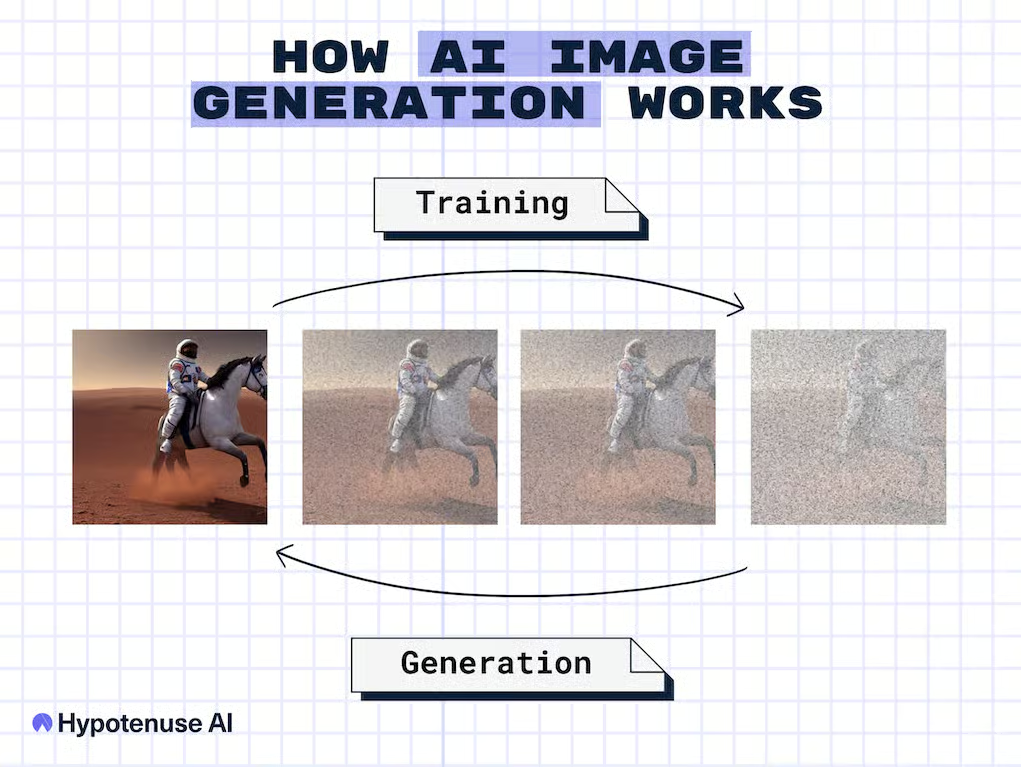
Research into diffusion models dramatically improved the quality of synthetic images, although a growing number of alternative and hybrid techniques are now being developed as well.
Modern systems increasingly combine language and vision capabilities. This allows them to understand detailed natural-language instructions and turn them into visual content.
Similar advances are now taking place in video, music, speech and other media.
What Are Multimodal AI Models?
Early consumer chatbots worked mainly with text.
Modern AI is increasingly becoming multimodal, meaning a single system can work with several types of information at once.
A multimodal model might receive a photograph, a written question and an audio recording, then respond in either text or speech.
It could, for example, examine a chart in an image, explain what the data shows and then continue discussing it with the user through a spoken conversation.
As these capabilities converge, the distinction between “language AI,” “image AI” and “voice AI” is gradually becoming less important.
What Are AI Agents?
One of the fastest-developing areas of artificial intelligence is the emergence of AI agents.
A traditional chatbot generally follows a simple interaction pattern: a user asks something, the model responds and the task ends.
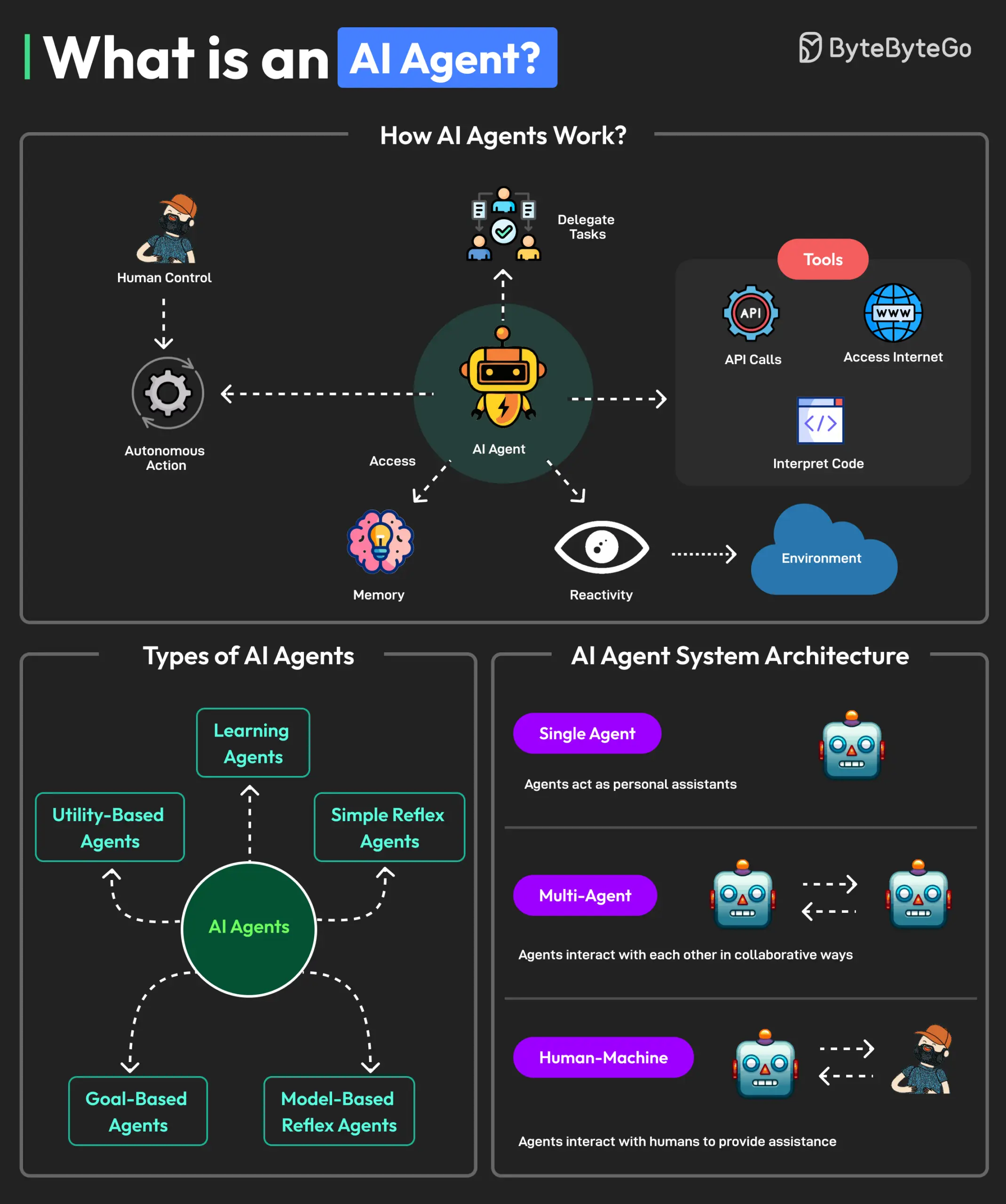
An AI agent can instead receive a broader objective and determine, with some degree of autonomy, which steps are needed to complete it.
OpenAI describes agents as systems capable of independently performing tasks on behalf of users while using available tools to gather information or take actions.
Consider the request:
“Find suitable flights for next weekend, compare hotels near the city center and prepare an itinerary.”
A conventional language model might explain how the user could complete those tasks.
An AI agent could potentially carry them out itself — searching for information, comparing options, interacting with maps or calendars and combining everything into a final result.
Agents therefore often combine a language model with external tools such as search engines, databases, email, programming environments and corporate software.
The shift from AI that simply generates information to AI that can also take action could become one of the defining changes in the next stage of the technology’s development.
A Brief History of Artificial Intelligence
The idea of intelligent machines predates today’s generative AI by decades.
One of the earliest major milestones came in 1950, when British mathematician Alan Turing published Computing Machinery and Intelligence.
Rather than trying to directly answer the difficult question “Can machines think?”, Turing proposed what he called the imitation game. The concept later became widely known as the Turing test.
The term artificial intelligence is closely associated with American computer scientist John McCarthy.
In the summer of 1956, the Dartmouth Summer Research Project on Artificial Intelligence brought together researchers at Dartmouth College. The event is widely regarded as one of the founding moments of AI as a distinct academic discipline.
The decades that followed brought repeated waves of optimism and disappointment.
Early researchers expected rapid breakthroughs, but limited computing power, insufficient data and the sheer complexity of real-world intelligence repeatedly slowed progress.
Periods in which enthusiasm and funding declined became known as AI winters.
The later expansion of the internet, the availability of huge quantities of digital data, increasingly powerful graphics processors and improvements in neural networks eventually created the conditions for another wave of progress.
Deep learning made major advances during the early 2010s, followed by the introduction of the Transformer architecture in 2017.
In the early 2020s, generative AI rapidly became accessible to ordinary consumers.
Artificial intelligence was no longer something confined mainly to universities and research laboratories. It had become a mainstream technology.
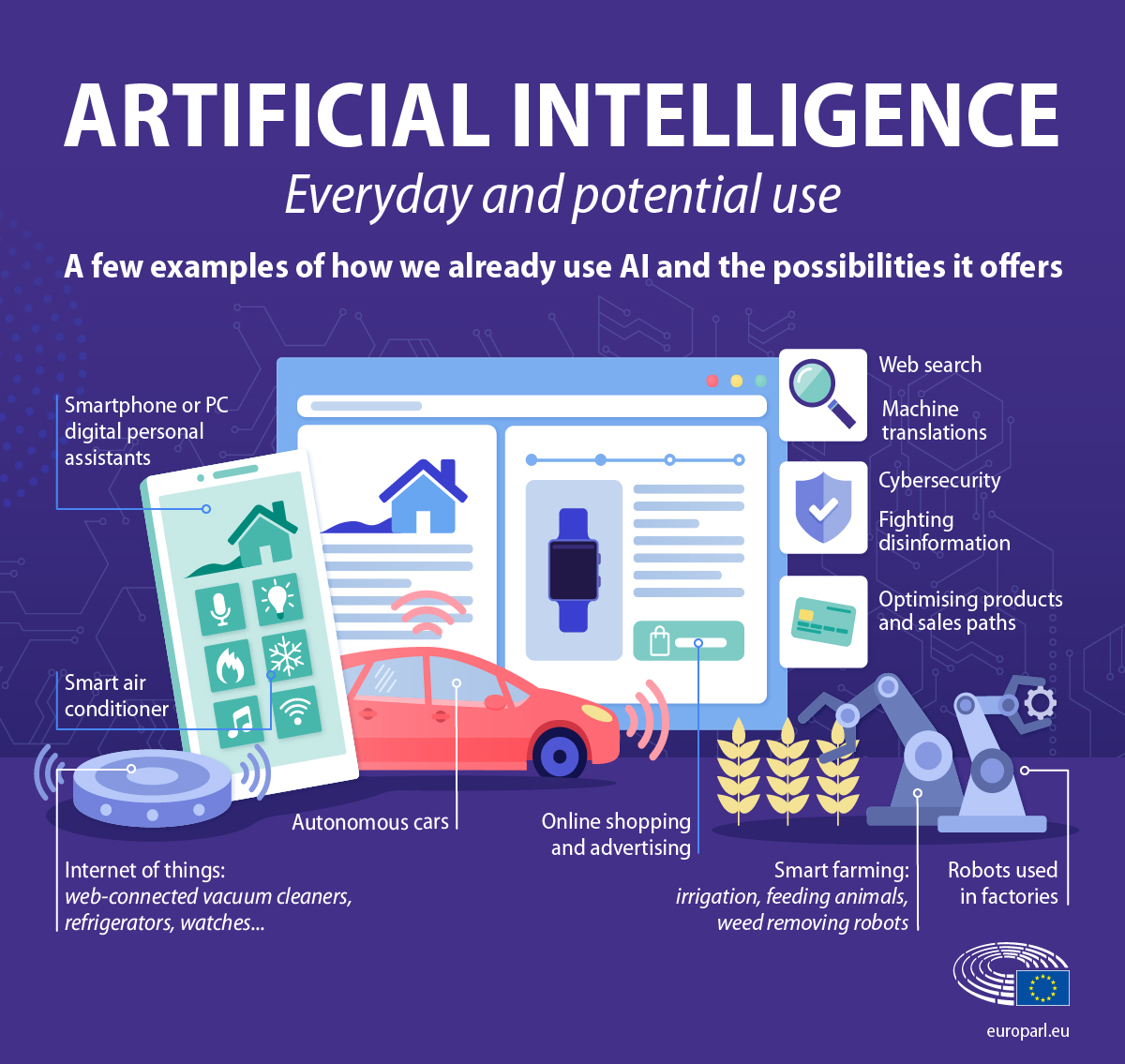
Where Is Artificial Intelligence Used?
AI is now embedded in a vast range of products and services, often without users even noticing it.
In search engines and online platforms, AI helps rank results, recommend content, filter spam and detect malicious activity.
In finance, machine learning is used to detect suspicious transactions, manage risk, analyze documents, support customers and process enormous quantities of market data.
In software development, generative AI can suggest code, identify errors, explain existing programs and create tests.
In healthcare and science, AI can help analyze medical images, identify potential drug candidates, model biological structures and process large scientific datasets.
In marketing and media, AI is used for writing, image and video creation, translation, data analysis and content personalization.
In manufacturing and logistics, it can help predict equipment failures, optimize transportation and inspect products through computer-vision systems.
AI is also increasingly becoming an everyday personal assistant.
People use it for studying, document analysis, planning, programming, research and content creation.
Adoption has accelerated sharply. According to the Stanford AI Index 2026, 88% of surveyed organizations reported using some form of AI in at least one business function, while 70% reported using generative AI in at least one area.
AI, Automation and Robots Are Not the Same Thing
Artificial intelligence is often confused with automation or robotics, but the terms describe different concepts.
Automation means a system performs a predefined task automatically. It does not necessarily involve artificial intelligence.
A robot is a physical machine capable of performing tasks. It may use AI, but it does not have to.
Artificial intelligence, meanwhile, refers to methods for processing information, identifying patterns and making decisions. AI can exist entirely as software without any physical body.
A modern warehouse robot, for example, could combine all three: robotics, automation and artificial intelligence.
What Are the Main Limitations of AI?
Modern AI can be remarkably capable, but it still has significant limitations.
One is the problem of hallucinations, where models generate inaccurate or entirely fabricated information.
Another is their dependence on data. AI models can reproduce errors or biases contained in their training data, and their performance may vary across different groups of people or types of tasks.
Privacy, security and copyright are also major concerns.
Users should understand where sensitive information is being sent and how a service provider may store or use that data.
Large AI models also require significant computing infrastructure. Developing and operating them depends on data centers, specialized chips, electricity and other resources.
Another risk is overconfidence in automated output.
An AI response can sound authoritative and polished even when the underlying information is wrong.
AI therefore works best as a technology that extends human capabilities rather than automatically replacing human judgment in every situation.
Is Today’s AI Actually Intelligent?
That depends largely on how intelligence is defined.
Today’s AI systems can match or exceed human performance in some tasks while failing at others that people find extremely simple.
Most existing systems are therefore described as narrow or specialized AI.
They can be exceptionally capable within certain domains, but that does not mean they possess human-like general intelligence.
A separate concept is AGI, or Artificial General Intelligence.
AGI typically refers to a hypothetical system capable of performing a wide range of intellectual tasks at or above human level.
There is, however, no universally accepted technical definition of AGI, nor is there agreement on exactly how such intelligence should be measured.
Where Is AI Heading?
AI development is increasingly focused on combining abilities that were previously handled by separate systems.
Models are becoming multimodal, enabling them to process text, images, audio and video within the same system.
They are also improving at using external tools, working with very large documents, writing software and solving more complex problems through multiple steps.
AI agents are another major area of development.
While the first wave of generative AI was primarily about creating content, agent-based systems are beginning to shift the focus from generating answers to completing tasks.
According to the Stanford AI Index, agentic systems are among the fastest-developing areas of AI, although their real-world adoption within organizations remains significantly lower than that of generative AI more broadly.
The future of artificial intelligence is therefore unlikely to be just about “smarter chatbots.”
AI is gradually becoming a new software layer that can be integrated into everyday applications, business processes, devices and even physical machines.
