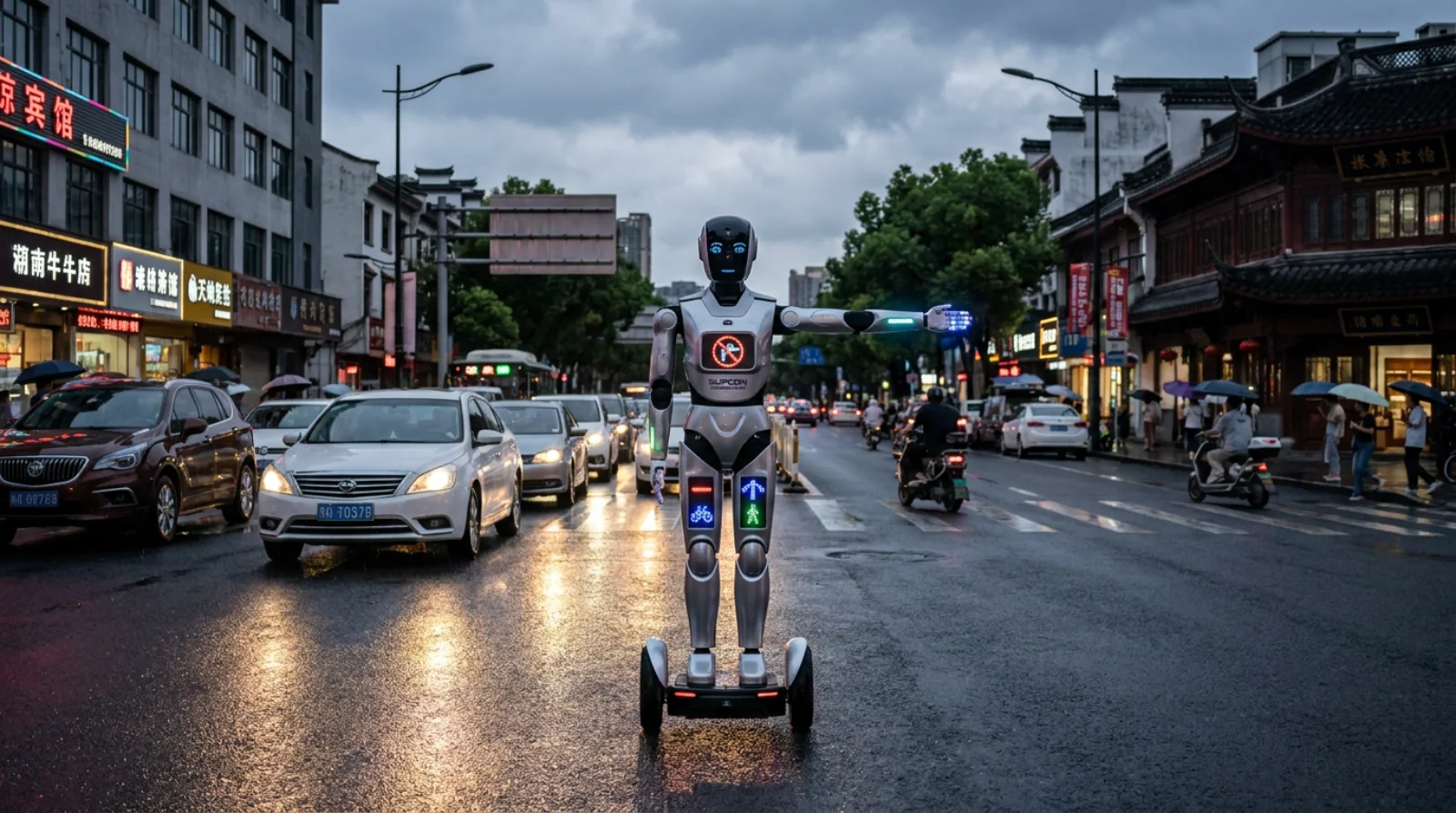
Robots in China are starting to replace traffic police
In the Chinese city of Hangzhou, humanoid robots have begun performing the routine work of traffic police. The T2 machine monitors violations, directs traffic, and advises tourists, relieving human colleagues of repetitive tasks in heavy traffic.
Humanoid robots in the streets: Hangzhou tests the future of traffic policing
The Chinese city of Hangzhou is testing an innovative approach to road safety. Part of the routine work of traffic police officers is being taken over by humanoid robots. These mechanical law enforcers can direct traffic, warn cyclists and pedestrians about rule violations, or serve as interactive information points for tourists. Although they do not yet have the authority to arrest or fine anyone, their deployment signals a major shift in the Chinese robotics industry from flashy demonstrations to actual field use.
Meet the T2 robot: A guardian with joints and radar
The main protagonist of this technological revolution is the T2 robot from SUPCON Information. This machine commands respect through its parameters and equipment:
- Height and weight: It stands 1.88 meters tall and weighs approximately 98 kilograms.
- Movement: Instead of legs, it uses a wheeled chassis for smooth motion.
- Sensors: It is equipped with cameras, radar, and a powerful proprietary computing system.
- Motor skills: The arms feature seven joints, allowing them to faithfully mimic the standard gestures of human police officers.
Thanks to advanced image analysis, the T2 can recognize several types of common violations in real-time, to which it immediately responds with voice warnings and gestures:
- Riding an e-bike without a protective helmet.
- Illegally carrying an additional person on a single-track vehicle.
- Stopping the vehicle beyond the marked intersection line.
- Pedestrians entering the roadway on a red signal.
Furthermore, developers from SUPCON have connected the robots to the city's infrastructure. The machines have access to traffic light status data, with which they synchronize their movements. In addition to surveillance, they function as assistants—answering questions about parking, explaining traffic rules, and, in an emergency, facilitating a connection with a live police officer.
Balance sheet of the first robotic unit: Over 170,000 warnings
Hangzhou launched the operation of the first comprehensive robotic unit in China at the beginning of May. A total of 15 machines found their place in the busiest locations, such as the area around West Lake, busy commercial zones, and the city's main arteries. Before full deployment, the robots underwent a stress test while securing running races.
Results of the fifteen-member team's deployment according to July data:
- Nearly 5,200 hours served in the field.
- Direct traffic control for more than 500 hours.
- Provision of more than 8,000 information services to the public.
- Issuing more than 170,000 warnings for pedestrian and cyclist traffic violations.
SUPCON states that thanks to the presence of robots, the number of rides without a helmet and ignoring stop lines has dropped by more than 40%. Although these figures have not been independently verified, the company stands by a 95% accuracy rate in violation recognition. However, it admits that extreme weather conditions, such as heavy downpours or harsh sunlight, remain a limiting factor as they can affect the sensors.
Autonomy with human supervision: The robots operate independently from 7:00 AM to 6:00 PM. They move between stations autonomously, planning their route and avoiding obstacles. However, the human factor remains key—dispatchers can monitor the machines and correct their activities via a central platform.
The goal for now is not to completely replace police officers, but to relieve them of some of their repetitive tasks.
Expansion and ambitions: From Chinese provinces to the Middle East
Success in Hangzhou is only the beginning. SUPCON already operates nearly 50 robots in eight cities across three provinces and plans to increase this number to two hundred by the end of the year. Similar technologies are also beginning to appear in Shanghai.
However, the competition is not sleeping. Chery's robotics division, called AiMOGA, has already deployed 110 humanoid guardians who help with crowd control and safety education. Furthermore, Chinese manufacturers are openly talking about exports, especially to regions like the Middle East or Southeast Asia. The demanding local climates, particularly high temperatures, are an ideal argument for deploying robots.
Challenges for the global market: Exporting robotic police officers will be more challenging than selling electronics. Machines with sensors must be integrated into state systems, meet strict safety certifications, and, above all, comply with data protection legislation. Specifically, the handling of biometric data and camera records could be a major obstacle for Western markets.
The current situation in Hangzhou does not yet resemble sci-fi scenarios of RoboCop, but rather a practical demonstration of artificial intelligence in a mobile body. For the Chinese industry, this is a critical milestone.
Humanoid machines are gradually moving from trade fairs, dance performances, and technological demonstrations into environments where they must handle real and often unpredictable situations every day. It is precisely the ability to function long-term in the real world that will decide whether robots become a common part of cities or remain primarily a technological curiosity.
Frequently Asked Questions
What can Chinese robotic police officers recognize?▼
Can these robots issue fines or make arrests?▼

I got into cryptocurrencies at the end of 2020 and quickly became a Bitcoin maximalist. I’m interested in what’s happening in the financial markets, and in my free time I travel around Southeast Asia. At KryptoMagazine, I’m in charge of news and video content.