


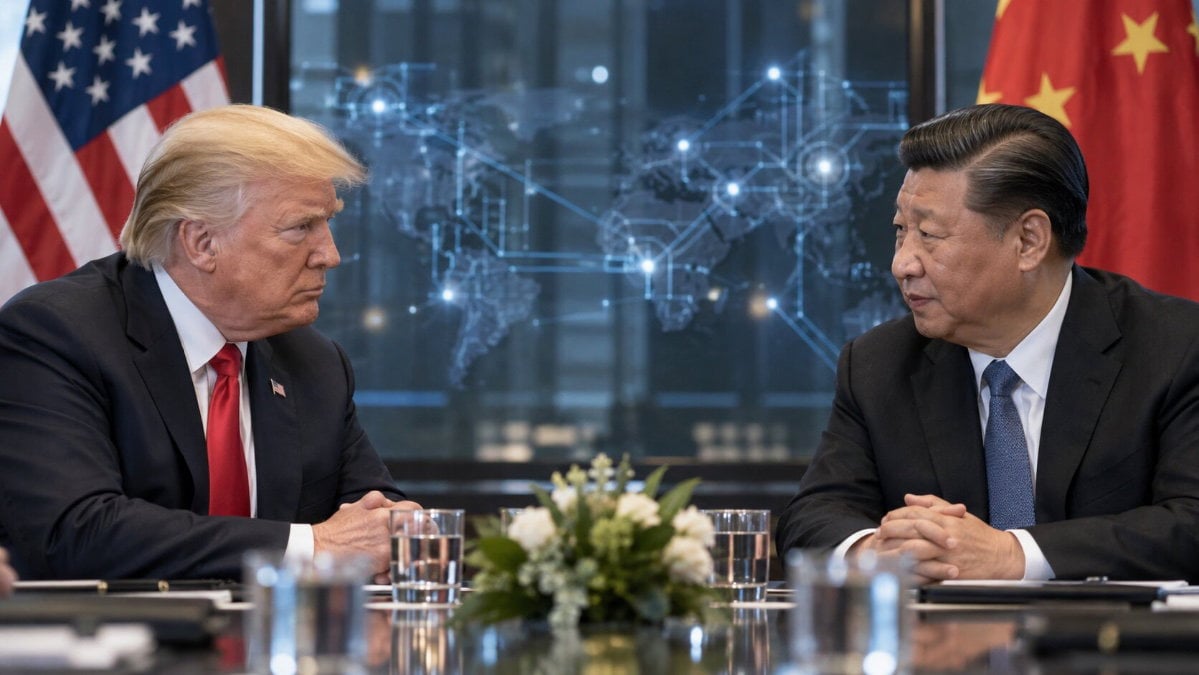
A New Era of Digital Diplomacy: USA and China Launch Communication Channel for Artificial Intelligence
The United States and China intend to create a new, specialized communication channel focused exclusively on the field of artificial intelligence (AI). This strategic agreement comes at a critical time – just days before the highly anticipated summit between US President Donald Trump and his Chinese counterpart Xi Jinping in Washington.
The main motive behind this initiative is the effort to minimize risks. Both superpowers realize that an uncontrolled AI-related incident could very quickly escalate into a serious national security problem with global impacts.
Key negotiations on this topic took place in New York between US Treasury Secretary Scott Bessent and Chinese Vice Premier He Lifeng. Beijing subsequently confirmed that the AI dialogue has become a permanent part of broader economic and trade talks.
Early Warning System as a Safeguard Against Escalation
Washington has come forward with a specific proposal for a mechanism that would function as a “hotline” for the digital age. This system would allow both parties to inform each other about serious incidents affecting national security related to artificial intelligence. According to Secretary Bessent, the goal is to increase transparency and build a common understanding of the greatest threats posed by this rapidly evolving technology.
As part of this dialogue, the US administration wants to focus primarily on these critical areas:
- Autonomous AI agents: Risks associated with systems capable of independent decision-making without direct human intervention.
- Advanced cyberattacks: The threat of attacks that are more sophisticated, faster, and harder to detect thanks to AI.
- Biological threats: Concerns regarding the potential misuse of artificial intelligence in the development or dissemination of biological weapons.
This communication channel could play a decisive role in “fog of war” situations, where it is not immediately clear whether a hostile state or a cybercriminal group is behind an incident, or whether it was an unpredictable failure of the autonomous system itself.
Washington Summit: AI at the Highest Level
The issue of artificial intelligence security will be one of the central points of the planned meeting between Donald Trump and Xi Jinping. The Chinese president will visit the United States from September 23 to 25, with the summit itself scheduled for Tuesday, September 24.
Despite this new diplomatic effort, however, the technological rivalry between the two powers shows no signs of abating. The reality of the relationship remains tense:
- The United States continues to maintain and tighten export restrictions on the most advanced chips and technologies to China.
- Chinese tech firms are working intensively to close the gap with their American competitors in the development of LLM models and AI applications.
- Both countries are engaged in concurrent disputes over access to critical raw materials essential for electronics manufacturing and over general trade restrictions.
The creation of the new channel is therefore seen more as a pragmatic attempt at crisis management than as the beginning of deep technological cooperation. Scott Bessent suggested that if the initial steps are successful, another round of expert negotiations on AI could take place in approximately two months.
The main reason is the prevention of unintended escalation of conflicts. With the increasing integration of AI into military and security systems, there is a growing risk that a technical error or an autonomous system action will trigger an international crisis. The channel is intended for the rapid clarification of such situations.
No. The United States continues to restrict China’s access to high-end chips, and China continues its pursuit of technological self-sufficiency. This is about creating security mechanisms for crisis situations, not about sharing know-how.
